
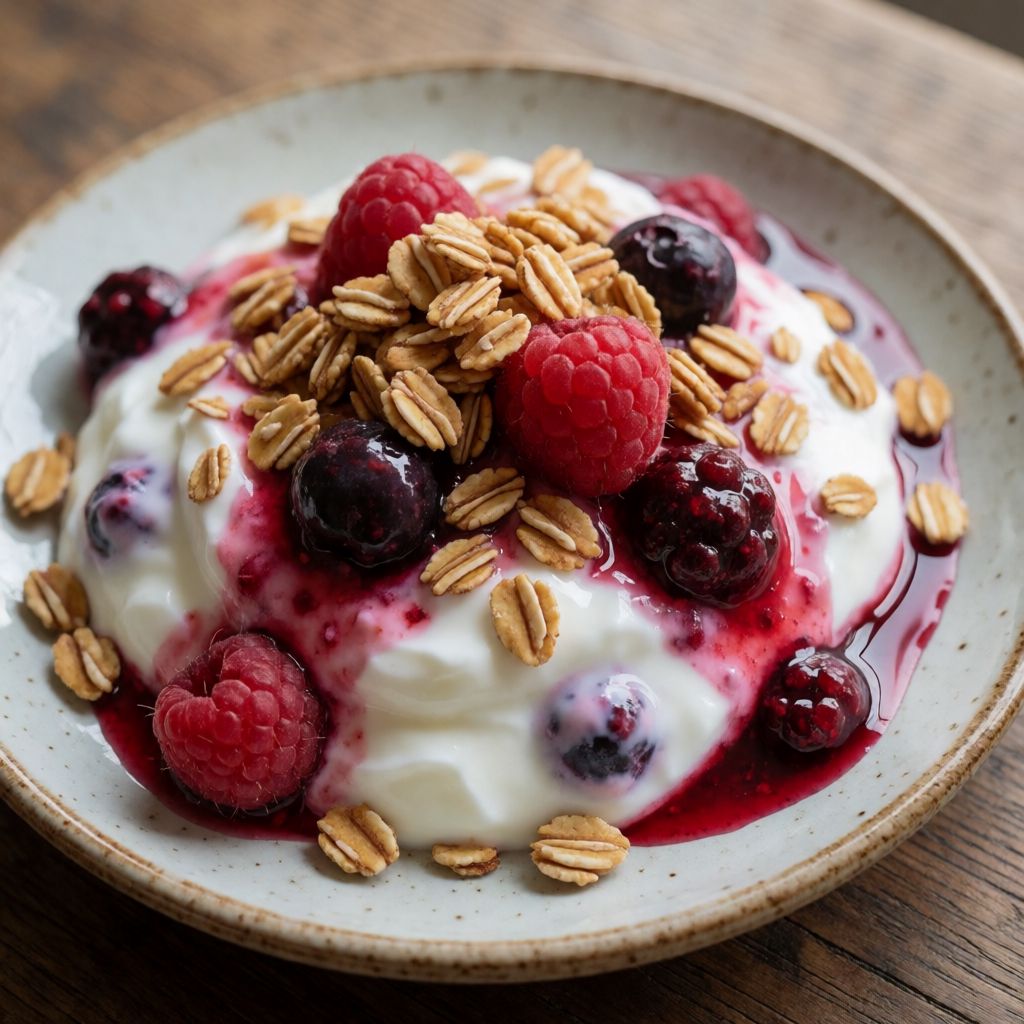
 AI photo
Yogurt and Red Berry Cups
A quick layered dessert of Greek yogurt, honey and lightly cooked red berries with crunchy granola, chilled before serving.
Labels are worked out automatically from the ingredients and can be wrong. Check the packaging if it matters to you.
Ingredients
- 150 g Greek yogurt
- 100 g Crunchy granola
- 1 tbsp Honey
- 20 g Caster sugar
- 50 ml Water
- 250 g Mixed red berries




Steps
Put the berries in a small saucepan with the water and sugar.
Simmer gently, watching closely so the berries don't break down too much.
5 minTake the pan off the heat and let the berries cool completely.
In a bowl, mix the Greek yogurt with the honey until smooth.
Fold in the cooled berries and stir until you have a smooth, mousse-like mixture.
Spoon the mousse into four glasses, layering it with the crunchy granola.
Top with fresh berries if you like, then chill the glasses in the fridge until ready to serve.
This is not really cooking — it's assembly with one small rescue mission in the middle. Four minutes at the stove, the rest is patience and a fridge. What decides whether it works isn't skill, it's timing: when you cook the berries, when you cool them, and — this is the part everyone gets wrong — when you add the granola.
The berries go into the pan with sugar and a splash of water not to be boiled into jam, but to be persuaded to bleed. Gentle heat ruptures the thin skins just enough that juice runs out and meets the sugar, making its own light syrup. Push the heat too hard and the fruit collapses into pulp, the syrup reduces too far, and what you get is jam, not a sauce you can fold through yogurt. Some people think you need fresh summer berries for this — you don't, because once they're going into a pan to be broken down anyway, frozen mixed berries do the same job for less money and no disappointment in February.
Cooling the berries fully before they meet the yogurt is not fussiness, it's physics. Warm fruit juice hitting cold strained yogurt makes the yogurt weep — the proteins seize up and push out water, and your 'mousse' turns thin and grainy at the edges. Spread the cooked berries on a wide plate instead of leaving them in the pan and they'll cool in minutes, not the quarter hour you'd wait otherwise. That's the patience the recipe asks for, and it's cheap patience — you can get on with washing the pan.
Greek yogurt is doing more work here than 'yogurt flavour.' It's strained — much of its whey already drained off before you bought it — which is why it holds shape and gives you something mousse-like without any whipping or cream at all. Some recipes for this kind of dish reach for whipped cream, as if air is the only way to get lightness; it isn't, because thick protein does the same job without the fat. If all you have is ordinary yogurt, tip it into a sieve lined with a clean tea towel or a coffee filter and let it drip in the fridge for a few hours — you're making your own strained yogurt, and it costs nothing but time.
The sugar and water in the pan aren't there to sweeten so much as to draw. Sugar pulls water out of the fruit by osmosis before the heat even properly starts, and the splash of water stops that first stage from catching and scorching on the base of a small pan with nothing else in it. Any granulated sweetener works here — golden caster, white, even a spoon of jam if that's what's in the cupboard — the mechanism doesn't care, only the sweetness level does.
Honey goes into the yogurt, not the berries, because its flavour is more useful kept separate from the fruit's own acidity, and because stirring it through cold yogurt — rather than hot fruit — lets you taste and adjust before you commit. If your honey has set hard in the jar, don't fight it cold; a few seconds in a bowl of warm water loosens it enough to stir. Maple syrup or golden syrup will do the same job if honey isn't to hand — the criterion is a liquid sweetener with a flavour you don't mind sitting under the berries, nothing more specific than that.
Granola is the modern, shop-bought shortcut for something British kitchens have done for a long time without the name: toasted oats layered with soft fruit and something creamy, which is essentially what a Scottish cranachan is — oatmeal, raspberries, honey, cream, sometimes whisky. Granola does the same structural job as the toasted oatmeal, pre-made and bagged, because almost nobody has the time or the inclination to toast their own oats on a weeknight anymore. Buy a granola without too much dried fruit in it — the berries are already supplying the sweetness and the chew you don't need doubled.
You don't need a kazan or anything special for this — a small saucepan you'd use for porridge, four glasses or even jam jars, a plate to cool the fruit on instead of hunting for a lid. It feeds four as four small puddings, not four hearty ones; these are meant to be light after a Sunday roast, not a second main course. If you're serving more people, multiply the yogurt and berries but keep the granola addition for the very last minute regardless of how many glasses you're filling — that rule doesn't scale down with patience, it just repeats.