
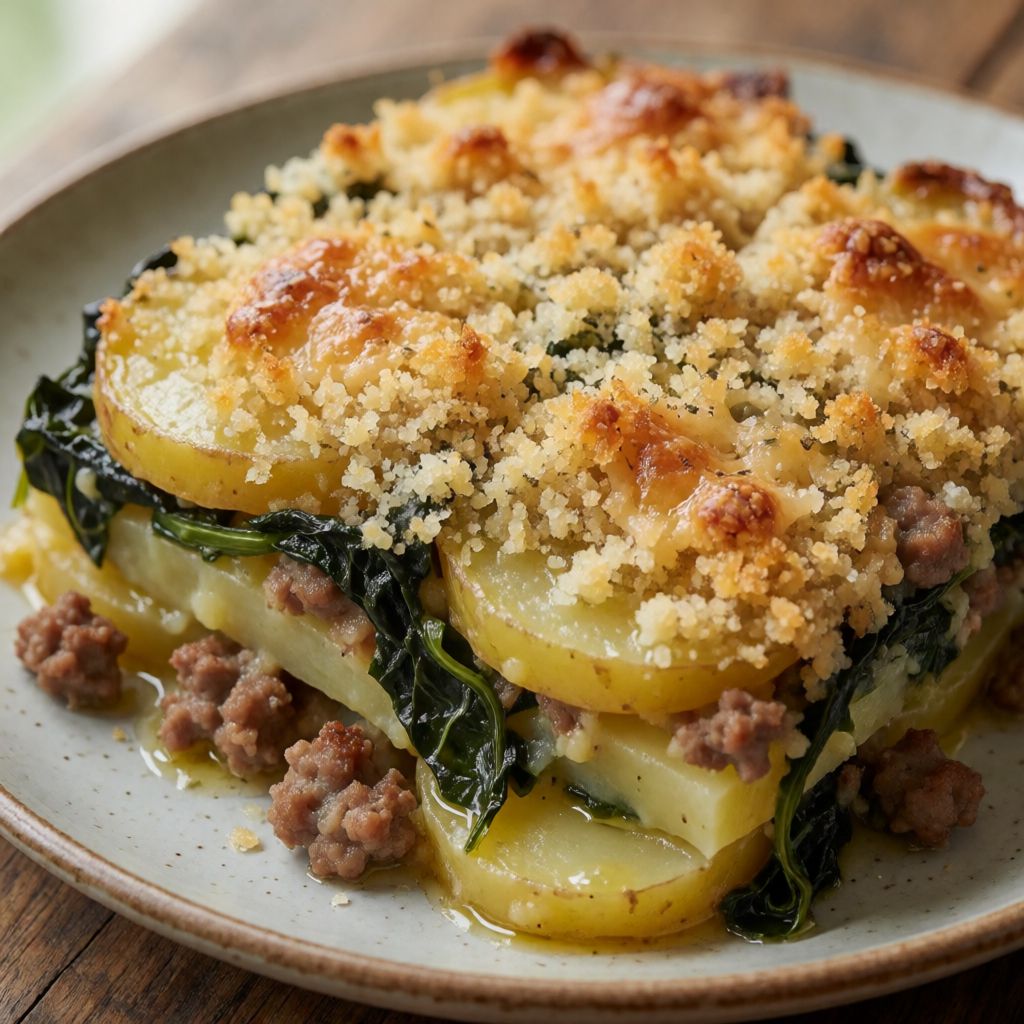
 AI photo
Potato and Swiss Chard Bake
A comforting bake of potatoes, Swiss chard and sausage meat, topped with mozzarella and crisp breadcrumbs.
Labels are worked out automatically from the ingredients and can be wrong. Check the packaging if it matters to you.
Ingredients
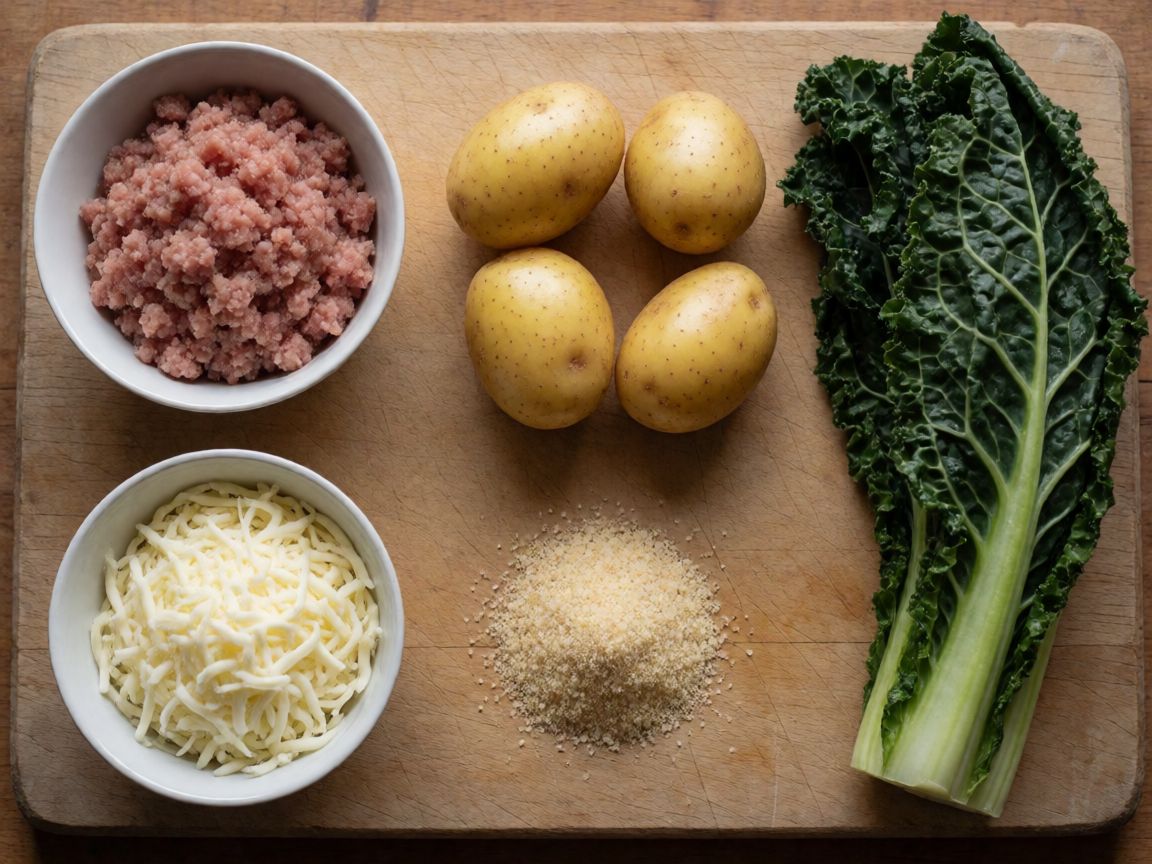
- 250 g Sausage meat
- 4 pcs Potatoes
- 1 bunch Swiss chard
- 200 g Mozzarella
- 2-3 tbsp Dried breadcrumbs
- Olive oil to taste
- Salt to taste
- Black pepper to taste







Steps
Wash and blanch the Swiss chard, drain, keeping a few spoonfuls of the cooking liquid, then roughly chop it.
Crumble the sausage meat and fry it in a well-heated pan.
Add the olive oil and chard, and cook for a few minutes.
Add the peeled and diced potatoes, season with salt and pepper to taste.
Add the reserved chard cooking liquid, cover with a lid and cook over medium heat.
18 minTransfer everything to a baking dish. Add the diced mozzarella, breadcrumbs and olive oil.
Bake in an oven preheated to 200°C until golden brown.
20 minServe immediately.
This isn't really a bake in the way the name suggests. A bake implies you build the thing raw and the oven does all the work. Here the oven does almost nothing — it's finishing heat, there for the cheese and the crumb, a few minutes of colour. The actual cooking, the bit that decides whether the potato is a joy or a disappointment, happens earlier, in a pan, on the hob, with a lid.
So the dish is really: fried sausage meat for base flavour, chard wilted into it, potato braised in the chard's own liquid until tender, and only then — only then — does it go into a dish to be topped and finished under heat. Think of it as an Italian farmhouse habit of using what's already in the pot rather than reaching for a stock cube.
What decides if it works is simple and unglamorous: is the potato properly soft before it goes into the oven? If it isn't, no amount of baking fixes that — the top will scorch and the breadcrumbs will char long before the centre of a potato cube softens. People treat the oven stage as the cooking stage because that's where the smell and the colour show up. But the smell is cheese melting, not potato cooking. The potato's fate was already decided on the hob.
Done right, a piece of potato gives to a knife without resistance but still holds its shape — no snap, no collapse into mush. The top should be spotted gold, not blanket-brown, and the mozzarella should pull in strings when you lift a spoon, not pool as oil round the edge. That's the version worth eating.
Start with the sausage meat. Crumbling it into a well-heated pan isn't fussiness — a pan that isn't properly hot makes the meat sweat its juices out instead of browning, and you get grey, flat-tasting mince sitting in its own water. Properly hot, it browns, leaves a fond on the pan, and that fond is the base flavour for everything that follows. For substitution, the rule is: any mince that already carries its own fat and seasoning — a British sausage with the skin pulled off works fine, or plain mince worked through with fennel seed and a spoon of extra fat if it's lean.
The chard's blanching isn't a formality either. Chard carries oxalic acid, which is what gives raw or under-cooked greens that metallic bitterness some people wrongly blame on the vegetable itself rather than the cooking. Blanching washes that out. And the water you save isn't an afterthought — it's already salted, already green with flavour, and it becomes your braising liquid for the potato. Some recipes would have you reach for stock here. Don't — the chard water already does the job, and stock on top of it just muddies a clean, simple taste with someone else's seasoning.
Potato is where your choice of variety actually matters, and in Britain you have real options. A floury potato — Maris Piper, King Edward — will shed starch into that chard liquid as it cooks, thickening it into something close to a light sauce, which is lovely but can tip into mush if you look away too long. A waxy one — Charlotte, or Jersey Royals in season — holds its diced shape with more stubbornness and gives you a cleaner bite. Neither is wrong; they're just different final textures, so pick by what you want to eat, not by habit.
The lid matters more than it looks. Most ordinary kitchens don't have a lid that seals properly to the pan it's paired with — a plate balanced over the top does the same job here, because what you need is steam trapped, not pressure sealed. Without it, the chard liquid evaporates before the potato softens, and the bottom scorches while the middle stays raw. The lid is what turns this from frying into braising.
For the topping, mozzarella is chosen because it melts by stretching rather than splitting into oil — that's the quality you're after, not the brand. A mild hard cheese can substitute, but expect more oil pooling and a sharper bite, not the same stretch. Breadcrumbs need to be properly dry, bone dry, so they toast under heat instead of steaming soft — stale bread grated and left to dry, or shop panko, both do the job.
And the oven's 200°C is only hot enough, in the time given, to colour that crumb and melt that cheese — nothing more. The patience in this dish is spent at the stove, watching the potato go from stubborn to yielding under a lid. Rush that part, hoping the oven will finish what the hob didn't, and you get the classic failure: a burnt top sitting over a hard, unforgiving centre.