
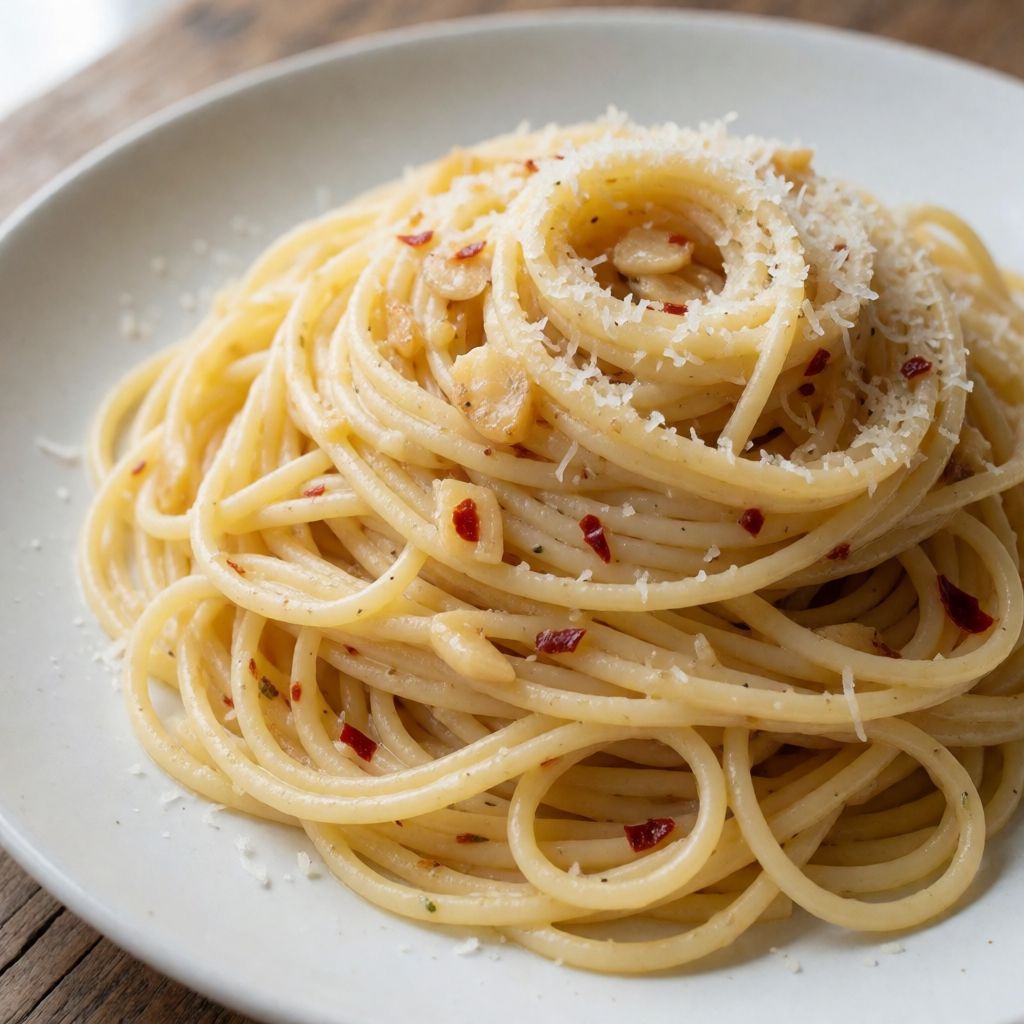
 AI photo
Spaghetti Aglio e Olio
A simple Italian pasta dish of garlic, chilli and olive oil, finished with parmesan and parsley.
Labels are worked out automatically from the ingredients and can be wrong. Check the packaging if it matters to you.
Ingredients







Steps
Cook the pasta until al dente in a large pot of lightly salted water.
10 minPut the garlic and finely chopped chilli in a frying pan with the olive oil and set over a low heat. Stir the oil to draw out the flavour of the chilli and garlic.
3 minDrain the pasta and tip it, still hot, into the pan with the oil, garlic and chilli. Mix well.
2 minServe on plates with a generous sprinkle of parmesan, a little parsley and freshly ground black pepper.
This is not a sauce dish, not really. The oil itself is the sauce — garlic and chili wake it up for three minutes, and that oil, warm and perfumed, is what coats the spaghetti. Everything else is dressing. So the whole dish stands or falls on one small, unglamorous moment: what happens to the garlic in the pan before the pasta arrives.
Some cooks think flavour comes from colour — the darker the garlic, the deeper the taste. No. Garlic has sugars in it, and sugars that scorch don't deepen, they turn bitter and sharp, like a burnt match. Once that happens the whole three tablespoons of oil are ruined, because bitterness spreads through fat the way salt spreads through water — you can't fish it back out. So the pan stays low, barely a whisper of sizzle, and you watch for the garlic turning the colour of pale honey, not amber, not brown. That takes patience more than skill. It's three minutes you're not allowed to rush.
The second decision is smaller but just as real: the pasta goes into that pan straight from the colander, still dripping, still hot. Don't shake it dry, don't let it sit and go tacky. The water clinging to it, loaded with the starch it shed while boiling, is what lets the oil actually grip the strand instead of pooling at the bottom of the plate. A dry noodle and an oily puddle next to it — that's the usual failure, and it's not the oil's fault, it's the moment you drained too thoroughly.
Olive oil, here, is not a cooking medium — it's the main flavour, so for once you want the oil with the strongest personality you can find, not the blandest. A good extra virgin, something a little peppery at the back of the throat, is right. If what's in your cupboard is a flat, characterless bottle, the dish will still work, it just won't have much to say for itself. Don't reach for sunflower or vegetable oil as a stand-in — this is the one dish where a neutral oil is the wrong kind of safe.
Garlic should be firm and tight-skinned, not the soft, greenish-sprouting cloves that sit at the bottom of the bag for a month — those turn bitter almost the moment they hit heat, long before you've drawn any sweetness out of them. Chop it finely, by hand, not through a press. A press turns garlic into paste, and paste has far more surface area touching the hot oil, so it catches and burns in half the time a sliced piece would. Slow release needs a slice, not a smear.
The chilli is there for warmth, not for a story about heat tolerance — half a fresh red chilli, deseeded if you want to control it precisely, chopped as fine as the garlic so it infuses at the same rate. No fresh chilli in the house? A pinch of dried flakes does the same job with less moisture going into the oil, which if anything makes the infusion slightly more reliable.
Parmesan wants to be grated off a block, and grated at the last minute, not tipped from a tub of pre-grated dust. That dust is treated with an anti-caking powder to stop it clumping in the packet, and the same powder stops it melting properly into warm oil — it just sits there in gritty little islands. A block, grated fresh, melts half into the oil and half just clings to the strand, which is the texture you're actually after. Pecorino, sharper and saltier, is the cousin dish's usual cheese if Parmesan isn't to hand — use less of it, since it carries more salt.
Parsley is the one ingredient here doing a job none of the others can: cutting through all that oil with something green and sharp. Chop it at the end, not early — it wilts and goes grey if it sits around, and you lose exactly the freshness you added it for.
One honest note for a flat with an electric hob: those rings hold their heat and don't drop off the moment you turn the dial down, the way gas does. So when the garlic looks nearly right, pull the pan off a beat early — it will keep gently cooking on residual heat for another thirty seconds whether you like it or not, and that's often enough to tip pale gold into the wrong side of brown.