
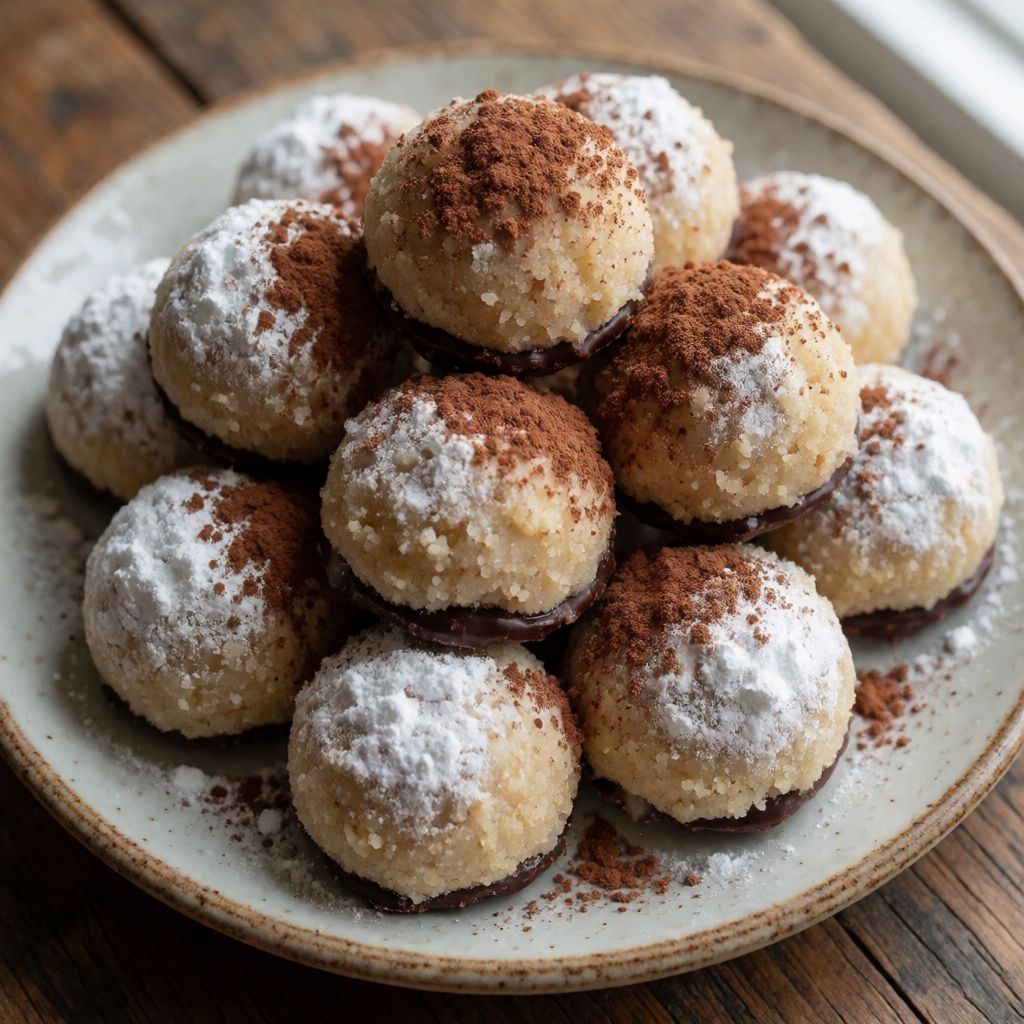
 AI photo
Almond Kisses
Soft almond and cocoa sweets, rolled in melted dark chocolate.
Labels are worked out automatically from the ingredients and can be wrong. Check the packaging if it matters to you.
Ingredients
- 200 g Almond Flour
- 130 g Icing Sugar
- 2 tbsp Cocoa Powder
- 1 tbsp Rum or orange liqueur
- Dark Chocolate to taste





Steps
Mix the almond flour with the icing sugar.
Add the cocoa powder and rum (or orange liqueur) and mix into a thick dough.
Shape the dough into small balls.
Melt the dark chocolate in a bain-marie and roll each ball in it.
Place the sweets on a sheet of baking paper dusted with cocoa powder and let them dry.
Once the sweets have set, roll them again and wrap each one in foil for storage.
This is a no-bake sweet - no oven, no flame under the pan except for melting chocolate. It's closer to marzipan than to a biscuit: a dough of almond and sugar, bound not by egg or heat but by the almond's own oil and a spoon of alcohol, then rolled and enrobed in chocolate. What decides whether it works isn't your skill at shaping balls - anyone can roll a ball - it's whether the dough is right before you get there.
The tablespoon of rum in the recipe isn't a measurement you follow blindly. Almond flour varies in how dry it is, icing sugar varies in how it's lumped, so you add the liquid by feel until the dough holds a shape under light pressure and doesn't spring back or crumble. Too dry and it won't pack; too wet and the balls slump flat on the tray instead of sitting round. Think of wet sand pressed in your fist - hold together, not ooze.
The second decision point is the chocolate. A bain-marie - a bowl over simmering water, not sitting in it - melts chocolate gently enough that the fat in it stays smooth. Melt chocolate straight over a flame or let water splash in, and it seizes into a grainy paste that won't coat anything properly, or scorches and turns bitter and dull. This is the one place in the whole recipe where heat matters, and it's a low, patient heat, not a fast one.
After that it's mostly waiting. The chocolate shell has to actually set - firm to the touch, not just glossy-looking - before you roll the sweets a second time and wrap them. Rush this and you smear the coat, and the foil sticks to a tacky surface instead of lifting away clean.
Almond flour here is doing the job egg usually does in other confections: it holds the dough together, because ground almonds carry their own oil even after grinding. That's why there's no binder beyond rum - fat plus a little moisture is enough glue. Buy it finely ground, not the coarser kind sold for baking bases, because coarse grains won't pack into a smooth ball; they'll crumble at the edges. If you want to substitute, look for the same thing in another nut - hazelnut flour works on the same principle - but you're trading the neutral taste of almond for a stronger one, so expect the chocolate to compete rather than sit quietly on top.
Icing sugar has to be the powdered kind for a reason that has nothing to do with sweetness: there's no cooking step here to dissolve sugar crystals, so if you used granulated sugar it would stay gritty in the finished dough. Icing sugar is already fine enough to disappear into the almond flour on contact.
Cocoa powder is mostly there for bitterness and colour against all that sugar - natural or Dutch-process both work fine, since nothing here needs cocoa to react with a raising agent the way it would in a cake. Pick whichever tastes less sweet to you; that's the only criterion that matters.
The rum, or orange liqueur, is often read as flavouring, and that's the myth worth breaking: it's not just flavour, it's the moisture that lets the dry mix become a dough at all. That's also why you add it gradually rather than all at once - too much and the balls won't hold their round shape, they'll flatten. If you want to leave out alcohol, strong black coffee or orange juice can take its place, but understand what you lose: alcohol evaporates as the sweets dry and tightens the dough as it goes, which is part of why these set firm enough to handle twice. A water-based liquid won't tighten the same way, and the sweets may stay a touch softer and need longer to firm up.
For the chocolate, go dark, and go for one with a decent percentage of cocoa solids rather than a supermarket bar built mostly of sugar and milk solids - the fat in a leaner chocolate sets into a thin, snapping shell at ordinary room temperature, which is what you want for a sweet that's meant to be wrapped in foil and kept, not refrigerated. Milk chocolate stays too soft for that and will smear on the foil. On the point of the fridge: you don't need one here, and putting these in it can actually work against you, because cooling chocolate too fast or storing it somewhere damp brings on that dull greyish bloom - better to let them set on the counter at whatever temperature your kitchen sits at.
As for the kitchen itself: you won't have a confectioner's cooling tray, so baking paper dusted with cocoa is standing in for one, and it earns its place - plain paper would let the chocolate stick as it sets, the dusting keeps the base from gripping. And a bowl set over a pan of barely simmering water is your bain-marie; the water should never touch the bowl, only its steam should reach it, or you'll scorch the chocolate against the glass. Two hundred grams of almond flour gives you somewhere around fifteen to twenty small sweets - plenty for two people over several cups of tea across a week, not a dessert eaten in one sitting. The foil wrap at the end isn't decoration; it's what lets these sit in a tin for days without picking up smells from the rest of the kitchen, which is the same reason sweets like this were made this way long before anyone had a fridge to rely on - small batches of an expensive ingredient, stretched with sugar, kept wrapped and cool rather than refrigerated.