
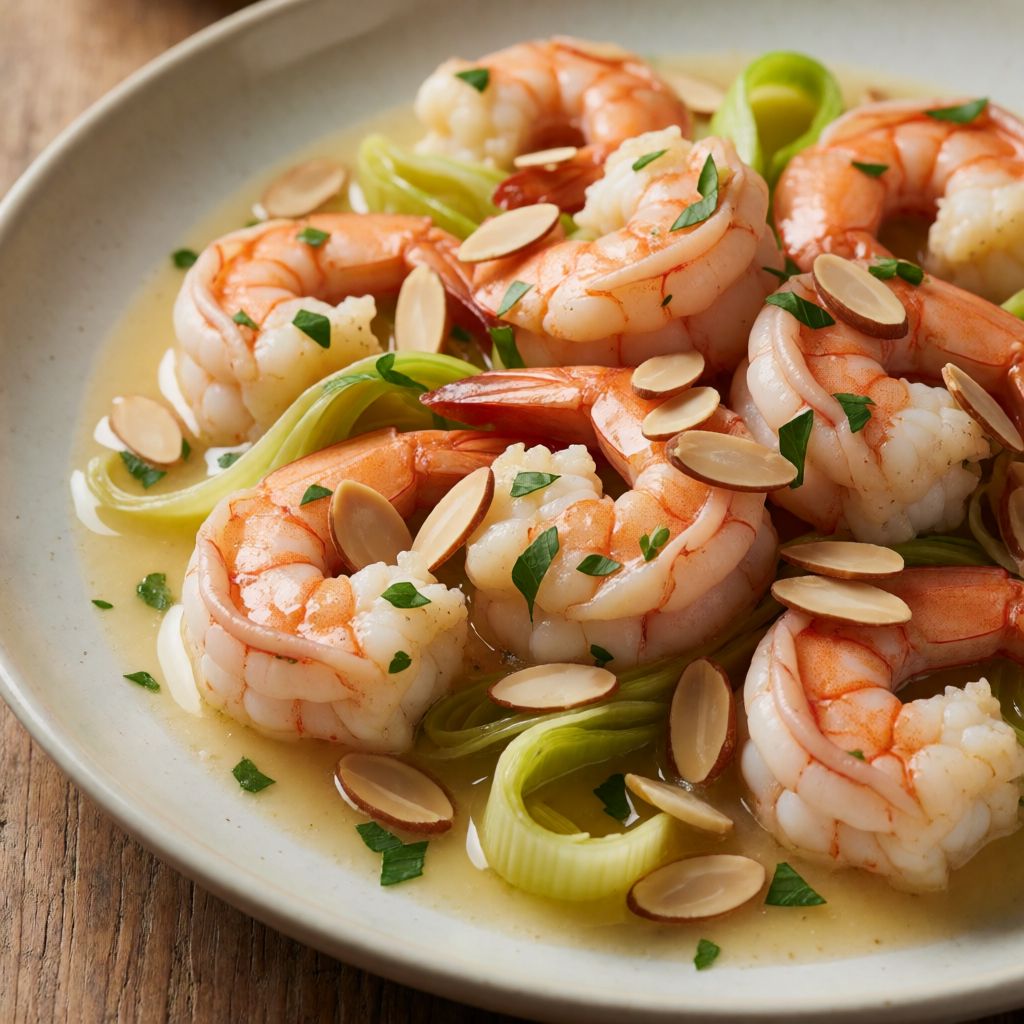
 AI photo
King prawn tails with almonds
A quick, buttery dish of king prawn tails and leeks finished with a golden almond and butter sauce.
Labels are worked out automatically from the ingredients and can be wrong. Check the packaging if it matters to you.
Ingredients
- 500 g King prawn tails
- 150 g Leeks
- 120 g Almonds
- 80 g Butter
- Parsley to taste
- 8 tbsp White wine
- Salt to taste
- Black pepper to taste
- Sweet paprika for colour, to taste








Steps
Peel the king prawn tails, removing the shells.
Melt 60g of the butter, without letting it brown.
Add the prawn tails (cut some into rounds, leave some whole), the leeks, salt and black pepper, and splash in the white wine.
Fry over high heat until the wine has completely evaporated.
In a small pan, heat the remaining butter until golden, add the almonds and fry.
8 minArrange the prawn tails on a serving plate and spoon over the almond sauce.
Sprinkle with parsley and sweet paprika.
What was changed
The pink pepper has been replaced with Sweet paprika, giving a colourful finish without adding extra salt to the dish.
This is a two-pan dish wearing the coat of a one-pan dish. In the big pan you flash-fry peeled prawn tails with leek in butter, hit them with wine, and keep the heat up until the wine is gone. In a small pan, separately, you brown butter until it smells of hazelnuts and tip almonds into it. Only at the very end do the two meet — the almond butter goes over the prawns on the plate, not into the pan with them. Keep them apart and you keep two different things good: quick-seared shellfish, and a nutty, slightly caramelised sauce that would turn bitter if it sat in the pan the whole time the prawns were cooking.
What decides whether this works is nerve, not skill. Prawn flesh is mostly water and a little protein, and that protein sets hard within moments of real heat. So you want the pan hot, the wine splashed in and gone fast, and your eye on the prawns the whole time — pink through, slightly curled, still glossy, not a tight little comma gone grey-white and chalky. That second state is rubber, and there's no fixing it afterwards. Some cooks think the answer to nervous seafood is to keep the heat gentle and give it longer — no, the opposite: a short, hot pass is what keeps it tender, because the protein never gets the time to over-tighten.
King prawn tails: in a British fishmonger or supermarket, 'king prawn' most often means already cooked — pink straight out of the bag. That's the wrong ingredient here. You want them raw: grey-blue or translucent, flesh still slightly see-through. Cook an already-cooked prawn a second time and you're not cooking it, you're punishing it — the protein that set once sets again, harder, and you get the rubber texture faster than you'd think possible. Check the packet for 'raw' or 'uncooked', not just 'king prawn'. Cutting some tails into rounds and leaving others whole isn't decoration for its own sake — it spreads the cooking time across the pan, so you get a range of textures rather than everything hitting doneness at the identical second, and it gives the dish some visual rhythm on the plate.
Leeks: a mild, sweet allium that doesn't need the colour-change work an onion does — you're not chasing that gold-to-ginger turn, just softening it enough to lose its rawness alongside the prawns in the same short window of heat. If you've only got onion, use less of it and finer, because its bite is sharper and it needs longer to lose that edge than the time the prawns can spare.
Butter, twice, for two different jobs. The first 60g is melted gently and kept pale — if it browns here, the milk solids start caramelising too early and you lose control of that flavour, because it's meant to happen later, deliberately, in the second pan. The second batch is pushed further on purpose: melted until it turns the colour of runny honey and smells of toasted hazelnut — that's beurre noisette, butter whose milk solids have browned without burning. Go past honey-brown into dark brown and it turns bitter and acrid, no recovering it. Any fat you use here needs to be one you can watch browning without it smoking first — that's what butter gives you cheaply. Ghee or clarified butter will do the same trick with more patience before it smokes; a neutral oil won't brown at all, so you'd lose the whole reason for this second pan.
Almonds: fried briefly in that browned butter, they pick up colour and a little crunch rather than staying raw and chalky. The criterion for a substitute is an oily, dense nut that holds its bite in hot fat rather than going soft — hazelnuts work on the same logic, walnuts less well because they turn bitter faster in heat. This is also, by the way, an old piece of Mediterranean household economics rather than a flourish: ground or chopped nuts have long stood in for cream in coastal kitchens, because cream spoils and nuts keep — ajo blanco, romesco, this almond butter, all the same thinking. Richness without a larder that needs refrigeration.
White wine: here for acid and aroma, boiled down hard enough that only the flavour stays and the harshness of raw alcohol doesn't. Any dry white does the job; if you want it without alcohol, a splash of dry vermouth reduced the same way gets you closer than water with lemon, though you do lose some of the perfume. Sweet paprika goes on at the very end, off the heat, because its colour and aroma come from compounds that scorch fast — cook it in the pan and you get a dull, slightly bitter dust instead of the bright, sweet colour it's there for. Parsley the same: added after plating, raw, because its colour and smell break down the moment it meets real heat for more than a few seconds. Salt and pepper you judge by taste as you go — there's no fixed number here because the wine and the butter both carry their own salinity and sweetness, and a recipe that insists on an exact spoon measure for these two is pretending prawns are more uniform than they are.