
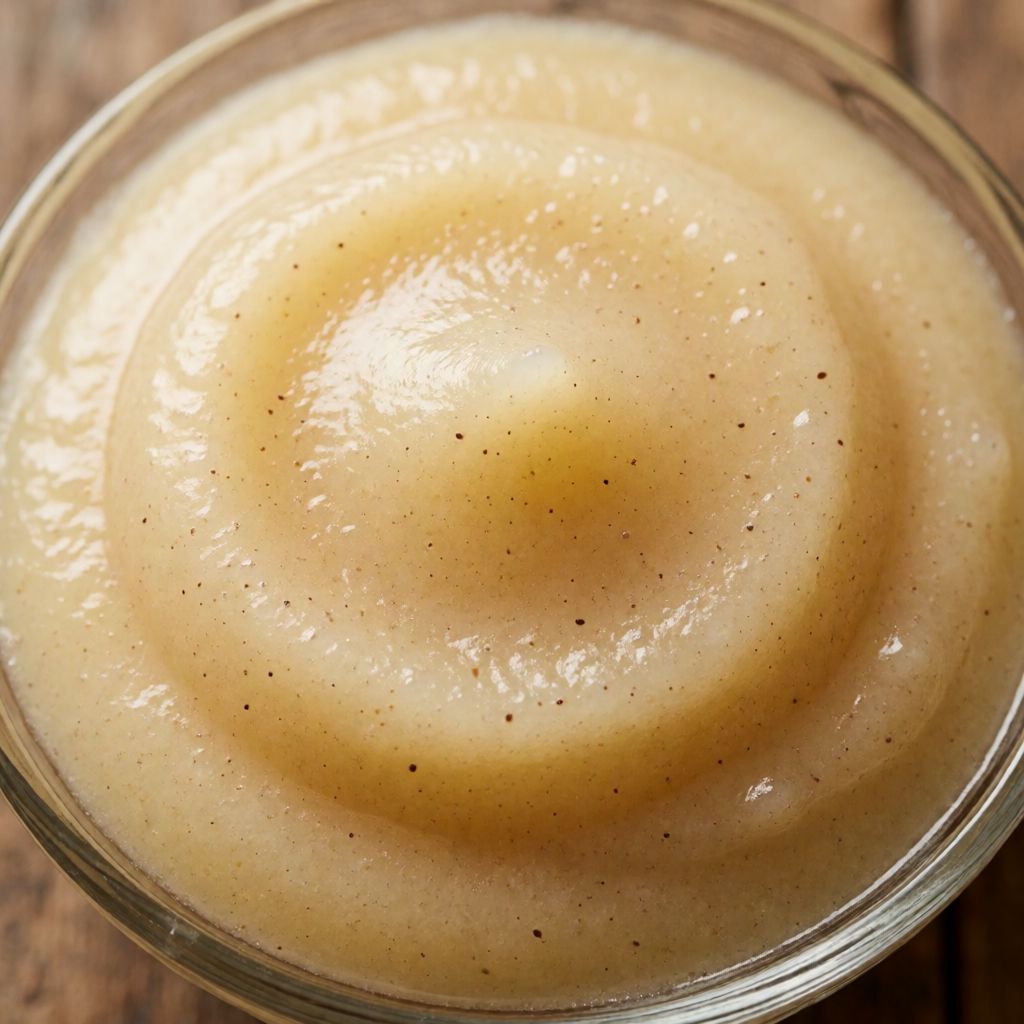
 AI photo
Vanilla Apple Purée
A smooth vanilla-spiced apple purée, gently simmered until soft and ready to serve as a dessert.
Labels are worked out automatically from the ingredients and can be wrong. Check the packaging if it matters to you.
Ingredients
- 1 kg Apples peeled and diced
- 75 g Sugar
- 1 pcs Vanilla pod
- 200 ml Water




Steps
Split the vanilla pod lengthways, scrape out the seeds and mix them with the sugar.
5 minAdd the sugar, vanilla seeds and the empty vanilla pod to the pan together with the apples and water, and mix well.
2 minSlowly bring to the boil and simmer gently, uncovered, until the purée reaches the desired consistency.
30 minRemove the vanilla pod once the purée is ready.
1 min
This is the simplest kind of cooking there is: apples, sugar, water and vanilla, pushed through heat until they stop being pieces and become a mass. The whole trick sits in one word the recipe uses honestly — "desired consistency" — because no clock can tell you that. You watch the chunks lose their edges, the spoon start to drag instead of slide, and the colour deepen from pale cream to something closer to honey. Thirty minutes is where to start checking, not where to stop.
What decides whether it works is the apple, not the method. Some say any apple will do, since you're mashing it anyway — no, because apples come in two temperaments. One kind holds its shape under heat because it was bred for eating raw or baking whole; the other collapses, because it's low in structure and high in acid and pectin, which is exactly what breaks down into softness. Put the wrong kind in the pan and you'll have warm apple chunks swimming in syrup after an hour, not a purée after thirty minutes. In Britain this problem has a name attached to a solution: the Bramley, bred for exactly this collapse, which is why it ended up in every pie and crumble in the country — not magic, just selective breeding doing the chef's job in advance.
On the apples: a kilo of a cooking variety — Bramley is the obvious British choice, but any apple that's sharp rather than sweet and known to fall apart when stewed will behave the same way. If all you have is an eating apple like Gala or Braeburn, it isn't a disaster, just a different purée: it'll want longer at the heat, and you may end up finishing it with a fork or a quick pass of a stick blender, because it won't collapse entirely on its own. Either way, peel and dice evenly — not for looks, but because uneven pieces cook at uneven speeds, and you'll get soft mush around hard little islands.
On the sugar: 75g against a kilo of apple is a light hand, and it's written for a sharp apple that needs balancing, not sweetening. Taste a raw piece before you commit the sugar — a Bramley will want every gram of it and sometimes more; a sweeter eating apple might only need half. Sugar here isn't decoration, it's also what helps the apple give up its juice faster through osmosis, so skipping it entirely slows the whole process down, it doesn't just change the taste.
On the vanilla pod: buy a real one if you can, because what you're after is the oil locked in the pod's lining, not a sweet smell sprayed onto sugar. If you have no pod, the honest substitute is real vanilla extract or a vanilla bean paste, stirred in only at the very end, off the heat — because boiling drives the aroma straight out into the air above your pan, which is the one thing you don't want to do to it. A pod, once rinsed and dried, isn't rubbish either — old habit, not sentimentality, says you dry it and bury it in a jar of sugar for the next cake, which is where vanilla sugar actually comes from in most kitchens that don't waste things.
On the water: 200ml is a starting medium, not a soup base. It's there to stop the apples catching before they release their own juice, and it's meant to leave the pan as steam over the half hour, not stay in it. If your purée looks thin at the thirty-minute mark, the water hasn't left yet — give it more time uncovered, don't reach for a lid or a higher flame to speed things along, both just trap the problem rather than solving it.
In an ordinary flat, a wide saucepan does everything a kazan would here — there's no searing, no need for the depth or the heat retention a kazan gives you, because this dish never leaves a gentle simmer. The only real equipment decision is width over depth: a wider pan means more surface exposed to the air, which means the water leaves faster and you're not standing over it for an extra twenty minutes waiting.
This kind of purée has no grand history worth inventing — it's nursery food, the kind that used up bruised and windfall apples cheaply, cooked down because a soft spoonful was easier for a child or an old person to eat than a raw apple, and sweetened just enough to make it worth the trouble. That's also why it sits so naturally after a Sunday roast or alongside a bowl of porridge: it was built to be plain, comforting and to cost almost nothing.