
 AI photo
Apple Cake with Teff Flour
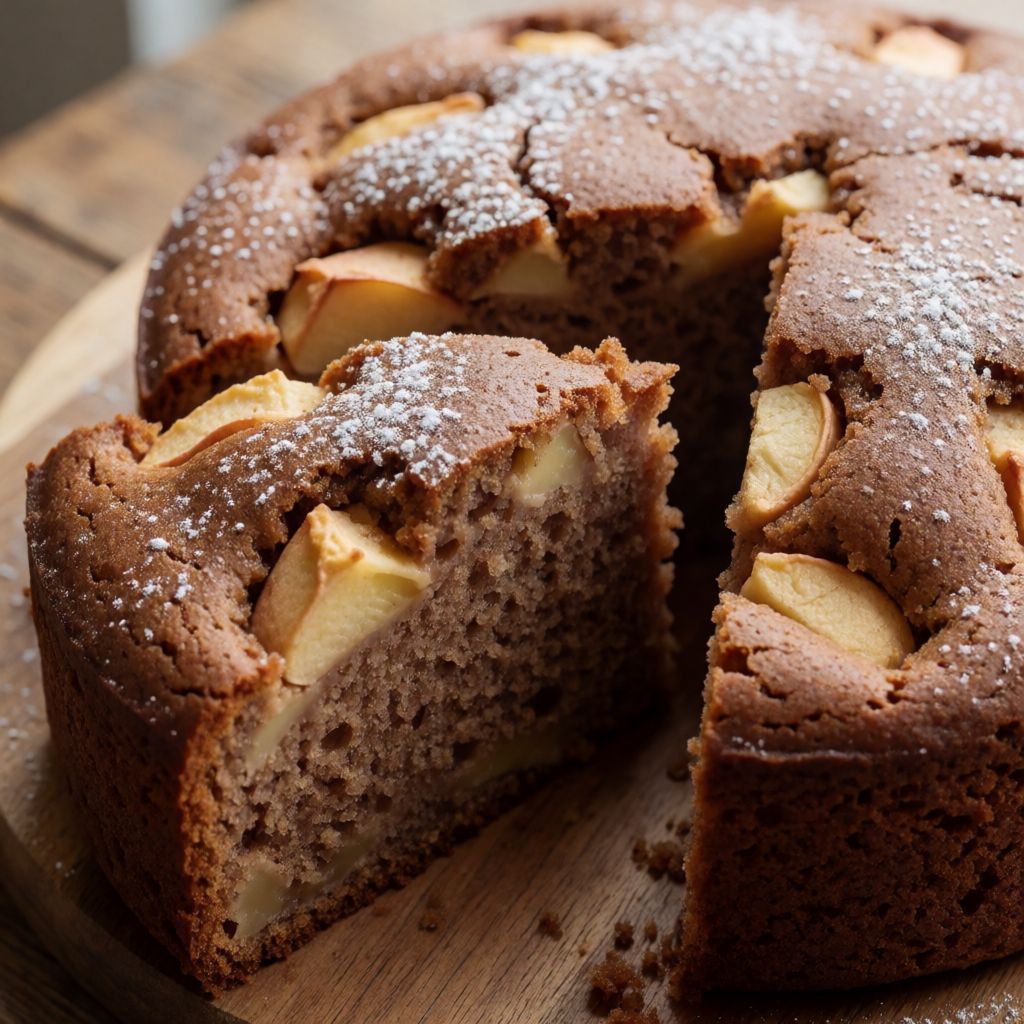
A gluten-free apple cake made with teff and rice flour, light and airy, topped with apple slices.
Labels are worked out automatically from the ingredients and can be wrong. Check the packaging if it matters to you.
Ingredients
- 100 g Teff flour
- 200 g Rice flour
- 100 g Sugar
- 16 g Baking powder
- 3 pcs Egg yolks
- 3 pcs Egg whites
- 100 ml Vegetable oil
- 2 pcs Apple
- 1 pinch Icing sugar for dusting









Steps
In a mixer bowl, combine both flours with the sugar, baking powder and egg yolks.
Beat until smooth, then pour in the vegetable oil and mix well again.
Cut one apple into small pieces.
Transfer the batter to a bowl and add the chopped apple.
Whisk the egg whites to stiff peaks and gently fold them into the batter with a spatula, using upward strokes.
Line a baking tin with baking paper and pour in the batter.
Slice the second apple and decorate the top of the cake with it, if you like.
Bake in a fan oven preheated to 180°C for about 40-45 minutes.
43 minDust with icing sugar, if you like.
What was changed
Removed , which did not belong in the cake, and added Egg yolks, since the steps call for egg yolks.
This is a gluten-free apple cake, and the whole character of it comes from teff and rice flour standing in for wheat with nothing to apologise for. Teff is the tiny Ethiopian grain they make injera from — dark, slightly malty, a bit like cocoa and buckwheat had a quiet conversation. Rice flour is the opposite: neutral, pale, fine, there to carry bulk and keep the crumb light rather than sandy. Wheat flour does two jobs in a normal cake — it gives structure through gluten, and it gives bulk. Here gluten is off the table entirely, so the structure has to come from somewhere else, and that somewhere else is egg.
Which is why the recipe splits the eggs and treats them separately. The yolks go in early, into the fat-and-sugar mix, where they work as an emulsifier — binding oil and sugar into something smooth rather than a slick sitting on a paste. The whites are whipped on their own to stiff peaks and folded in last, upward strokes, barely touched. That whipped foam is doing the job gluten usually does: trapping air, holding the crumb up. Fold it in like you're stirring soup and you've beaten in minutes of patient work for nothing — the bubbles collapse, the cake sits flat and dense, and no amount of baking powder rescues it afterwards. Baking powder helps, but it can only expand bubbles that are already there; it can't create them from scratch.
On substitutions: teff flour is the one ingredient here that isn't easily replaceable without changing the cake's personality, because it's not neutral — it has flavour, a faint cocoa-and-malt note, and it's what makes this cake taste like something rather than like "gluten-free cake, apologetic." If you genuinely can't get it, buckwheat flour is the nearest cousin in character, though it'll push the colour and taste further toward earthy. What you shouldn't do is just double the rice flour to compensate — you'll get a paler, blander, more flour-dusty result, because you've removed the one ingredient doing flavour work and left only the one doing bulk work.
Rice flour's job, by contrast, is to not get in the way — any fine, neutral gluten-free flour with the same job description will do: cornflour-based blends, or a commercial gluten-free plain flour mix, though those often already contain a gum (xanthan, guar) meant to replace gluten's binding, and if yours does, you can be a little more relaxed about overmixing since something is holding structure for you regardless of the egg foam. Checking the packet matters more than brand loyalty here.
The baking powder at 16 g for this amount of flour is a generous dose — about double what you'd use in a wheat cake of similar size — and that's not a typo, it's compensation. Wheat flour has gluten to stretch around rising bubbles; without it, you need more lift chemically to get the same rise, especially since the egg-white foam alone won't carry a cake this size without help.
Sugar here is doing more than sweetening — it's tenderising. In a flour with no gluten to toughen, that matters less than in wheat baking, but it still slows down starch structure forming too fast and keeps the crumb from going gummy, which teff and rice flour can do if underbaked.
On the apples: anything that holds its shape under heat rather than collapsing into mush works for the folded-in ones — a firm eating apple, not a soft cooker that turns to sauce. For the decorative top layer it matters less, since it's there to look nice and catch a bit of colour, not to contribute texture.
On the oven: 180°C fan is a temperature chosen for even cooking through a cake this size without catching the top before the middle sets — a real risk with gluten-free batters, which often look done on the surface well before the centre has. The 40–45 minutes is a floor, not a verdict. Judge it the way you'd judge any cake without gluten to hold a crust: a skewer should come out without wet batter clinging, and the top should spring back rather than dent and stay dented. Teff darkens things slightly on its own, so don't trust colour alone here — it'll look baked a shade earlier than it is.
One more thing worth saying honestly: a domestic oven, even a decent fan one, rarely heats as evenly as the dial promises, and gluten-free batters are less forgiving of hot spots because there's no gluten network to even out uneven rising. If your oven runs hot at the back, turn the tin halfway — not because the recipe demands it, but because your oven, not the recipe, is the variable you don't fully control.