
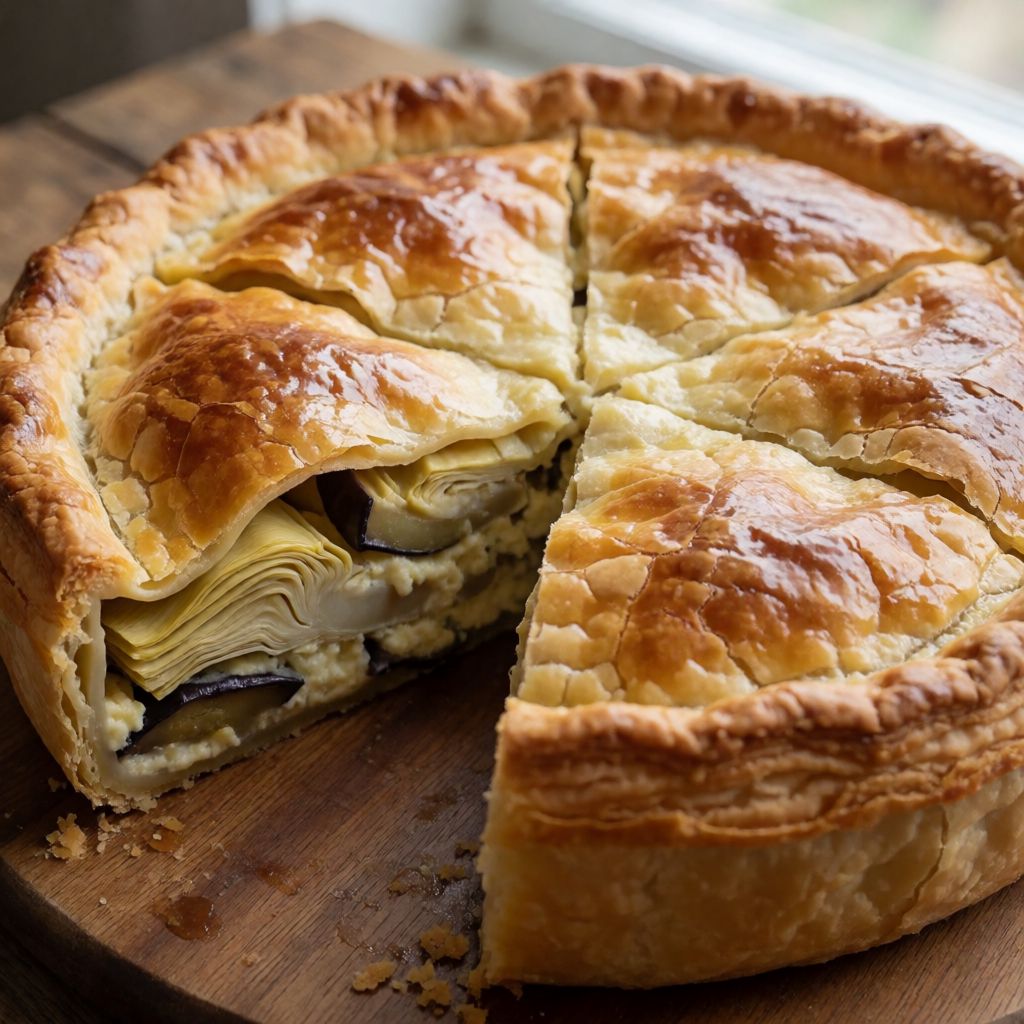
 AI photo
Artichoke and Aubergine Pie
A savoury puff pastry pie filled with roasted aubergine, artichoke and creamy ricotta, ideal as a light main or starter.
Labels are worked out automatically from the ingredients and can be wrong. Check the packaging if it matters to you.
Ingredients
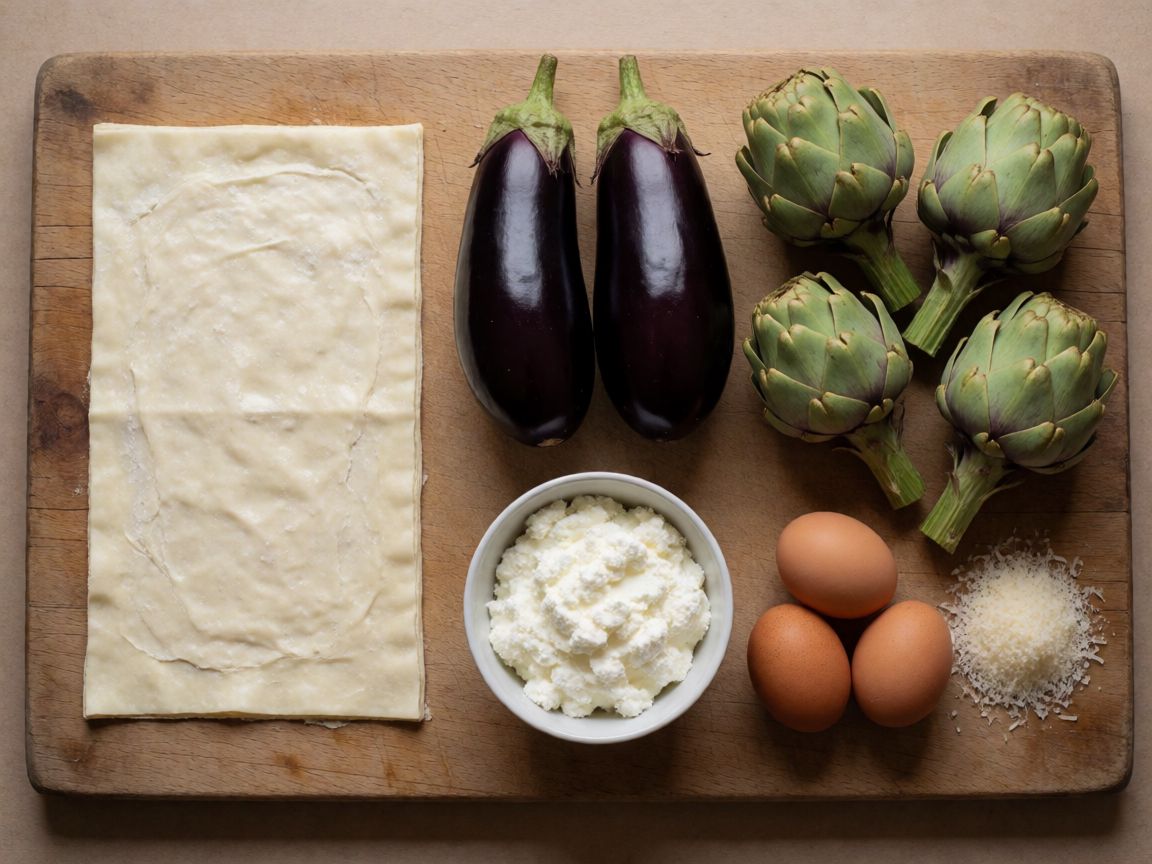
- 1 pcs Ready-rolled puff pastry
- 2 pcs Aubergine
- 4 pcs Artichoke
- 250 g Ricotta
- 3 pcs Eggs
- 50 g Parmesan
- Vegetable oil to taste
- Salt to taste
- Black pepper to taste









Steps
Clean the artichokes, cut into wedges and boil in salted water.
Cut the aubergines into slices about 1 cm thick, arrange on a baking tray lined with baking paper, drizzle with oil, then season with salt and black pepper, and roast until golden.
Lay the puff pastry, together with its paper, on a shallow baking tray and prick it all over with a fork.
In a blender, combine the artichokes, aubergines, ricotta, parmesan, eggs, salt and black pepper and blitz until smooth and creamy.
Spread the mixture over the pastry and smooth it out evenly.
Bake in a preheated oven at 180°C for 40 minutes.
40 minServe warm.
Forget the word pie for a second. What you're building is a vegetable custard poured onto a pastry base and baked until it sets - closer kin to a quiche than to anything with a lid. The puff pastry's only job is to hold a crisp, dry platform under a wet mixture; the filling's job is to go from a loose puree to something that holds together when you cut it. Everything in this recipe is in service of one of those two jobs.
What decides whether it works is water - how much is still sitting in the aubergine and artichoke when they hit the blender, and whether the oven is hot enough to set the pastry's bottom before that water can soak through it. A soggy base here isn't bad luck. It's vegetables that were boiled and roasted but never properly dried out, meeting a pastry that sat in a not-quite-hot-enough oven and lost the race.
The second thing that decides it is the egg. Three eggs, a tub of ricotta, a handful of parmesan - that's the actual structure of this dish. Take the egg away and you've got warm vegetable dip on pastry: it won't slice, it'll just slump. The oven does one real job at 180°C: it holds long enough for the egg's protein to knit into a custard, without going so fierce that the custard curdles and weeps its water straight back onto the pastry it's meant to be protecting.
Serve it warm, not oven-hot. Pulled straight out, the custard is still finishing its set underneath that golden top. Give it ten minutes on the side and it cuts in clean wedges; cut it too soon and it falls apart on the plate - patience here is as much an ingredient as the eggs.
Start with the aubergine, because it's the biggest source of trouble. Choose ones that feel heavy for their size and have tight, glossy skin - a spongy, light aubergine has gone past its prime and developed seeds, which means more water and more bitterness. Roasting the slices isn't about cooking them through, it's about driving water out as steam before they ever meet the blender; wait until the edges have gone from pale cream to properly brown and the flesh has collapsed and gone slack under a fork. Pale and merely soft is not done - it's just steamed, and it'll flood your custard later.
Artichokes get boiled rather than roasted because their structure is different - fibrous leaves and a tough base that need moisture and heat to break down, not drying out. You'll hear that artichokes must sit in lemon water or they turn black and ruin everything - some say that, but here it barely matters, because you're boiling them, blending them, and baking them again; any discolouration disappears into the mixture. Cook until a wedge gives with no resistance when pressed, not just until it looks tender. If buying fresh ones and cleaning the chokes feels like more trouble than a Tuesday evening deserves, jarred artichoke hearts in water (not oil) are a fair stand-in - drain and pat them dry so you're not adding back the water you just avoided elsewhere.
Ricotta and parmesan aren't doing the same job even though they both say "cheese" on the label. Ricotta brings moisture and a mild fat that keeps the custard soft; parmesan brings salt, dryness and a firmer set, because it has almost no water left in it to begin with. If you're out of ricotta, any fresh, mild, well-drained curd cheese works - drained cottage cheese, for instance. For parmesan, any hard, aged, salty cheese does the same structural work - a mature pecorino or grana padano, nothing soft or young, because softness here means extra water you don't want.
The eggs are the actual engineering. They're what turns a blended vegetable paste into something that holds a slice. There's no trick to them beyond getting them properly incorporated in the blender - no separating, no tempering, nothing fussy. Three eggs for this amount of filling is enough to set it without turning it rubbery.
As for the pastry: buy the ready-rolled sheet without guilt. Puff pastry is butter folded into dough dozens of times so it lifts into layers in the oven - that lamination used to be hours of a baker's patience, and the ready-rolled sheet is just that patience bought back industrially, which is exactly why it exists and why there's no shame in using it in a flat with one oven and no marble slab. Pricking it all over with a fork isn't decoration - it's venting. Without those holes, trapped steam pushes the pastry up into a dome under the weight of the wet filling, and you get air pockets and uneven patches instead of one even base. And do let the oven actually reach 180°C before the tray goes in - a domestic oven that's still climbing means the pastry's underside sits in gentle warmth for ten minutes, softening and absorbing moisture, instead of starting to crisp the second it goes in.
If you've got the oven on anyway for a Sunday roast, this is the kind of thing that can go in on a lower shelf once the roast comes out to rest - no need to heat an oven twice in one afternoon just for a pie that feeds two as a proper lunch, or stretches to four as a starter with a sharp green salad alongside.