
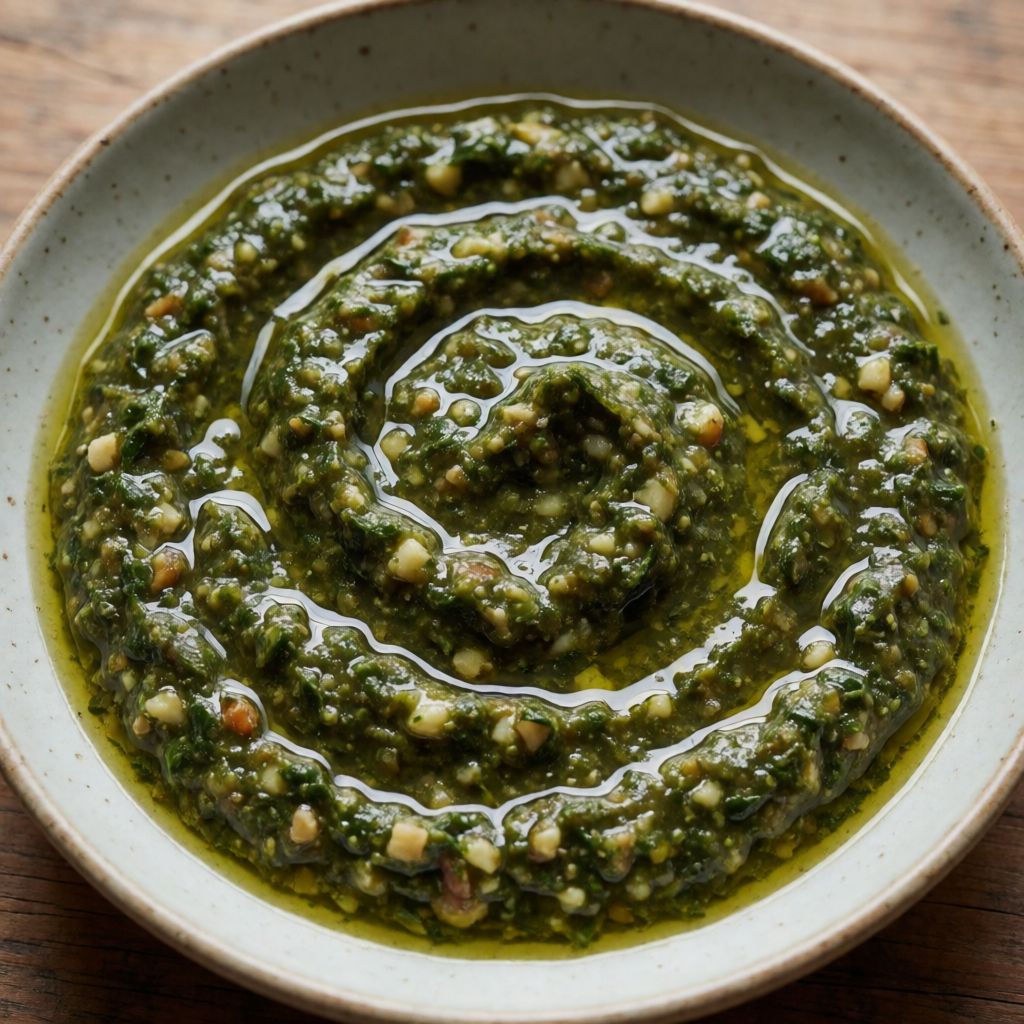
 AI photo
Rocket Pesto
A fresh pesto made with peppery rocket, garlic, olive oil, cheese and walnuts.
Labels are worked out automatically from the ingredients and can be wrong. Check the packaging if it matters to you.
Ingredients
- 3 bunch Rocket
- 1 clove Garlic
- 4 tbsp Olive Oil
- 40 g Mature Cheddar
- 30 g Walnuts





Steps
Pour boiling water over the walnuts, then rub them dry with a clean towel — this makes their flavour less bitter and a little softer.
2 minPut everything into a food processor or a mini chopper and blitz to a texture you like.
3 minOr make it the classic way: finely chop all the ingredients together on a board at the same time (except the olive oil, which is added at the end).
5 minTaste and decide whether a little more olive oil is needed.
This recipe makes about 100 ml of pesto.
What was changed
The hard aged cheese was not available locally, so Mature Cheddar is used instead to keep the pesto's firm, savoury base.
Pesto just means "crushed" — pestare, the same root as pestle. Swap the basil for rocket and you've got a British kitchen's answer to a Genoese staple: rocket is cheap here, grows fast in a window box, and unlike basil it doesn't bruise black in the bottom of the fridge by Wednesday. What decides whether this works isn't how fine you chop it — it's how little heat you let anywhere near it.
A food processor blade spins fast enough to warm what it's cutting through friction, even without a flame in sight. Chlorophyll doesn't like that: run it on continuously and the bright green dulls to a khaki paste that tastes flatter and more bitter than it should. So the real doneness marker here isn't the clock, it's the colour — stop while it's still vivid, in short pulses, scraping down between bursts. That's also why the board-and-knife method survives: a knife doesn't generate heat, it just cuts, which is the whole mechanical point of doing it "the classic way".
Rocket itself carries a natural peppery bite — the same family of compounds as mustard and horseradish, stronger the more mature the leaf. Left alone, that bite dominates. The fat in the cheese and oil, and the sweetness coaxed out of the walnuts, are what pull it back into balance rather than letting it taste like a mouthful of raw salad leaf.
Rocket: buy it properly peppery, not baby-leaf-mild and wet from a bag — mature rocket has the backbone this sauce needs. If none's to be had, watercress or wild garlic (in season) do the same job of carrying bite through the fat. Spinach won't — it's flat and watery, no pepper, wrong tool for the job.
Walnuts get scalded and rubbed dry on purpose: the thin skin around a walnut carries tannin, and tannin is what reads as raw bitterness on the tongue. Boiling water loosens that skin so it rubs off in seconds; skip it and you're fighting a bitterness you put there yourself. Any nut with enough fat to bind will substitute — almonds, blanched the same way for the same reason, or pine nuts if you don't mind paying Italian prices for them in a British shop. Walnuts are the economical choice here, not a compromise — English walnut trees have been doing this job long before pesto ever crossed the Alps.
Garlic: one clove, raw, no cooking to soften it, so check it before you use it. If it's old enough to have gone green inside, cut that sprout out — it's where the sharpest, most bitter pungency concentrates.
Cheddar stands in for parmesan or pecorino, and it's not a lesser swap, just a different ageing tradition doing the same chemistry — long ageing builds salty, crystalline grains that carry savour and a bit of crunch. Choose mature or extra mature, never a mild block; mild cheddar is softer and wetter and brings nothing to the fight.
Olive oil goes in last, after the grinding, not during it — the same reason you don't run the processor too long. Blitz it in with everything else and the blade's friction half-emulsifies it into the paste, losing the gloss and the separate taste of the oil itself. The criterion for choosing one is simple: any oil with no smell of its own, or one whose smell you actually want in the finished sauce. Olive oil is traditional; a decent British rapeseed oil, cheaper and fairly neutral, will carry the sauce just as well if that's what's in the cupboard.
This batch makes about 100ml — a jarful, not a dinner. Treat it as a condiment: enough to toss through pasta for two, or spoon over something from Sunday's roast tin the next day. And give the walnuts their full soak, and the blade its short bursts rather than one long run — patience here isn't decoration, it's the only thing standing between bright green and bitter brown.