
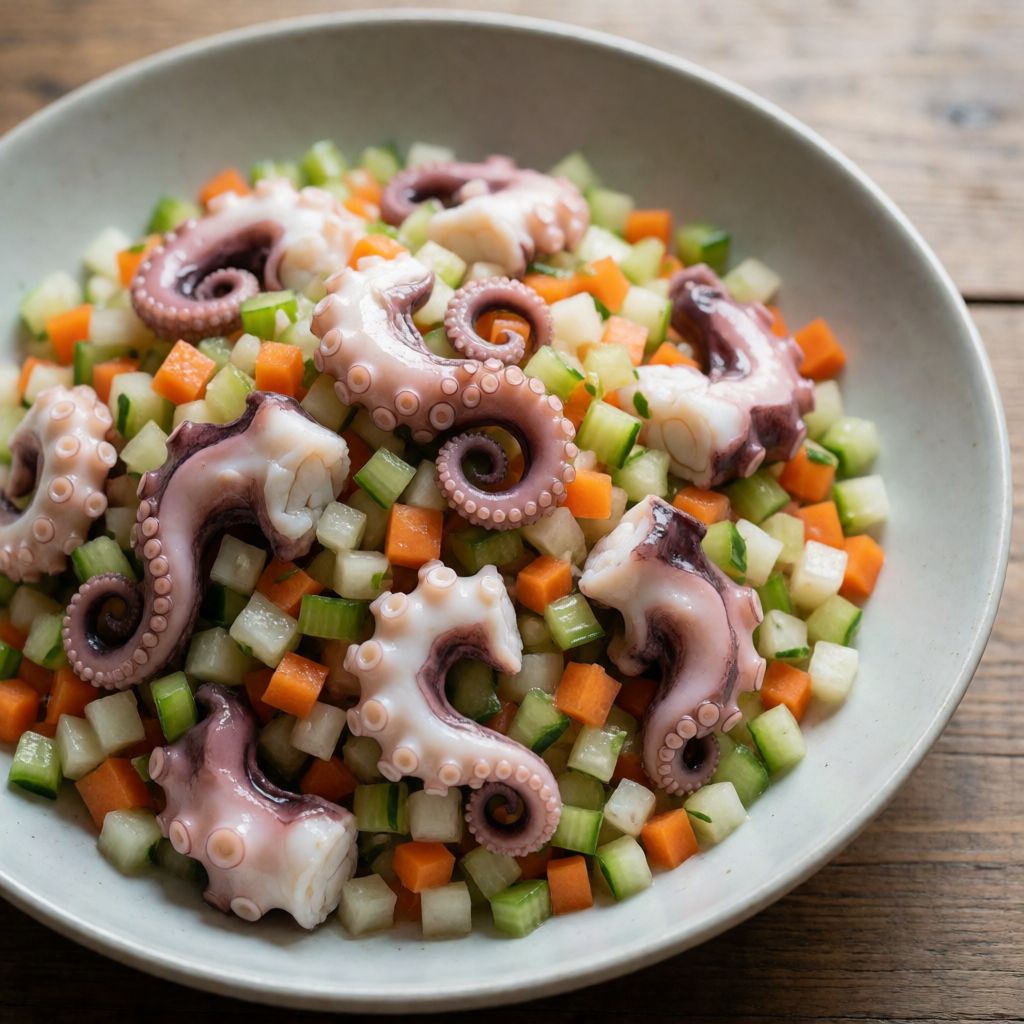
 AI photo
Baby Octopus Salad
A light salad of tender baby octopus with pickled vegetables, dressed in olive oil and apple cider vinegar.
Labels are worked out automatically from the ingredients and can be wrong. Check the packaging if it matters to you.
Ingredients
- 3 pcs baby octopus
- 1 pcs bay leaf
- 250 ml white wine
- pickled mixed vegetables to taste
- salt to taste
- white pepper to taste
- olive oil to taste
- apple cider vinegar to taste
- parsley fresh, chopped








Steps
Bring water to the boil in a saucepan.
Add the octopus, white wine and bay leaf to the water.
Reduce the heat, cover and simmer for over 30 minutes, until the octopus is tender.
30 minDrain the octopus and leave to cool completely; peel if you like.
Cut the cooled octopus and pickled vegetables into small pieces and place in a bowl.
In a separate bowl, whisk together the olive oil, apple cider vinegar, a pinch of salt and ground white pepper until smooth.
Pour the dressing over the salad and sprinkle with freshly chopped parsley.
This salad stands or falls on one thing happening correctly in a pot of simmering water, long before any oil or vinegar comes near it: did the octopus relax, or did it clench up. Nothing you do afterwards — not the dressing, not the pickles, not the parsley — fixes that. Baby octopus is the right choice here, not because it's fashionable on a menu, but because the smaller animal carries less of the thick, collagen-heavy tissue that fights you hardest in the tentacles of a big one, so it gets tender in under an hour instead of the two a large specimen can demand.
The mechanism is a tug of war between two kinds of protein. Muscle fibre tightens and toughens the instant it meets real heat — that's the squeak-against-your-teeth rubberiness everyone fears. Collagen, the connective tissue running through the flesh, does the opposite: given gentle, sustained heat, it slowly dissolves into gelatine, which is what gives cooked octopus its silky give. Boil hard and you win the fight for the muscle fibre and lose it for the collagen. That's why the pot goes down to a bare simmer and stays covered — covering it isn't about keeping heat in for safety, it's about keeping the water from thinning out into a rolling boil the moment you look away. If your lid doesn't fit the pan properly, a plate sitting on top does the same job.
The wine in the poaching liquid is doing two honest jobs, not one mystical one. Its acidity gives the collagen a small extra push toward breaking down, and it perfumes the cooking water so the octopus doesn't taste only of the sea. It is not there to tenderise on its own, and it won't turn the flesh tough either — that particular worry belongs with meat marinades, not with a thirty-minute simmer. If there's an open bottle left over from Sunday lunch, that's exactly what goes in; a dry vermouth works just as well, and in a pinch a splash of vinegar in the water does the acid's job, minus the aroma.
Bay leaf is a quiet aromatic, nothing more — it won't rescue a bad simmer and it won't be missed much if you haven't got one. Peeling the octopus afterwards is a question of texture, not hygiene: the purple skin turns slightly gelatinous and a touch bitter against the firmer white flesh underneath, so peeling gives you a cleaner bite, but plenty of good cooks leave it on because they like the contrast.
The pickled vegetables are there to argue with the octopus, in a good way — their sharpness cuts through flesh that's otherwise rich and a little sweet from the gelatine, and their crunch sets off the octopus's give. The test for which pickle to use is simple: it should taste of vinegar first, sugar a distant second. A British piccalilli, mustard-heavy and syrupy, fights the dish rather than seasoning it; a plain vinegar-pickled giardiniera, or carrot and cauliflower you've quick-pickled yourself, does the job properly.
The dressing is deliberately unclever — oil, vinegar, salt, pepper, whisked till it looks even rather than split. Apple cider vinegar instead of wine vinegar is a choice of temperament: it's a gentler, rounder acid, more forgiving if you're heavy-handed with the measure. Dissolve the salt into the vinegar first, then whisk in the oil — salt won't dissolve in fat, only in the watery part, and skipping that order is the usual reason a vinaigrette tastes patchy, salty in one mouthful and bland in the next. For the oil, the criterion is simply that it shouldn't have an opinion of its own strong enough to argue with the octopus — a light, mild olive oil rather than an aggressively peppery estate one.
Parsley goes in at the very end and stays raw for a reason that has nothing to do with garnish and everything to do with chlorophyll — cook it and it turns drab and loses its bite; chop it too finely with a blunt knife and it bruises black at the edges and tastes bitter before it even touches the plate.
Three baby octopus, roughly 150–200g each once cleaned, is a generous starter for four, not a main course — treat it that way and the proportions make sense. And give the whole thing the one ingredient that isn't written on the list: patience through that simmer. Rush it and you'll know within the first bite why the clock on this recipe is a floor, not a target.