
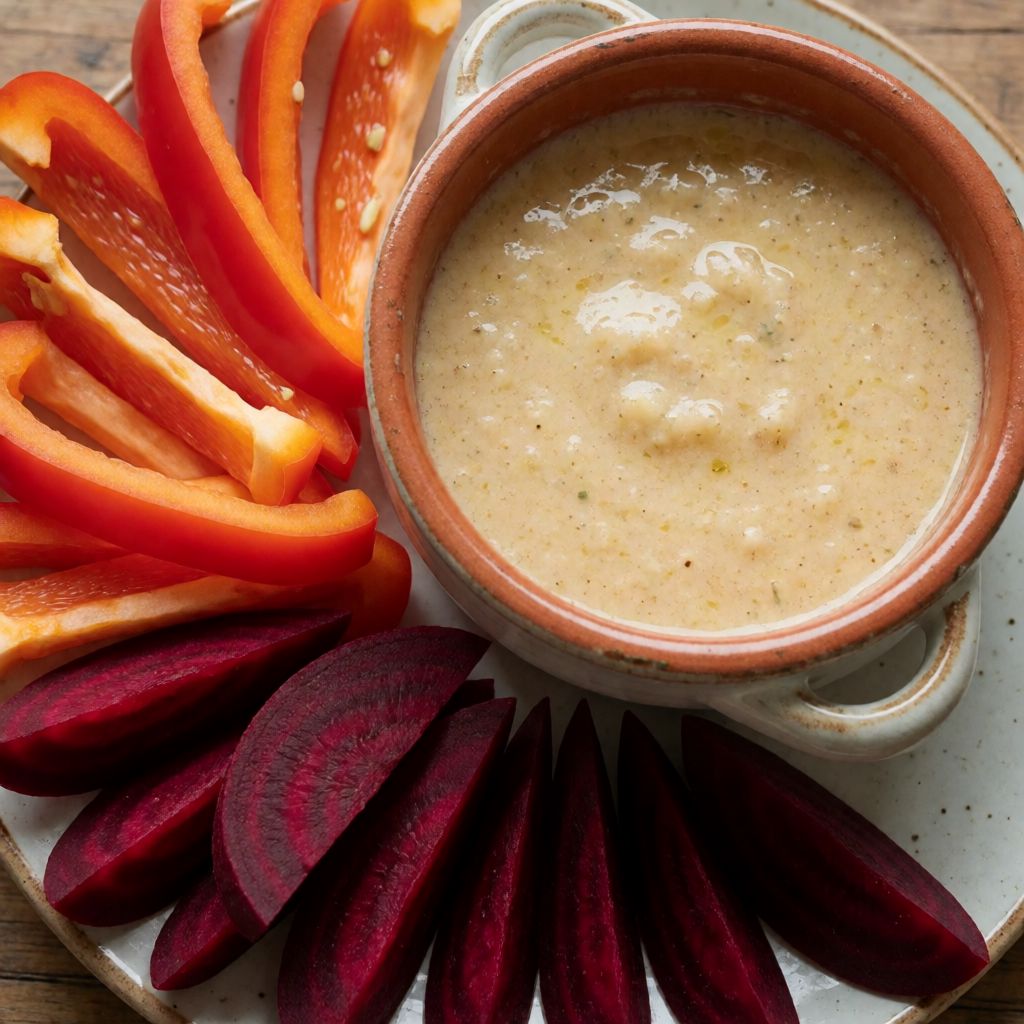
 AI photo
Bagna Càuda
A warm garlic and anchovy dipping sauce, served with roasted and fresh vegetables for sharing.
Labels are worked out automatically from the ingredients and can be wrong. Check the packaging if it matters to you.
Ingredients
- 500 g Garlic
- 150 g Olive oil
- 325 g Milk
- 280 g Salted anchovies
- 1 pcs Pepper
- 1 pcs Beetroot
- 1 pcs Onion
- 1 bunch Spring onion
- 1 pcs Potato
- 1 pcs Celery used in place of cardoon, which is hard to find in British shops








Steps
Peel the garlic heads, cut the cloves in half, remove the inner green shoot and slice the garlic thinly.
Soak the salted anchovies in cold water, changing the water three times over 180 minutes.
180 minAfter soaking, open the anchovies, remove the centre bone and clean out the insides. Lay the fillets on paper to dry.
Put the sliced garlic in a saucepan, cover with the milk and simmer gently for at least 20 minutes.
20 minIn a pan, heat half the olive oil, add the anchovies and cook gently until they turn into a creamy paste.
Add the garlic cooked in milk, stir, then pour in the remaining olive oil.
Cook the sauce a little longer on a low heat until it is creamy and rich.
Meanwhile, roast the onion, pepper and beetroot in the oven, then cut them into wedges.
Boil the potato in simmering water without overcooking it, then cut into wedges.
Serve the finished sauce in a fondue pot with the prepared vegetables, including the celery sticks, alongside.
What was changed
Celery was swapped in because cardoon is hard to find in British shops.
Bagna càuda means "hot bath" in Piedmontese, and that's exactly what it is — a shared pot of garlic-and-anchovy sauce kept warm at the table, with raw and roasted vegetables dipped in like fondue. It comes from the hills around Asti and Alba, grape and hazelnut country, where November meant the new wine was ready and the garlic from the summer crop was still good. It's a farmer's dish dressed up as a feast: cheap garlic, salted anchovies that travelled up from Liguria on mule tracks in exchange for wine, and whatever vegetables the cellar still held at the start of winter.
What decides whether it works is not the quantity of garlic — 500 g sounds alarming until you understand what the milk is for. Garlic cooked raw or fried hard turns bitter and sits on the breath for days; garlic simmered slowly in milk loses its sting because the sulphur compounds that make it harsh dissolve into the milk rather than scorch in oil. This is the whole trick of the dish. Skip it, and you get an aggressive, one-note sauce. Do it, and the garlic turns sweet, soft, almost forgettable as a separate thing — it becomes body, not bite.
Garlic: use whole heads, not pre-peeled jarred cloves, because you need to find and strip out the inner green shoot — that's the sprouting germ, and it's the most bitter part of an older clove. Leave it in and no amount of milk will fully tame it. Slice thin, not minced, so it cooks evenly through in the milk rather than some pieces dissolving and others staying raw-hot in the middle.
Milk: whole milk, nothing skimmed, because the fat is doing real work here — it's what the garlic's harsh compounds partition into instead of staying on your tongue. Some say milk is just there to "soften" the garlic. No — it's there to pull specific bitter, sulphurous molecules out of the garlic and carry them away, the same reason you'd soak sliced onions in milk before frying them for something delicate. You discard most of that milk's usefulness by the time the garlic goes soft; that's the point, it's already done its job.
Salted anchovies, not the oil-packed tin kind from the supermarket shelf: proper salt-cured anchovies are packed hard in salt, not brine, and need the long soak with changed water to pull the salt back out without turning the flesh mushy. If you can only find tinned anchovy fillets in oil, use more of them and skip the soak, but understand you're trading some of the texture and clean savour for convenience — tinned fillets have already started breaking down and won't give you quite the same paste. Don't substitute with fish sauce or paste; it reads as a different, sharper flavour that doesn't melt into the garlic the same way.
Olive oil: split in two for a reason — the first half cooks the anchovies gently into paste, the second half is stirred in raw-ish at the end to loosen the sauce and give it shine rather than a cooked, flat taste throughout. Use a plain, fairly light olive oil here, not your best peppery extra virgin saved for salads; a strong oil fights the anchovy and garlic instead of carrying them. Any neutral oil "with no character of its own" would technically dilute the sauce, but it loses the Piedmontese point entirely — olive oil, even an ordinary one, is non-negotiable here.
Vegetables: these aren't a garnish, they're the entire point of the hot sauce existing. Roasting the onion, pepper and beetroot concentrates their sugars and softens their raw bite so they can stand up to something this intense; some say raw vegetables are more "authentic" — no, raw crunch is lovely with a light dip but gets lost against bagna càuda's weight, which is why half the vegetables here are cooked. Boil the potato in simmering, not rolling-boiling water, and pull it before it's soft all through — you want wedges that hold together on a dip, not ones that collapse into the pot. The celery stands in for cardoon, a bitter thistle relative that's basically unfindable in British shops; celery gives you the same crisp, faintly bitter crunch raw, which is the job cardoon was doing, nothing more mystical than that.
Patience is the actual ingredient that makes or breaks this. The anchovy bone-picking, the three water changes, the twenty slow minutes of garlic in milk, the low simmer turning anchovy into paste — none of these steps are hard, they're just slow, and every one of them is standing between you and either a bitter garlic sauce or a fishy one. Rush any single stage and you taste exactly where you rushed it.