
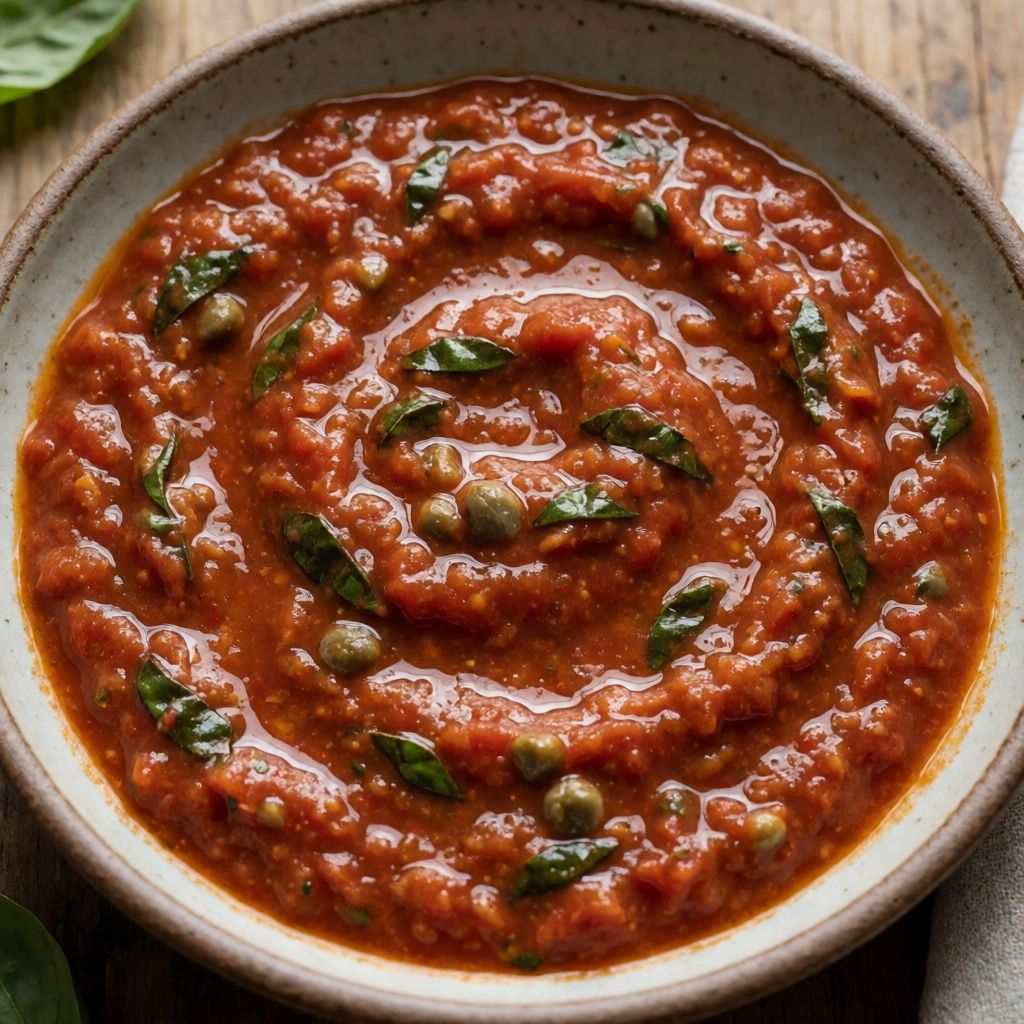
 AI photo
Bagnetto Rosso, Piedmontese Tomato Sauce
A classic Piedmontese red sauce, cooked slowly until thick and then blended smooth.
Labels are worked out automatically from the ingredients and can be wrong. Check the packaging if it matters to you.
Ingredients
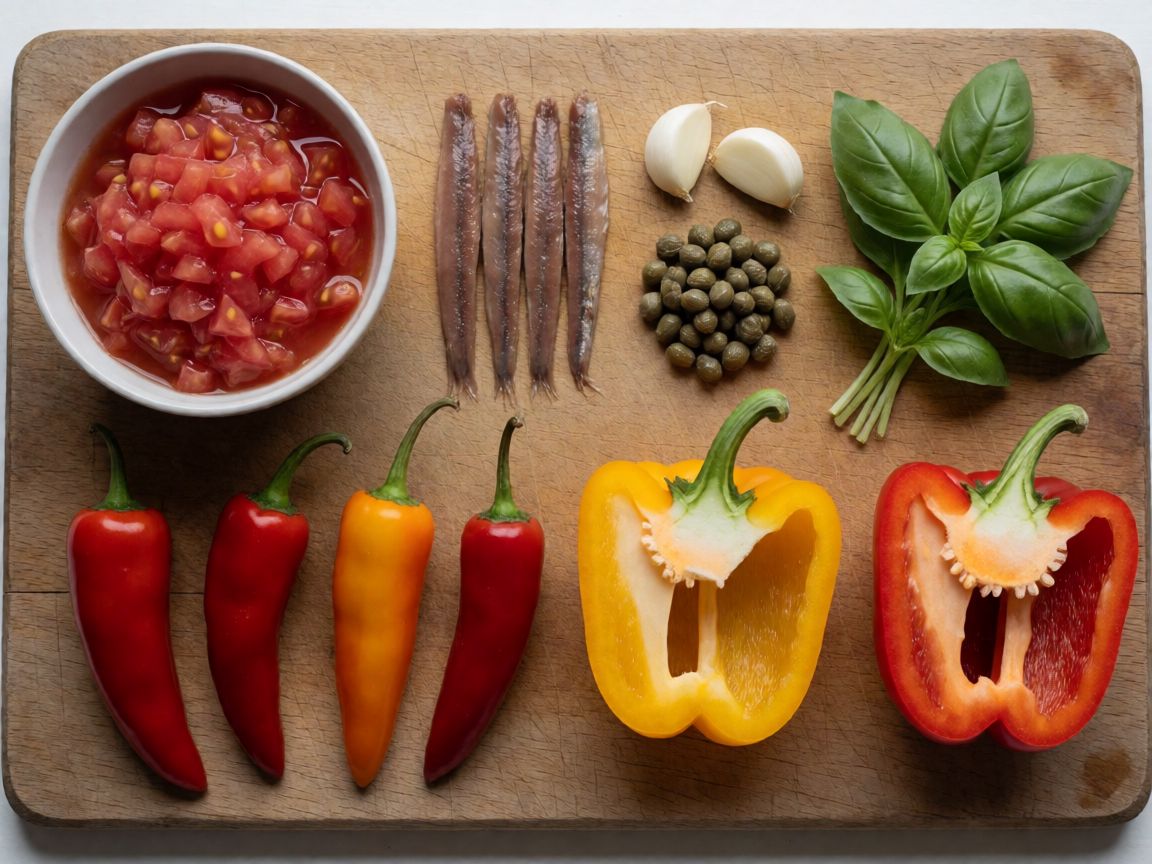
- 250 g Chopped Tomatoes, canned
- 4 pcs Anchovies
- 1 tbsp Capers
- 2 clove Garlic
- 1 bunch Basil
- 3 pcs Chilli Peppers whole
- ½ pcs Red Pepper
- ½ pcs Yellow Pepper
- 1 pcs Onion
- 3 tbsp Parsley
- 118 ml White Wine Vinegar
- Olive Oil to taste
- Salt to taste












Steps
Heat a generous tablespoon of olive oil in a frying pan.
Add the garlic, peeled and with the germ removed, the chopped anchovies, basil, whole chilli peppers, capers, red and yellow peppers, and chopped onion.
Turn on the heat, mix all the sauce ingredients, add the parsley and salt to taste, and stir well.
Pour in the chopped tomatoes and the white wine vinegar.
Simmer the bagnetto rosso on low heat for at least 40 minutes, until the sauce has thickened.
40 minWhile the sauce is still hot, transfer it to a blender and blitz well until the bagnetto rosso is smooth.
Transfer the sauce to a small container or jar and let it cool.
Bagnetto rosso is Piedmont's answer to the question "what do we put on the boiled meat from bollito misto". It's not really a tomato sauce in the Italian-grandmother sense — tomato is barely a quarter of what's in the pan, a binder more than a flavour. What decides whether it works is the anchovy-and-vinegar backbone underneath it: enough acid and salt to cut through boiled beef or tongue, and enough anchovy to give it a savoury weight that tomato alone can't.
Some say — no, because — this is a pasta sauce. It isn't built like one. There's no sugar-softened onion base cooked low and slow for an hour before the tomato goes in; here everything goes into the pan more or less together and simmers hard and fast. This is a condimento, a relish, meant to sit in a small pot on the table next to cold meat, not a ragù meant to coat strands of spaghetti.
The two peppers, the chilli, the capers and the anchovy are doing the same job from different directions: salt, sharp, bitter, heat, all pulling the sauce away from being merely "tomato on meat" and towards something that wakes the mouth up again after a plate of plain boiled beef. That's the whole logic of bollito accompaniments — the meat is deliberately bland, so everything around it has to carry the flavour.
Patience here isn't about babysitting the pan for hours. It's about not rushing the 40 minutes — that's the lower bound, not the target. You're waiting for the raw vegetable edge to cook off and the sauce to pull together into something you can blend smooth, not thin and separated.
The anchovies are the engine, not a garnish. Four fillets dissolve into the hot oil and more or less disappear, leaving behind savoury depth without any fishy taste you'd notice — that's the point of cooking them in oil first rather than adding them raw. If you don't eat fish, a teaspoon of dark miso or a splash of soy will cover the same job: something fermented and salty that reads as "umami" rather than "salt".
White wine vinegar at 118 ml is not a small splash — it's nearly half a cup, and that tells you this sauce is meant to be sharp. Any vinegar with a clean, light acidity works; cider vinegar is the obvious British stand-in, just not balsamic, which brings its own sweetness and muddies the brightness you're after. The vinegar is also doing a preservation job here, the way it has for centuries in Piedmontese pantries — a sauce this acidic keeps in a jar in the fridge for well over a week, which is exactly why bagnetto rosso and its green cousin, bagnet verd, became kitchen staples rather than one-off dishes: make a jar on Sunday, spoon it onto cold meat all week.
The peppers and chilli are chopped and simmered rather than roasted and skinned — don't bother peeling them, the blender at the end erases any toughness in the skin. Fresh chilli or dried, whatever you've got in the cupboard; the whole-pepper method just means you control the heat by how many you fish out before blending, not by how finely you chop.
Capers bring a salty, almost olive-like brininess that tomato alone lacks — if you're out, a few chopped green olives get you closer than anything else in a UK cupboard. Garlic with the germ removed isn't fussiness for its own sake: that pale green shoot in an older clove is where the sharp, bitter aftertaste comes from, and in a sauce simmered only 40 minutes rather than hours, there isn't enough cooking time to mellow it out if you leave it in.
Basil and parsley go in for freshness that survives the simmer and the blending — don't swap dried herbs here, they won't hold their edge through 40 minutes on the heat. Canned chopped tomatoes are fine and, honestly, standard: this is a sauce built for consistency jar to jar, not for the three-week window of good fresh tomatoes.
On a domestic hob, "low heat" means a gentle, lazy bubble, not a flat simmer where nothing moves — you want enough movement to drive off water and thicken the sauce by the end of 40 minutes, but not so hard it catches and scorches on the bottom of a thin pan. Watch it, not the clock: when a spoonful sits thick rather than pooling thin on the spoon, it's ready to blend. Blend it hot — cold tomato sauce seizes and separates more stubbornly in a blender than hot does, so don't let it sit and cool before you blitz it.