
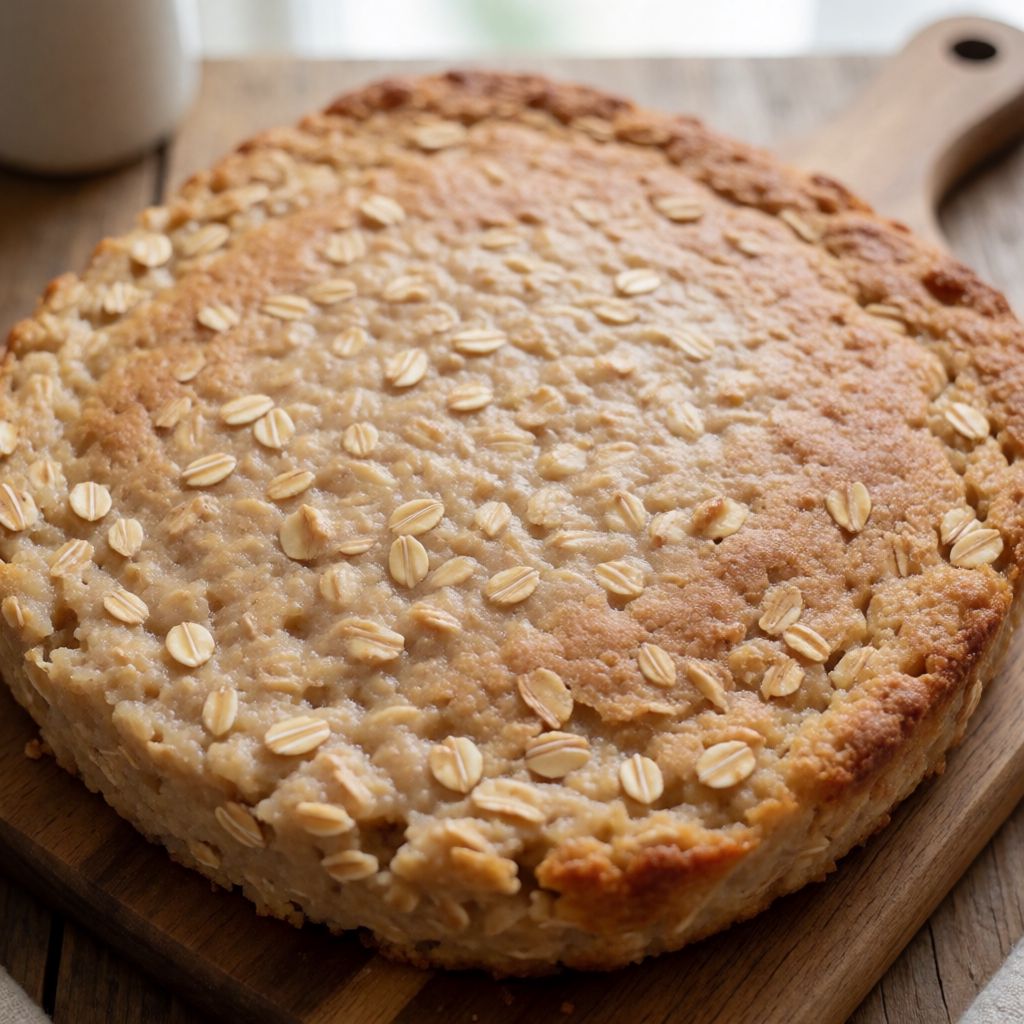
 AI photo
Baked Oat Porridge with Banana and Nuts
A warming baked oat porridge with banana, nuts and warm spices.
Labels are worked out automatically from the ingredients and can be wrong. Check the packaging if it matters to you.
Ingredients
- 75 g Rolled oats
- 0.5 tsp Baking powder
- 1 tsp Cardamom
- 1 tsp Cinnamon
- 1 pinch Salt
- 1 pcs Banana
- 1 pcs Eggs
- 200 ml Milk of your choice
- 15 g Almonds roughly chopped
- 15 g Hazelnuts roughly chopped
- 1 tsp Brown sugar
- 10 g Butter for the dish









Steps
Put the oats, baking powder, cinnamon and cardamom in a bowl and mix well so the spices and baking powder are evenly distributed through the oats.
Put the banana in a deep plate, mash well with a fork and mix with the egg until smooth.
Pour the milk into the bowl with the oats, then add the egg and banana mixture.
Mix well and transfer to a baking dish greased with butter.
Combine the chopped nuts (almonds and hazelnuts) with the brown sugar and sprinkle evenly over the porridge.
Bake in a preheated fan oven at 175°C for 20-25 minutes.
23 min
This is a casserole wearing porridge's clothes. Oats, egg, milk and mashed banana go into a dish and bake until the top sets dry and craggy while the inside stays custardy — somewhere between a bread pudding and the bowl of oats you'd normally stir on the hob. Two people, one smallish baking dish, about half an hour door to table.
What decides whether it works is the egg. Porridge on the stove is just oats drinking liquid; bake it and there's nothing to hold a shape, so the egg is there to set like a custard does, turning loose wet oats into something you can cut into wedges. Skip it and you get sweet oatmeal soup in a dish — edible, but not this.
The second thing is restraint with the milk. 200 ml against 75 g of oats is deliberately lean for a bake — oats on the hob often take three or four times their volume in liquid because the water's boiling off as steam the whole time. In an oven, covered by nothing but its own skin, that liquid has nowhere to go but into the oats and the egg. Too much milk and the middle never sets in the time it takes the top to brown; too little and you've built yourself a dry oat brick with nuts on.
The nuts on top aren't decoration. They toast in the same heat that's setting the custard beneath them, so by the time the centre has gone from wet to just-set, the almonds and hazelnuts have picked up a bit of colour and bitterness that plain raw nuts never get — that contrast is most of why this isn't just "baked porridge" but something worth doing in a dish instead of a pot.
Rolled oats, not the quick or instant kind, because this bakes for twenty-odd minutes only — not long enough to properly break down a coarser flake into a custard, but exactly long enough for rolled oats, already partly cooked in their processing, to soften through while still keeping a bit of chew against the egg-milk set around them. Steel-cut oats, the other direction, are too hard and too hungry for liquid; they'd still be gritty when the top's already browning.
Baking powder here is not for rise in the bread sense — there's no gluten structure to lift, no crumb to speak of. It's there to open up a few air pockets through the custard so the middle doesn't bake into a dense, leaden slab. Leave it out and the dish still sets, just heavier and tighter — some people prefer that, honestly, if they want it closer to a steamed pudding than a porridge.
Cardamom and cinnamon: the mechanism is simply that both are fat-soluble and milk carries fat, so they bloom into the liquid rather than sitting as dusty specks on your tongue. Cardamom has a resinous, almost citrus edge that cinnamon alone doesn't give — if you've only got cinnamon, use it, the dish survives, but it reads flatter, more like a plain spiced porridge than this slightly perfumed version.
The banana does two jobs at once — sweetness, so the added sugar can stay down at a single teaspoon, and moisture, since mashed banana is mostly water bound up in starch and fibre. Mash it properly smooth before it meets the egg; lumps of banana don't cook further in the oven the way they might on a stovetop stir, they just sit there as cold pockets inside the set custard. An overripe banana, the kind going brown and soft, actually mashes easier and tastes sweeter — this is one of the rare recipes where "too ripe to eat plain" is exactly what you want.
The egg: one is enough for 200 ml milk and 75 g oats because its job isn't to taste of egg, it's to coagulate — the proteins unfold with heat and link up, trapping the milk and oats in a loose web. Any dairy-free swap that tries to skip the egg (a flax or chia "egg") will bind some liquid but won't set as firmly; expect a softer, less sliceable result, which is fine if you're eating it with a spoon straight from the dish anyway, which most people do.
Butter on the dish isn't about flavour so much as release — oat-and-egg mixtures stick hard to bare ceramic or metal once baked, and you'll lose the crust trying to scrape it off. Any fat with no strong taste of its own does the job; a flavourless oil works, butter just leaves a faint richness at the very edge where it meets the dish wall.
Almonds and hazelnuts, roughly chopped rather than whole or ground — whole nuts on top would just roll off or burn on one face before the custard's set; ground nuts would vanish into the surface and toast unevenly, some burnt dust, some raw underneath. A rough chop gives enough surface area to catch heat and colour without disappearing. Walnuts or pecans are a straightforward swap if that's what's in the cupboard; the point is some nut, chopped coarse, that can toast rather than scorch in the time the custard needs.
On temperature: 175°C in a fan oven is a middling, steady heat — hot enough to brown nut and set egg within half an hour, not so fierce that the top scorches before the middle's cooked through, which is the real risk in a small domestic oven where the top element sits closer to the dish than in a professional one. The 20–25 minute window is a lower bound dressed as a range — the real test is the centre: give the dish a gentle shake, and if the middle still sloshes like liquid, it needs more time regardless of the clock. Patience here isn't passive — it's the five minutes you don't skip at the end just because the top looks done, because the top always looks done first.