
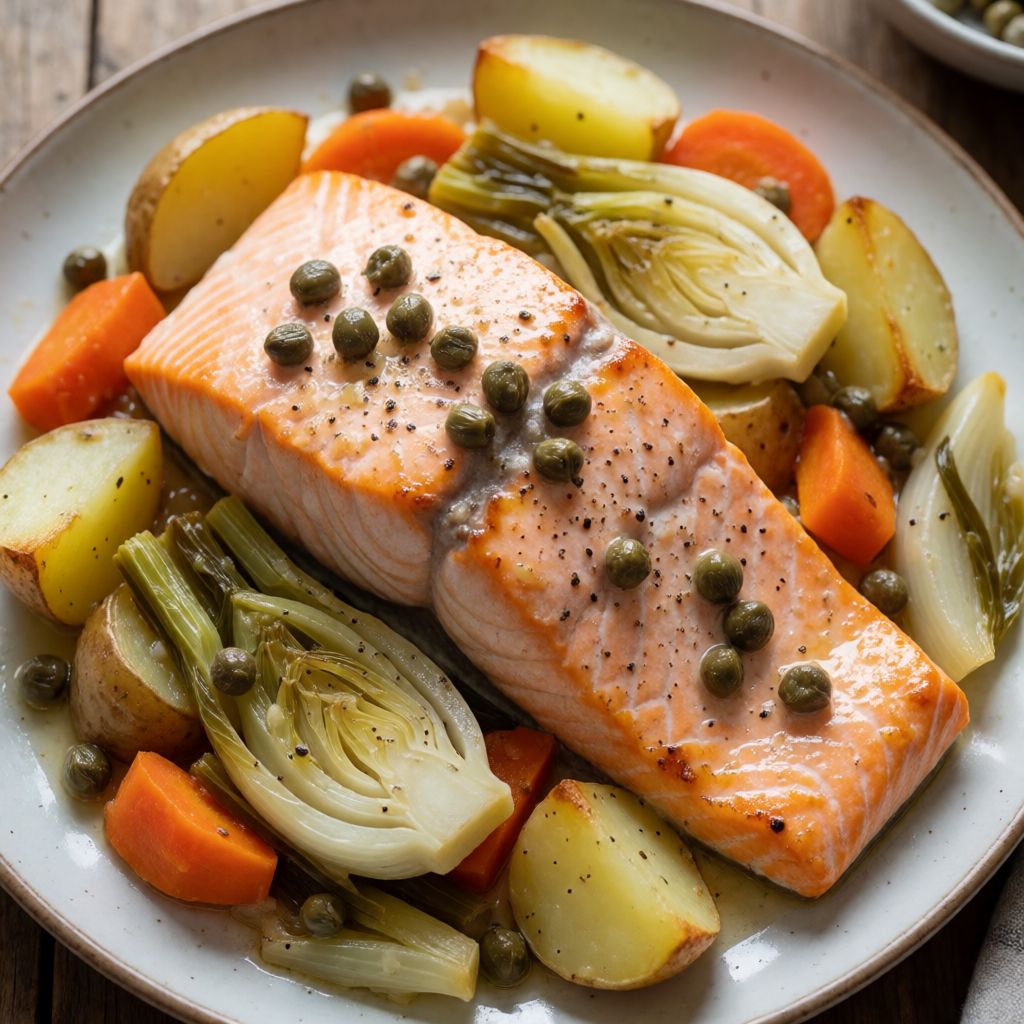
 AI photo
Baked Salmon with Capers and Fennel
A simple oven-baked salmon with fennel, new potatoes and a buttery caper-olive sauce.
Labels are worked out automatically from the ingredients and can be wrong. Check the packaging if it matters to you.
Ingredients
- 800 g Salmon
- 100 g Carrot
- 2 pcs Fennel
- 400 g New potatoes
- Salt to taste
- Black pepper to taste
- Olive oil to taste
- 1 pcs Lemon
- 80 g Butter
- 30 g Pitted black olives or Gaeta olives
- 2 pcs Dill or chives
- 1 tbsp Capers











Steps
Season the salmon fillet with salt and pepper. Meanwhile, peel the vegetables, cut into pieces and blanch for about 10 minutes in boiling water.
10 minDrain the vegetables and arrange them on a sheet of parchment brushed with oil. Place the salmon on top, season with salt and pepper and drizzle with olive oil. Fold the parchment into a parcel.
Bake in the oven for 20 minutes at 180°C. It is done when the thickest part of the salmon reaches 63°C inside.
20 minMelt the butter with the lemon juice and finely grated zest until golden. Add the capers and the olives.
Wait a few minutes before unwrapping the parcel, then serve, spooning the still-warm sauce over the fish and vegetables.
This is a parcel dish, and the parcel is the whole point. You wrap salmon and vegetables in paper and let them cook in their own steam rather than in dry oven air. Salmon muscle is short-fibred and fat-rich — it goes from silk to sawdust in the space of a few degrees. Open roasting dries the surface before the centre is even warm. Sealed in parchment, the fish sits in its own juice and a little olive oil, and that moisture does the work a basting brush would do in an open tray, except you're not standing there with the brush.
The vegetables go in blanched, not raw, and that's not fussiness — it's arithmetic. Carrot, fennel and potato need real time to soften; salmon needs about twenty minutes at a gentle 180°C to reach the inside of a fillet. Left raw, the vegetables would still be crunching away under tender fish, or you'd push the oven time up and ruin the fish to save the carrot. Ten minutes in boiling water first brings both clocks to the same finish line.
Some say fish is done when it flakes apart on the fork. No — by the time it flakes, the sheets of muscle have already separated because the collagen holding them has overcooked and dissolved past where you wanted it. Sixty-three degrees at the thickest point is the number that actually means something: below it the centre is glassy and raw, above it by much the fish turns chalky and dry. A probe thermometer tells you the truth; a fork tells you after it's too late.
Buy a fillet of even thickness if you can — tail end and belly cut cook at different speeds because one is thin and lean, the other thick and fatty, and in one parcel they'll never finish together. Skin on is fine; it crisps a little against the parchment and peels off easily at the table if you don't want it. Farmed salmon carries more fat and tolerates the steam better; wild fish is leaner and will tip over into dry territory faster, so if that's what you have, pull it at the lower end of the time and check the thermometer early.
Use new potatoes, not a floury baking variety. Waxy flesh holds its shape through boiling and steaming both; a King Edward would turn to mush in the same window. Fennel bulb, not the seed — raw it's sharp with anise, heat rounds that off into something closer to sweet celery. If you genuinely can't find it, celery will give you the crunch but not the aniseed note; that's a real trade, not a swap you should pretend didn't happen.
Capers are salt-brined flower buds, and their job here is acid and salt cutting through a butter sauce that would otherwise sit heavy on the tongue. If yours are the very salty kind packed in coarse salt rather than brine, rinse them — otherwise the sauce goes from piquant to simply salty. Black olives, ideally an oil-cured type like Gaeta, add a bitter edge the capers don't have; pitted ones save you an awkward moment at the table.
The butter sauce is a small brown-butter, done properly: melt it with lemon juice and zest until it turns golden, which means the milk solids are toasting, not just the fat melting. That's where the nutty flavour comes from, and it's also where people burn it — on a domestic hob the jump from gold to bitter black happens fast once the foam drops, so keep the heat low and watch the colour, not the clock. Add capers and olives once it's off the heat so they warm through without frying.
Fresh dill or chives go in at the very end, uncooked, because their aroma is in volatile oils that heat simply destroys — scatter them over the finished dish, not into the parcel.
For the oil brushed onto the parchment and drizzled over the fish, you want something with no flavour of its own to get in the way of the lemon and butter — a light olive oil or any neutral vegetable oil does the job; this isn't the moment for an assertive extra virgin you'd drink from the bottle. If you've no parchment, foil will stand in, but oil it well and double it over, since foil tears at the folds more readily than paper does. And trust a probe over your oven's dial: most home ovens drift ten degrees or more from what they claim, which matters far more here than it does for a roast that can forgive being a bit over.