
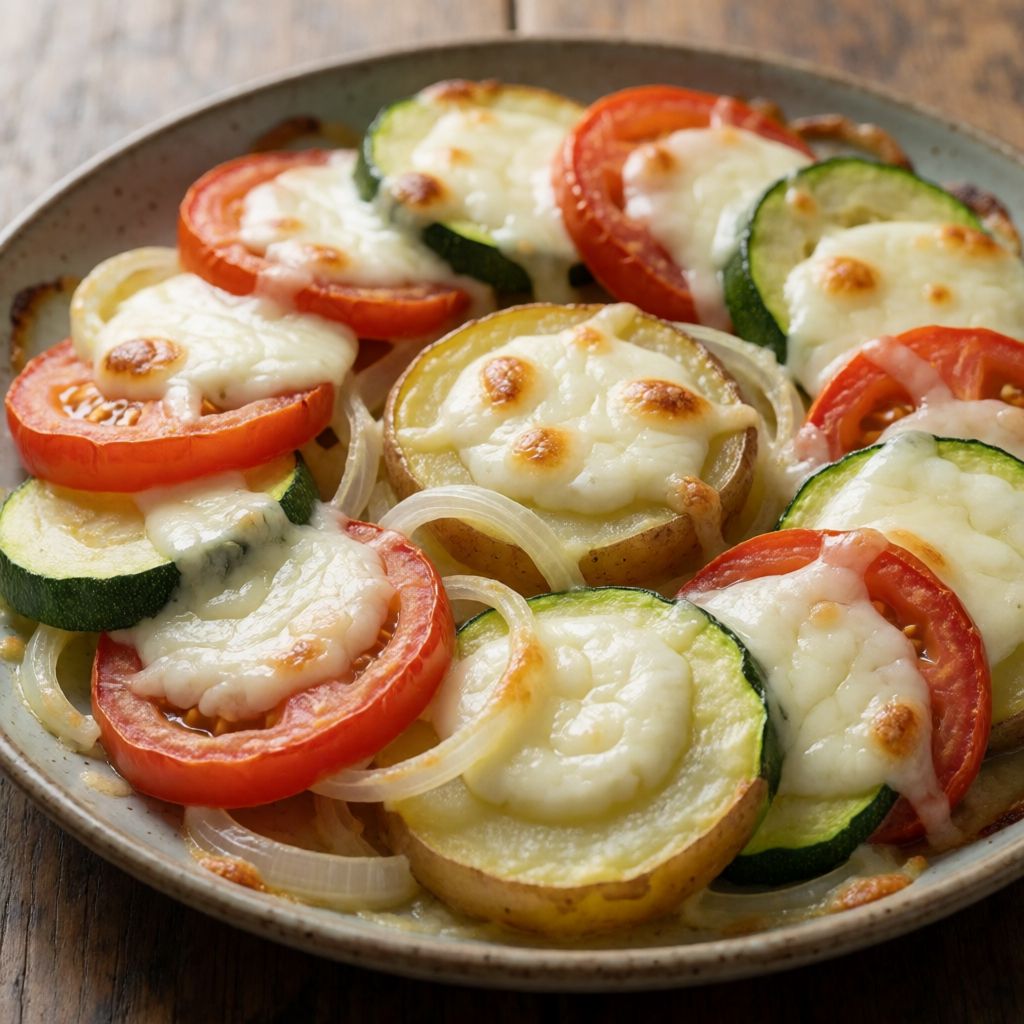
 AI photo
Baked Vegetables with Mozzarella
Layered baked vegetables topped with melted buffalo mozzarella.
Labels are worked out automatically from the ingredients and can be wrong. Check the packaging if it matters to you.
Ingredients








Steps
Slice all the vegetables thinly, using a mandoline, and dice the tomatoes finely.
Grease a baking dish with olive oil.
Layer the vegetables in the dish: onion, courgette, tomato, salt, potato — you can repeat this for up to two layers.
Drizzle with olive oil and finish with a layer of buffalo mozzarella.
Bake at 180°C for 30 minutes, until the mozzarella turns golden.
30 minServe hot.
What you're building is a tian — thin coins of vegetable laid in rings until they fuse into one thing, crowned with a cheese that's meant to blister, not just melt. It's a French Provençal method dressed in an Italian coat: the onion, courgette, tomato, potato are the peasant part, the buffalo mozzarella is the part that turns a frugal vegetable bake into something you'd put on a table for guests.
The whole dish is won or lost on water, not heat. Courgette and tomato are mostly water held in a cell structure; slice them thin on a mandoline and that water comes out fast, in the first ten minutes in the oven. If it has nowhere to go — too deep a dish, too many layers, a lid clamped on — you get a vegetable soup with a cheese lid, not a bake. That's why the dish must be shallow and wide, and why the recipe caps you at two layers. Wide surface, water escapes upward and off; deep dish, water just sits and stews everything grey.
Mandoline isn't there to look professional. It's there because potato is the slowest vegetable in the pile, and uneven slices mean some bits cook through while others stay raw and chalky in the middle of a dish that looks perfectly done on top. Uniform thickness is what lets every piece of potato finish at the same moment the cheese browns.
Layer order isn't decoration, it's logistics. Onion goes at the bottom because it's the one vegetable that benefits from direct, sustained contact with the hottest surface in the dish — the base — and the longest time to lose its sharpness and turn sweet. Put it on top and it stays raw-edged and bitter while swimming in the runoff from everything above it. Courgette sits above it so its released water rises through the stack and bastes the tomato and potato rather than drowning the onion that's trying to caramelise. Salting layer by layer, not just at the very end, matters for the same reason — salt pulls water out of each vegetable as it goes in, so the seasoning gets distributed through the dish instead of sitting on the surface while the bottom stays bland.
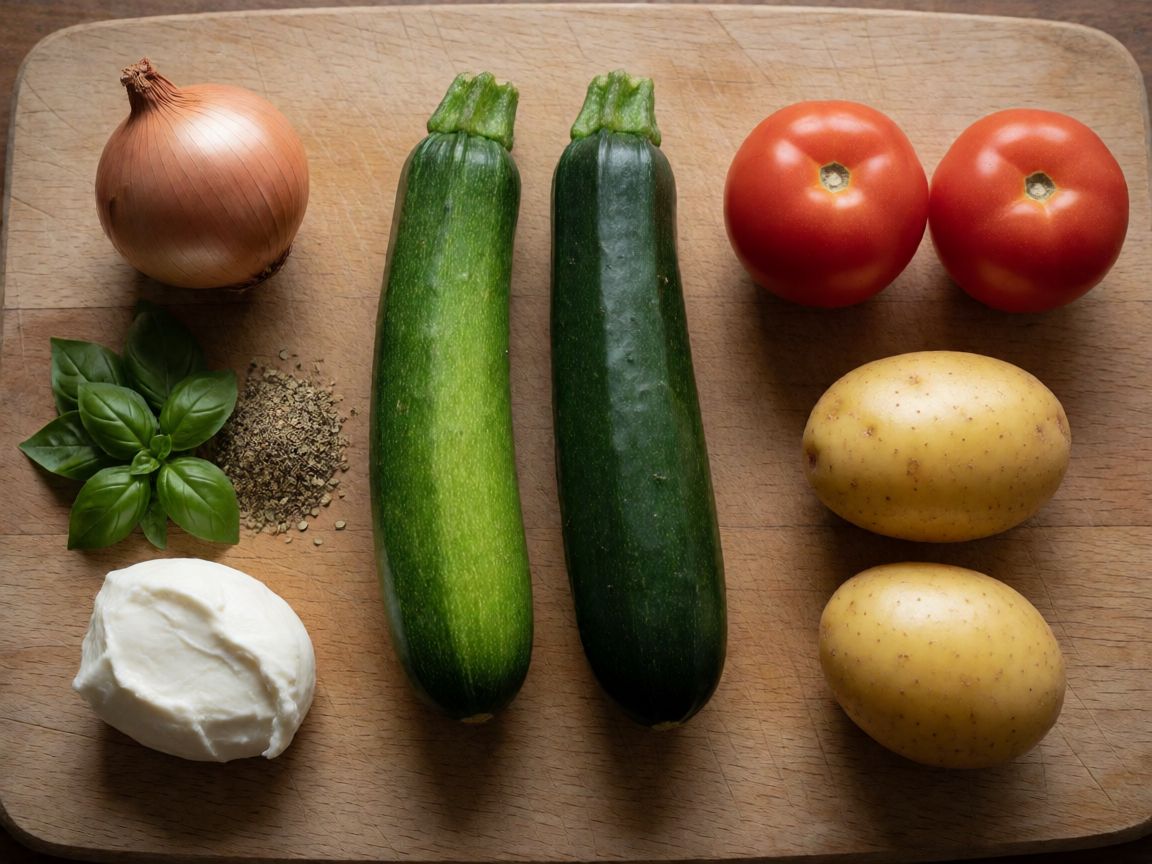
Onion: any firm cooking onion works; the only thing that matters is that it's dry and tight-skinned, not soft or sprouting, because a soft onion has already started breaking down and will turn to mush before it caramelises.
Courgette and tomato: look for firm, not for a particular variety. A watery, overripe tomato — common in a British supermarket in winter — will add more liquid than the dish can evaporate off in half an hour; if that's what you've got, dice it finer still, or drain the seeds and juice out before layering, or use well-drained tinned chopped tomato instead and don't apologise for it. The dish doesn't know the difference between a tomato from a vine and one from a tin, it only knows how much free water you've handed it.
Potato: this is the vegetable that decides whether thirty minutes is enough. A waxy potato holds its slice and keeps some bite; a floury one breaks down softer and almost merges with the sauce underneath. Either works here — this isn't a dish where the variety is sacred, it's a dish where the slice thickness matters ten times more than which potato you bought.
Buffalo mozzarella: the point of it is a high water content under a skin that can set and brown without the whole thing turning to rubber or to a flat puddle. Any fresh mozzarella in brine does the same job — fior di latte is the everyday, cheaper version and nobody at the table will complain. What won't work is a hard aged cheese on its own: it browns, yes, but it won't give you that soft, slightly leaking centre that's the actual reason this cheese goes here rather than cheddar.
Olive oil, basil, oregano: the oil's job is to carry heat into the vegetables and keep the top layer from drying to a crust before it browns — any oil with no smell of its own would do the engineering, but olive oil is also doing flavour work here, so don't swap it for something neutral unless you have to. Dried oregano holds up fine to half an hour in the oven; fresh basil doesn't — its aroma is volatile and burns off under sustained heat, so if you're using fresh leaves, hold half back and scatter them on after the dish comes out, still hot, rather than baking all of it in from the start.
One proportion note: a whole onion, two courgettes, two tomatoes, two potatoes and a full ball of mozzarella is a generous side for two, or a light vegetarian main for one with some bread alongside — treat the single serving on the card as an invitation to eat well rather than a literal measurement. And give it five minutes out of the oven before you cut into it. That's not laziness, that's the cheese and the released juices settling back into the vegetables instead of running out across the plate the second you break the seal — patience here is the last ingredient, and it's free.