
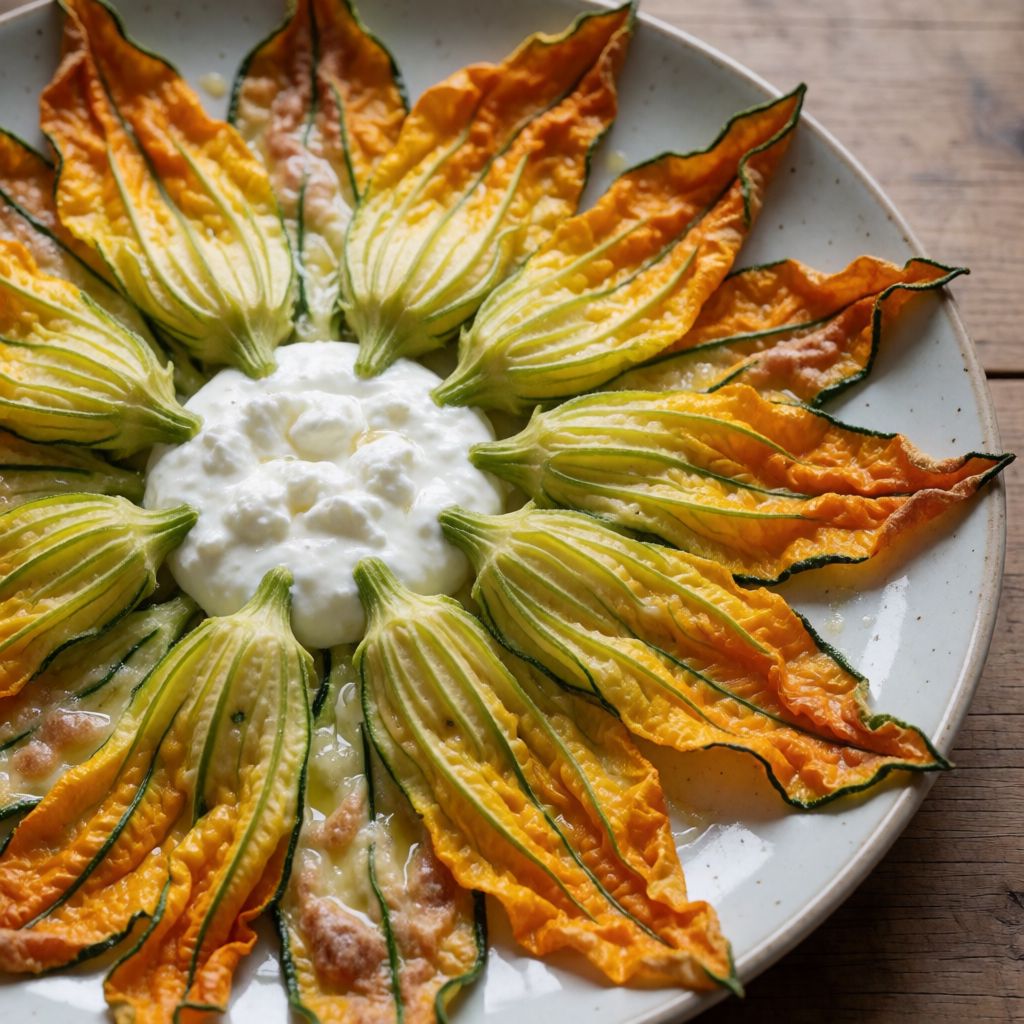
 AI photo
Baked Courgette Flowers
A simple oven-baked side of stuffed courgette flowers with burrata, anchovies and orange zest.
Labels are worked out automatically from the ingredients and can be wrong. Check the packaging if it matters to you.
Ingredients
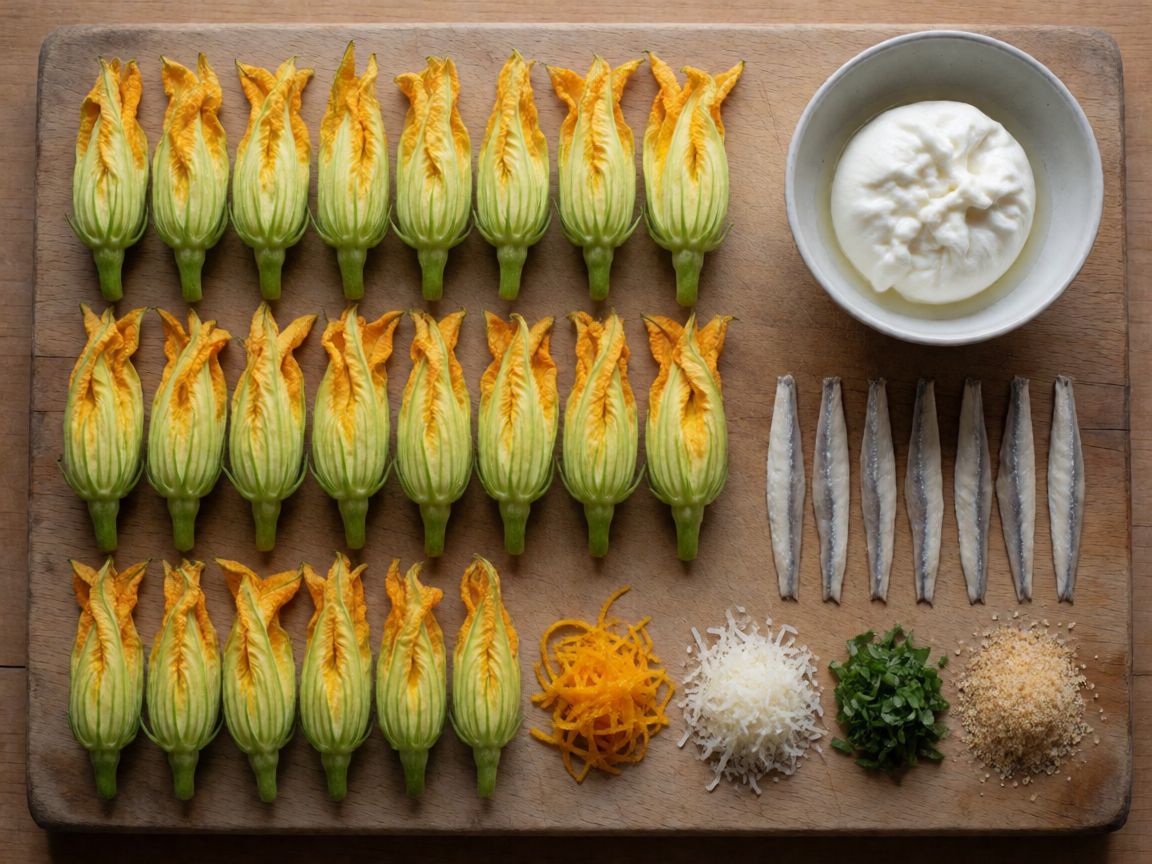
- 20 pcs Courgette flowers
- 300 g Burrata
- 10 pcs Anchovies in oil
- 1 pcs Orange zest
- Salt to taste
- Black pepper to taste
- 20 g Parmesan
- Basil to taste
- Olive oil to taste
- Breadcrumbs to taste, dried






Steps
Carefully open the courgette flowers, remove the central pistil and the outer green tips. Rinse them under running water.
Leave the flowers head-down for a few minutes so excess moisture drains off.
Finely chop the basil and anchovies with a knife, grate the orange zest and mix everything with the burrata.
Fill a piping bag with the prepared filling and fill the courgette flowers about halfway.
Gently twist the tips of the flowers and fold them downward.
Place the filled flowers in a baking dish lightly greased with oil.
Sprinkle with salt, black pepper, fresh basil, breadcrumbs and Parmesan. Add a thin drizzle of olive oil.
Bake at 200°C.
15 minRemove from the oven and serve the baked courgette flowers immediately.
A courgette flower is a bag of almost nothing — petals so thin they wilt the moment you look at them wrong — and the whole dish is a bet that you can get something creamy and savoury inside that bag before it collapses. Burrata is the right filling precisely because it's already half-liquid: it doesn't need to melt in the oven, it just needs to warm through, so the flower never has to survive long enough to dry out.
What decides whether this works is moisture — getting rid of the flower's own water, and controlling how much the filling adds. Courgette flowers hold water in their folds the way a closed umbrella holds rain; stand them head-down after washing and gravity does what a tea towel would do badly, which is pull that water out without you having to rub the petals and tear them. Skip this and the oven ends up steaming the flowers from the inside, and steamed petals go slimy, not soft.
Some say you should batter and fry these flowers to get them crisp — no, because this recipe isn't chasing crunch, it's chasing a thin wrapper that nearly dissolves with the cheese. The breadcrumbs and Parmesan on top aren't there to make a crust in the fried sense; they're there to catch the olive oil, brown slightly, and give you one small point of texture against all that softness underneath. That's a different job, and a smaller one.
Fifteen minutes at 200°C is a lower bound, not a stopwatch instruction — what you're watching for is the petals going translucent at the edges and the burrata softening and starting to weep slightly into the dish. Pull them the moment that happens. Go much past it and the thin tips, the part you twisted and folded down to seal the filling in, will scorch before the body of the flower has even warmed through properly, because they're a fraction of the thickness.
On courgette flowers: buy them the day you cook them if you possibly can, they're not a keeper — thin-walled and already starting to wilt in the shop. Male flowers (on a thin stalk, no courgette attached) are the ones usually sold for stuffing and are what the quantity here assumes; female flowers have a tiny courgette already forming behind them and are better left to turn into actual courgettes. If your greengrocer doesn't stock them — and most UK high streets don't, this is still a farmers'-market or Italian-deli item — there's no real substitute; this dish doesn't translate onto another vegetable, the whole point is the flower.
Burrata is a fresh, un-aged cheese with a liquid cream centre inside a mozzarella shell — it's chosen here because it needs no cooking, only warming, which matches how fragile the flower is. If you can't get it, a very good buffalo mozzarella torn up and mixed with a spoonful of double cream gets you close; ricotta on its own will work but gives you a drier, less luxurious filling, so loosen it with a little cream or olive oil.
The anchovies should be the tinned-in-oil kind, not the salted whole ones that need rinsing and boning — you want convenience here, not a side project. If you genuinely can't eat anchovy, a few capers chopped fine will give you a different but comparable hit of salt and savoury sharpness; it won't be the same dish, but it won't be a flat one either.
Orange zest is there to cut through the richness of the burrata and the saltiness of the anchovy — citrus does this by smell as much as taste, waking the whole thing up rather than adding its own flavour wholesale. Zest only the orange part, not the white pith underneath, which is bitter and will work against you.
For the olive oil, the rule is simple: anything with no strong flavour of its own that can take a bit of heat — a light, everyday olive oil, not your good finishing one, since this is cooked and the subtlety would be wasted. And on the breadcrumbs: dried, not fresh, because fresh crumbs hold moisture and will go soggy rather than catching any colour in fifteen minutes in a home oven, which runs cooler at the edges of the tray than the display says — put the dish on a middle shelf, not the top, so the tips don't catch before the filling's through.