
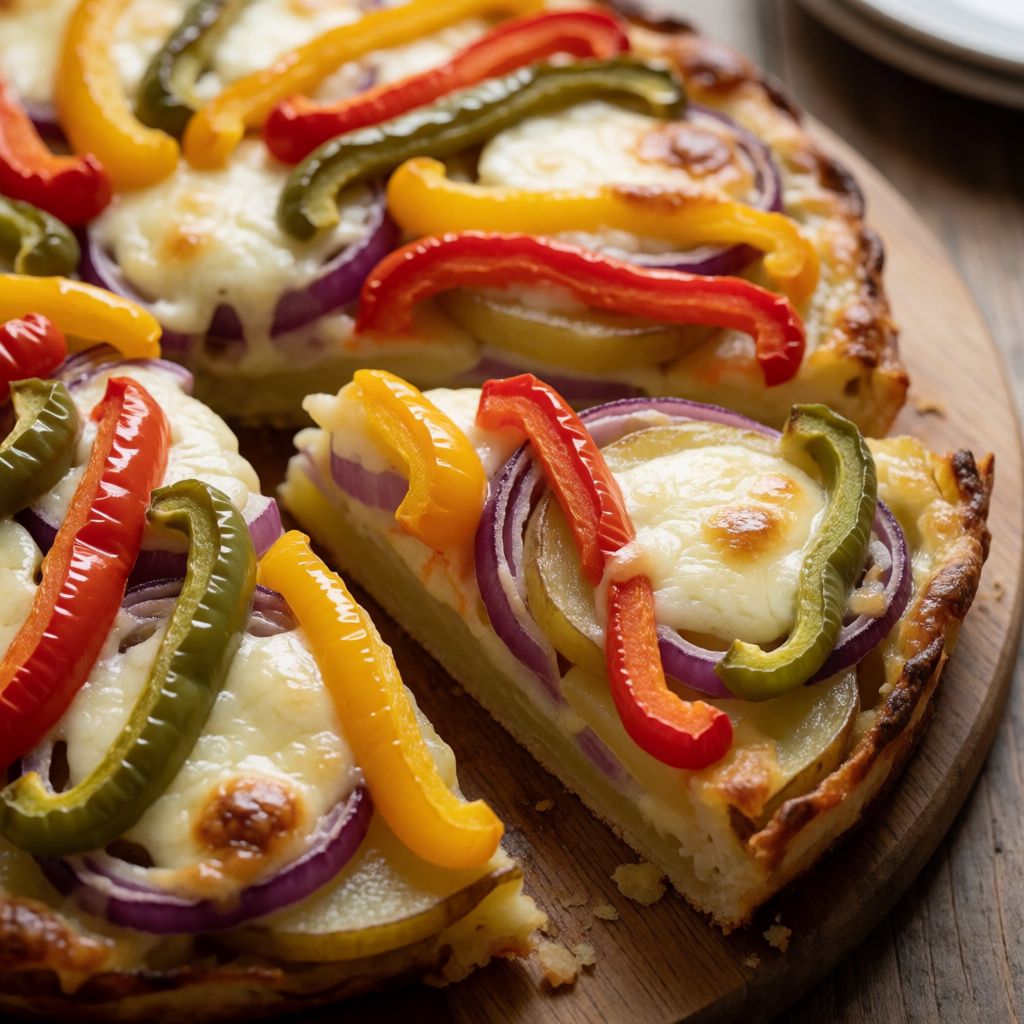
 AI photo
Bell Pepper, Potato and Mozzarella Pie
A savoury pie filled with stewed peppers, potato and mozzarella, baked in a shortcrust pastry case.
Labels are worked out automatically from the ingredients and can be wrong. Check the packaging if it matters to you.
Ingredients
- 2 pcs Bell pepper
- 1 pcs Potato
- 1 pcs Red onion
- Olive oil to taste
- Salt to taste
- Black pepper to taste
- Parsley to taste
- 1 pcs Shortcrust pastry
- 125 g Fior di latte mozzarella
- 2 tbsp Parmesan
- Breadcrumbs to taste, dried
- 3 pcs Eggs
- 200 ml Double cream












Steps
In a pan, heat the olive oil and fry the sliced red onion, then add the bell pepper.
Pour in a little water and simmer gently.
10 minLine a tin with the shortcrust pastry and baking parchment, prick with a fork and sprinkle with breadcrumbs.
Arrange the potato cubes, the stewed vegetables and the diced mozzarella on top.
Beat the eggs with the double cream, Parmesan, salt, black pepper and parsley, then pour over the filling.
Bake in an oven preheated to 200°C until golden on top.
30 min
What was changed
In the filling, Double cream was used instead, as it is the cream familiar to local kitchens.
This is a quiche with a borrowed accent — custard, pastry case, and a filling that owes more to peperonata than to anything French. The whole thing stands or falls on one ratio: eggs to cream to how much the filling weeps. Bell peppers and onions, stewed down, hold water the way a sponge holds water — squeeze them and it comes out. If that water goes into the tart with the custard, you don't get a set filling, you get a wet one that never quite becomes a pie, however long you leave it in.
So the pan work at the start isn't decoration, it's drainage. Sweating the onion and pepper slowly in oil, with a splash of water rather than a flood of it, forces the vegetables to give up their moisture before they ever meet the egg mixture. Some say you can just chuck raw peppers into a quiche and bake it all together — no, because raw pepper holds far more water than cooked, and that water has nowhere to go once it's sealed under custard in a hot oven. It steams the base instead of baking it.
Breadcrumbs on the pastry base are the second line of defence, and people skip them thinking they're just there for crunch. They're there because pastry is porous and custard is liquid, and a thin dry layer between the two slows down how fast that liquid soaks in and turns the base soft. Think of it as a raincoat for something that can't go in the wash.
Potato goes in raw, cut small, and that's deliberate rather than lazy — a single potato, diced fine, cooks through in the time the custard needs to set, because small cubes surrounded by hot cream behave almost like they're being poached. Cut it the size of a roast potato for your Sunday dinner and it will still be raw-tasting when the top is golden; cut it down to the size of a sugar cube and it has a fighting chance.
The bell peppers and red onion are the stew at the heart of this, and the point of simmering them with a little water rather than frying them hard is control, not virtue. A hard fry on a domestic hob, where the heat under a wide pan is never as fierce or as even as in professional kit, catches the sugars in the onion and pepper skin before the inside has softened — you get char on the outside, crunch in the middle. Gentle heat and a little water let the vegetables collapse evenly, pepper going from stiff and glossy to soft and almost translucent, onion sliding from sharp white to a mellow amber.
Fior di latte mozzarella is cow's milk mozzarella, the ordinary ball from the fridge aisle rather than buffalo mozzarella — less expensive, firmer, and it doesn't leak the same flood of milky water when you cut it. That matters here for the same reason the vegetable-draining matters: less water in, less water to ruin the set. If you can't get it, any firm block mozzarella sold for cooking rather than for a salad will do — the test is whether it holds a cube shape without collapsing, not the label.
Double cream and eggs are the custard, and the job of Parmesan folded into that mixture is to season it and firm it slightly as it bakes — a hard, salty cheese with no watery give to it, unlike a soft cheese which would add more liquid to a mixture that's already carrying cream. Any dry, hard grating cheese with a similar bite works in its place; pre-grated supermarket "parmesan" substitutes lacking any real sharpness will leave the custard flatter in flavour, so taste before you decide salt is the only seasoning doing the work.
Shortcrust pastry here is bought or homemade, your call — the recipe doesn't care which, only that it's rolled thin enough to crisp and thick enough not to split under the weight of a wet filling. Pricking it with a fork before baking isn't fussiness; it lets steam escape from underneath so the base doesn't puff up into a hollow dome and crack when you pour the filling on top.
Patience sits mostly in that first ten minutes with the pan, resisting the urge to turn the heat up and rush the vegetables. Rushed vegetables carry raw water into the oven, and the oven cannot fix in thirty minutes what the hob should have fixed in ten. Let the pepper go soft before you move on — it tells you, you don't have to guess.