
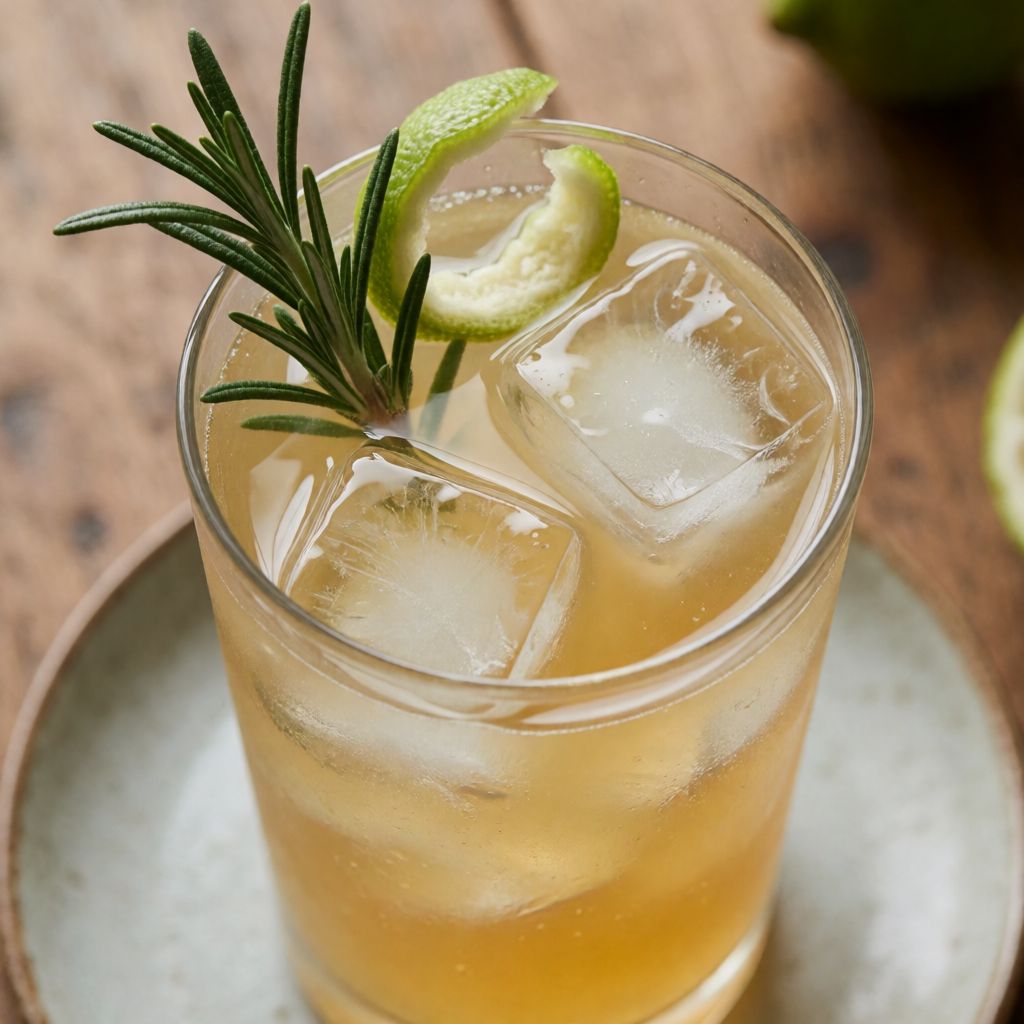
 AI photo
Bergamot and Gin Cocktail
A refreshing gin cocktail flavoured with fresh bergamot, ginger and rosemary, topped up with sparkling water.
Labels are worked out automatically from the ingredients and can be wrong. Check the packaging if it matters to you.
Ingredients
- 2 pcs Organic bergamot juice and finely grated zest
- 60 ml Gin
- 2 pcs Ginger slices
- 1 pcs Rosemary roughly chopped, fresh
- 180 g Caster sugar
- 100 ml Water
- 3 tbsp Glucose syrup
- 6 pcs Ice cubes to taste
- 2 pcs Rosemary fresh sprigs, for garnish
- 330 ml Sparkling water







Steps
Make the sugar syrup: put the sugar, water and glucose syrup in a saucepan and bring to the boil. Stir and cook until the sugar has completely dissolved. Pour into a bottle.
5 minFill two glasses with rosemary sprigs.
1 minAdd the bergamot juice and zest, gin, ginger, rosemary and the sugar syrup to a cocktail shaker filled with ice cubes. Shake for half a minute and strain the cocktail into the glasses.
1 minTop up with sparkling water and garnish with a fresh sprig of rosemary.
What you're making here isn't really a cocktail recipe in the slow sense — it's a flash infusion. You take a base spirit, shock it with cold and crush aromatics into it for thirty seconds, and that's the whole trick. Nothing simmers for an hour, nothing rests overnight. The entire dish happens in the time it takes a shaker to frost over, which tells you where to put your attention: not on steps, on timing.
Bergamot is doing the heavy lifting, and it's worth knowing what it actually is before you grate it. It's a bitter orange relative grown mostly in Calabria, and almost nobody eats it as fruit — it's grown for its peel oil, the same oil that scents Earl Grey tea. That's why you'll recognise the smell before you recognise the flavour. The oil sits in glands in the skin, not in the flesh, which is why the recipe asks for juice *and* zest separately — the juice gives you sourness, the zest gives you the actual bergamot smell. Squeeze the fruit without grating it first and you get a sharp, sourish gin with none of the perfume. Some people think citrus flavour is all in the juice — no, because with aromatic citrus like this, the juice is just acid; the scent lives in the skin's oil, and oil doesn't come out of fruit by squeezing, it comes out by abrading the surface.
The syrup itself is worth a minute of thought, because it's not just sugar water — the glucose syrup is there to stop the sucrose recrystallising once the mixture cools. Plain sugar syrup, left in a bottle for a few days, tends to go grainy or throw sugar crystals back out of solution; glucose syrup (an invert sugar) interrupts that process and keeps the syrup pourable and glassy for weeks. If you don't have glucose syrup, golden syrup does roughly the same job and adds almost nothing of its own flavour in these small amounts; light corn syrup works too if that's what's in your cupboard. You'll notice the recipe makes far more syrup than two drinks need — that's deliberate, it's a batch, keep the rest in a bottle in the fridge for the next round rather than scaling the whole thing down.
Caster sugar rather than ordinary granulated matters a little here too — finer crystals have more surface area, so they dissolve faster and with less risk of scorching on the bottom of the pan before the rest catches up. If all you've got is granulated, it'll still work, just give it that bit longer over the heat and stir so nothing sits and catches.
For the gin, you don't want something busy. A London dry style — juniper-forward, not loaded with its own citrus or floral botanicals — gives the bergamot room to be the interesting thing in the glass. A gin that's already heavy with orange peel or elderflower will just argue with it. If gin isn't to hand, a dry vodka will carry the same cocktail without the aromatic backbone, which changes the character but won't break the drink.
Ginger goes in as slices, not powder, and not grated to a pulp — you want it to bruise and give up its oil during the shake, not dissolve into the drink and turn it cloudy or over-spiced. Rosemary does double duty: one lot shaken with everything else for its resinous oil, a second sprig dropped into the glass afterwards so the first thing you smell when you drink is rosemary, not just taste it once it's already in your mouth. Fresh rosemary only — dried loses the volatile oils that make the smell work in the first place.
For the sparkling water, reach for something genuinely neutral — not tonic. Tonic carries quinine bitterness and its own sugar level, both of which were never designed to sit next to bergamot and rosemary; it'll fight the drink rather than lengthen it. Any unflavoured sparkling water does the job of the sparkling water here: lengthening the drink and lifting the aromatics up out of the glass with the bubbles, nothing more complicated than that.
Ice is your dilution control, not decoration — six cubes in the shaker is a starting point, not a rule, because ice size varies wildly between trays and what matters is how much it melts in thirty seconds of shaking, not how many cubes you counted in. If your cubes are small and melt fast, use fewer; if they're large, you can afford more without watering the drink out.