
 AI photo
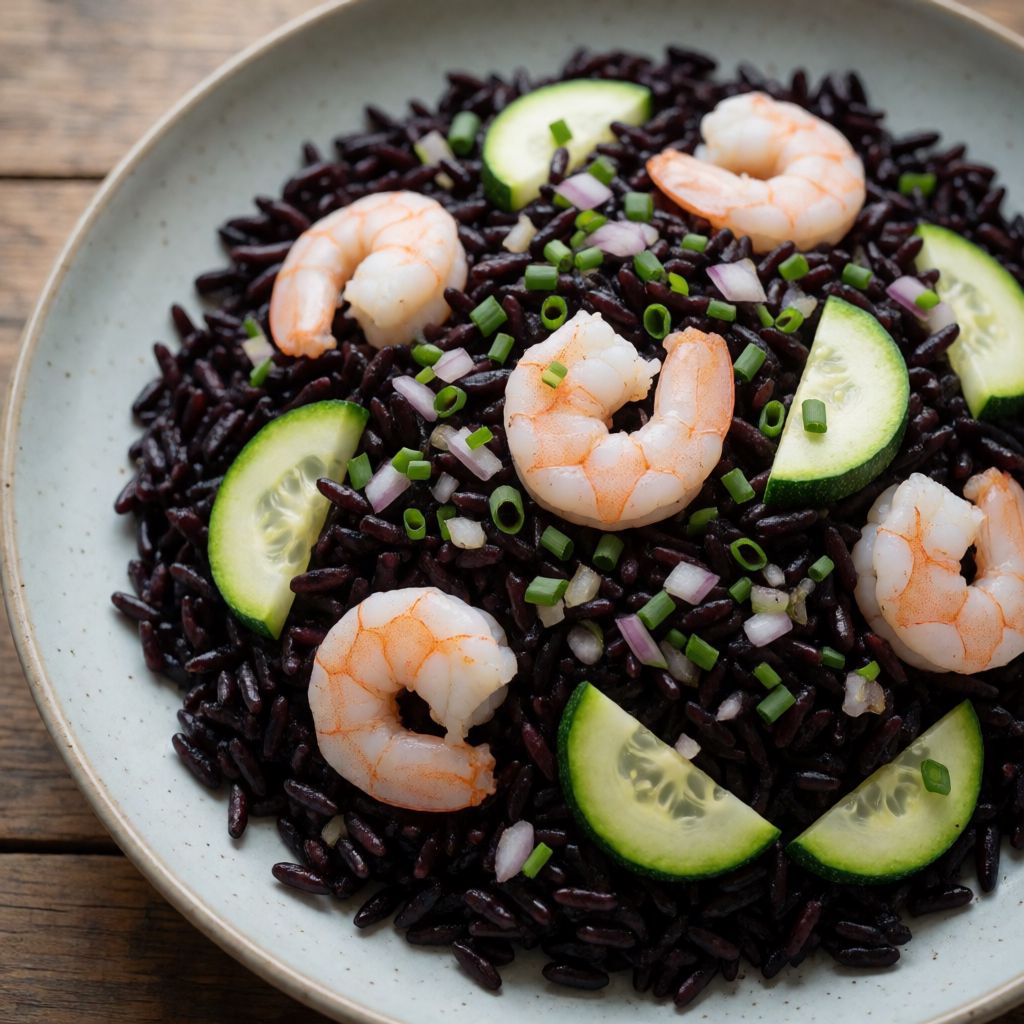
Black Venere Rice with Prawns and Courgette
A black Venere rice dish with prawns and courgette in a white wine sauce.
Labels are worked out automatically from the ingredients and can be wrong. Check the packaging if it matters to you.
Ingredients
- 200 g Prawns
- 300 g Black Venere rice
- 250 ml White wine
- 2 pcs Courgette
- 1 pcs Shallot
- 1 tbsp Chives
- 1 pcs Vegetable stock cube
- 4 tbsp Olive oil
- 1 pinch Salt to taste








Steps
Cook the black Venere rice in salted water for 19 minutes.
19 minFinely chop the shallot and sauté it in olive oil until soft.
Add the prawns without thawing them first.
Once the prawns have thawed, add the chopped courgette and the vegetable stock cube. Doneness: 63°C at the thickest part.
Drain the cooked rice and add it to the prawn and courgette sauce.
Pour in 250 ml of white wine.
Let the wine reduce.
Add the finely chopped chives and serve hot.
This is not a risotto, whatever its colour tells you. Black Venere rice — tossed with prawns, courgette, a wash of wine — is dressed the way you'd dress pasta: boiled separately in plenty of salted water, drained, then married to a sauce that was building in its own pan the whole time. Two workstreams, one plate. That's the whole architecture of it.
What decides whether it holds together is timing between those two streams. The rice needs its full boil because Venere keeps its bran coat — it's bred, not dyed, from a cross with wild rice back in the Po valley in the '90s, and that coat is what gives you the nutty bite and the black colour, and also what makes it stubborn against water. Nineteen minutes gets you close; your teeth get you the rest of the way. You want chew, not crunch, not mush — bite one grain in half and there should be no hard white speck left at the core.
The prawns go in frozen, straight into the pan with the softened shallot, and that's deliberate, not laziness. Thaw them on the counter first and they weep — all that liquid pools, then hits hot fat and you get a half-boil, half-fry, and rubber. Let them thaw in the pan instead, at a heat gentle enough to soften shallot without browning it hard, and they come up to temperature slowly, evenly. You're looking for flesh gone from grey-translucent to opaque white-pink, the body curling into a tight C — an O shape means you went too far and the muscle has seized.
Rice first, because it's the one piece of timing you can't improvise around. Buy it as Venere or Nerone — both names for the same Italian-grown black rice. If you can't find it, a short-grain brown rice will behave similarly (same intact bran, same stubbornness, same roughly 18–20 minute boil), though you lose the colour and the faint cocoa note Venere has. Don't rinse it hard before cooking looking to wash off starch for a 'cleaner' texture — there isn't much surface starch to lose, and you're boiling in an excess of water and draining it anyway, same as spaghetti.
Prawns: raw, shell-off or on as you prefer, but frozen is the point here, not a compromise. If yours are fresh, you lose nothing — just add them a little later, once the shallot's gone soft, and watch for the same colour change. The stated 63°C is the number a probe would give you for cooked-through shellfish flesh; nobody's sticking a thermometer into a prawn at home, so use the eye instead — opaque, no grey sheen, curled tight.
Courgette is mostly water held inside rigid cell walls, and heat is what breaks those walls down. Chop it so the pieces are small enough to cook through in the time the prawns need, no more — leave it in too long or over too fierce a flame and the cells collapse all at once, the water floods out, and you get grey sponge sitting in its own puddle instead of pieces with a bit of structure left. Choose one that's firm and heavy for its size; an old, soft courgette has already started that collapse before it ever meets your pan.
Shallot over onion for the same reason a sauce for shellfish stays gentle rather than sharp — less sulphur, more sugar, it melts rather than bites. Half a mild onion will do if that's what's in the fridge; just give it a minute or two longer over the heat so the rawness cooks off before the prawns go in.
The stock cube is doing exactly what gravy granules do to a Sunday roast — a fast, reliable hit of salt and savour standing in for a stock nobody has time to simmer from prawn shells on a Tuesday. Nothing to apologise for. If you do save your shells, though, simmering them in the wine for a few minutes before it goes in will out-perform the cube, no contest — that's free flavour most people throw in the bin.
Wine needs to actually reduce, not just steam off for show — you're boiling away the sharp alcohol smell and concentrating what's left into something closer to fruit and acid, which is what cuts through the oil and the prawns' richness. Use something dry you'd drink, not a bottle gone sour at the back of the cupboard; any decent dry white does the job, and in a pinch a spoon of white wine vinegar cut with water gets you the acid without the body. Chives go in off the heat, chopped fine, right at the end — cook them and you've paid for a fresh green bite you'll never taste. On a domestic hob, keep the prawns and courgette in a single layer in a wide pan rather than piling them up: crowd the pan and they steam in their own liquid instead of taking any colour, and you lose exactly the texture this dish is built on.