
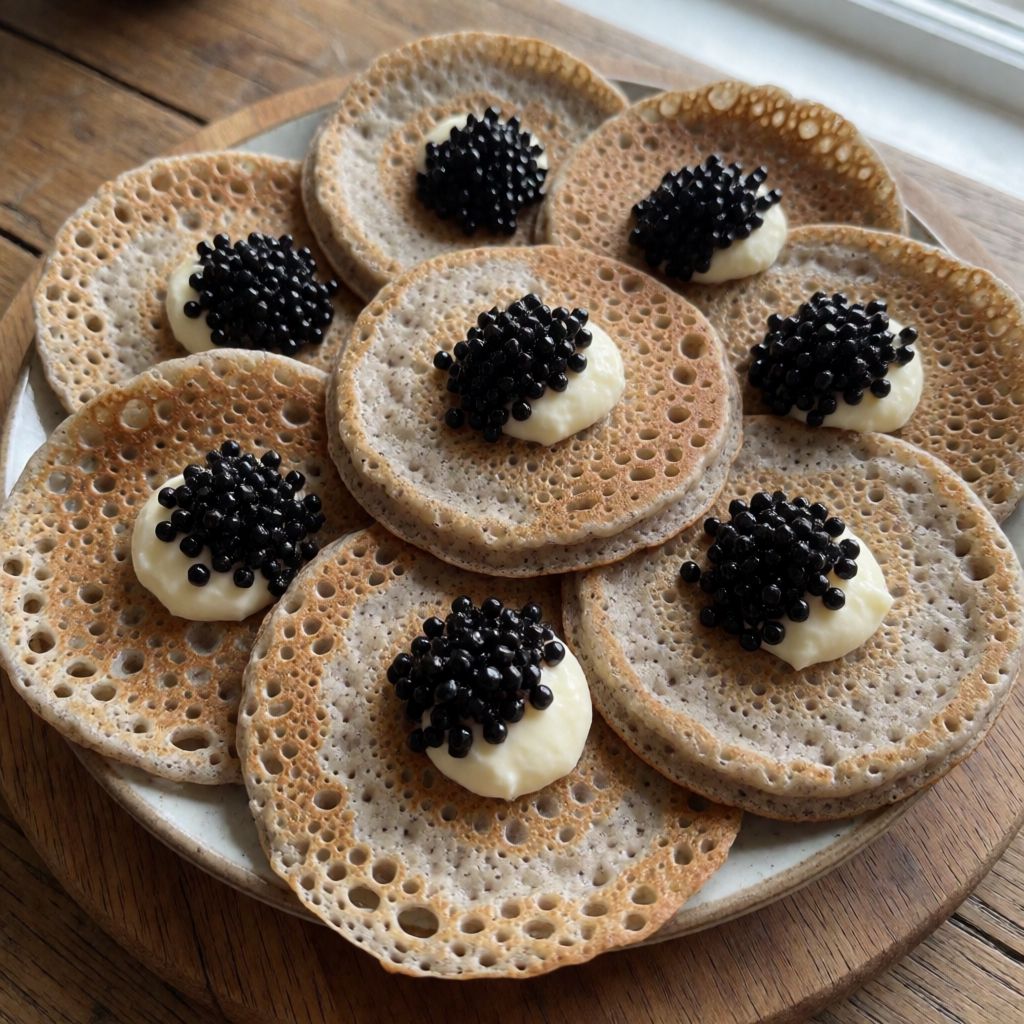
 AI photo
Buckwheat Blini with Lumpfish Roe
Soft yeasted buckwheat blini topped with roe, crème fraîche, red onion, chives and dill.
Labels are worked out automatically from the ingredients and can be wrong. Check the packaging if it matters to you.
Ingredients
- 200 ml Milk at room temperature
- 20 g Yeast
- 100 g Buckwheat flour
- 50 g Plain flour
- 1 pcs Egg
- ½ tsp Salt
- 1 tbsp Butter for frying
- 200 g Lumpfish roe fresh
- 100 ml Crème fraîche 38%
- 1 pcs Red onion finely chopped
- 1 bunch Chives finely chopped
- 1 bunch Dill fresh











Steps
Pour the milk into a bowl, dissolve the yeast in it, then add the buckwheat flour, plain flour, salt and egg yolk, and mix until you have a smooth batter.
Set the egg white aside for later use.
Cover the batter with a clean towel and let it rise on the kitchen counter for 1 hour.
60 minWhisk the egg white into a stiff foam and gently fold it into the batter.
Melt the butter in a frying pan and spoon in small portions of batter.
Fry the blini until golden on both sides.
10 minServe the warm blini with lumpfish roe, crème fraîche, red onion, chives and dill.
What was changed
The original roe is not sold locally, so it was replaced with Lumpfish roe, the usual shop substitute for blini.
Blini are not pancakes that happen to be small. They're yeast-raised, which means the batter is alive, not just mixed — the point is a crumb full of tiny holes that soaks up crème fraîche instead of sliding it off. Buckwheat flour is doing the heavy lifting here: it has no gluten worth speaking of, so the blin is tender and slightly grainy rather than chewy, and it carries that faint sour, earthy note that plain flour never will. Half-and-half with plain flour is a compromise, not a tradition for its own sake — all buckwheat and the batter won't hold together on a domestic hob; all plain and you've made a flapjack with ideas above its station.
What decides whether these work is the yeast and the egg white, in that order. The yeast needs an hour of quiet warmth to do its job — not speed it along on a radiator, just let it sit. Some say you can skip the rise and add baking powder instead — no, because the lift is only half the story; the slow ferment also gives you that faint tang in the finished blin that baking powder cannot fake, only the bubbles. The whisked egg white folded in afterwards is the second lift, a mechanical one on top of the biological one, and it's why the blini puff rather than spread flat in the pan.
Milk at room temperature is not a fussy instruction, it's a safety measure: yeast dissolved in fridge-cold milk sulks and takes forever, yeast dissolved in hot milk dies outright above roughly 50°C. Room temperature just means the yeast wakes up and gets on with it without you standing over a thermometer. If your flat is cold, warm the milk gently in a pan until it's no cooler than your finger finds comfortable, no more science needed than that.
Buckwheat flour: look for one that's genuinely dark and smells faintly nutty, almost like toasted hay — that's the hull showing through. If you can only find the pale, blond buckwheat flour, it'll still work but the flavour will be quieter; add a pinch more salt to compensate. There's no real substitute for buckwheat flour's taste — spelt or rye will give you a different, not a similar, blin — so if you don't have it, you're making a different pancake, and that's fine, just don't call it the same dish.
Plain flour here is structural scaffolding, nothing more: it supplies the gluten buckwheat lacks, so the batter holds a shape in the pan instead of spreading into a lace. Any white wheat flour of ordinary strength does this job; you don't need a "strong" bread flour, you actually don't want one, or the blini turn rubbery instead of soft.
Yeast at 20g fresh is a lot for 300g of flour total, and that's deliberate — these are meant to rise fast and hard within the hour, not sit overnight like a sourdough starter. If you only have dried yeast, use about a third of that weight and dissolve it the same way; don't proof it separately first, the milk and flour together are enough. Patience is the real ingredient in this recipe: the hour on the counter isn't dead time, it's the yeast building the air pockets that make these blini light instead of stodgy. Rush it with extra heat and you get big uneven bubbles and a sour, yeasty edge instead of a gentle lift.
The egg: separating it is the one step that looks fussy and isn't optional. The yolk goes into the batter early for richness and colour; the white gets whisked separately into a stiff foam and folded in gently at the end, after the rise. Fold, don't stir — stirring knocks the air straight back out, and you'll have spent an hour proving the yeast for nothing. This two-stage lift, yeast plus whipped white, is exactly how you get a blin that's thick rather than flat without resorting to baking powder's metallic aftertaste.
Butter for frying, one tablespoon, is there for flavour as much as function — it browns and smells like butter, which oil never does. If it starts to blacken in the pan before the blini are even in, your heat is too fierce; buckwheat batter has sugar in the flour that catches easily, so you want enough warmth to set the surface and bubble it without scorching the butter solids. On a domestic hob that's a setting you find by watching the butter foam gently rather than spit and smoke — there's no universal "medium" that works across every cooker and pan, so trust the butter's behaviour, not the dial number.
Lumpfish roe, crème fraîche, red onion, chives, dill: build these as contrast, not garnish. The roe is salt and pop, the crème fraîche is fat and sour, the onion is sharp raw bite, the herbs are green freshness cutting through all of it. Leave any one of them off and the plate tips toward flat or toward too rich — that balance is the actual recipe here, more than the blin itself.