
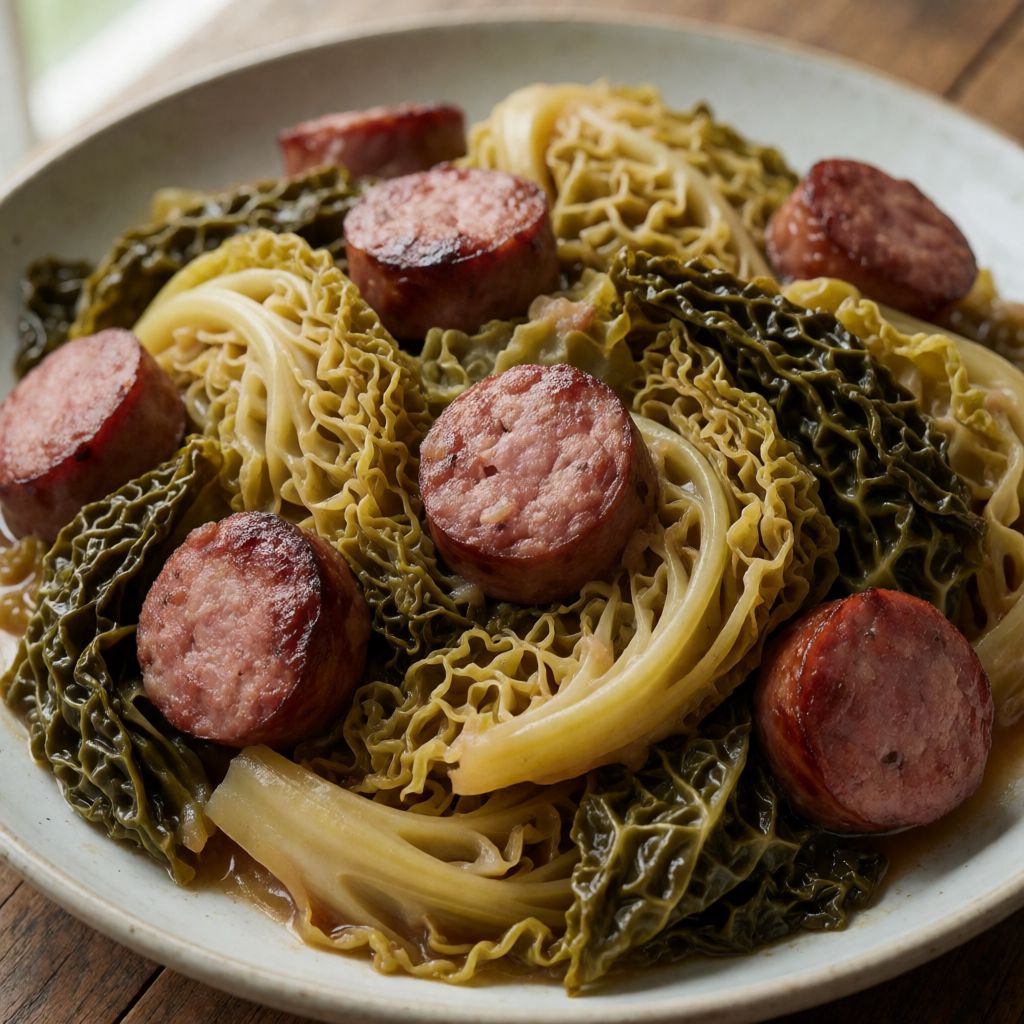
 AI photo
Braised Savoy Cabbage with Sausage
A simple braised savoy cabbage with sausage, cooked slowly until tender for a comforting meal.
Ingredients
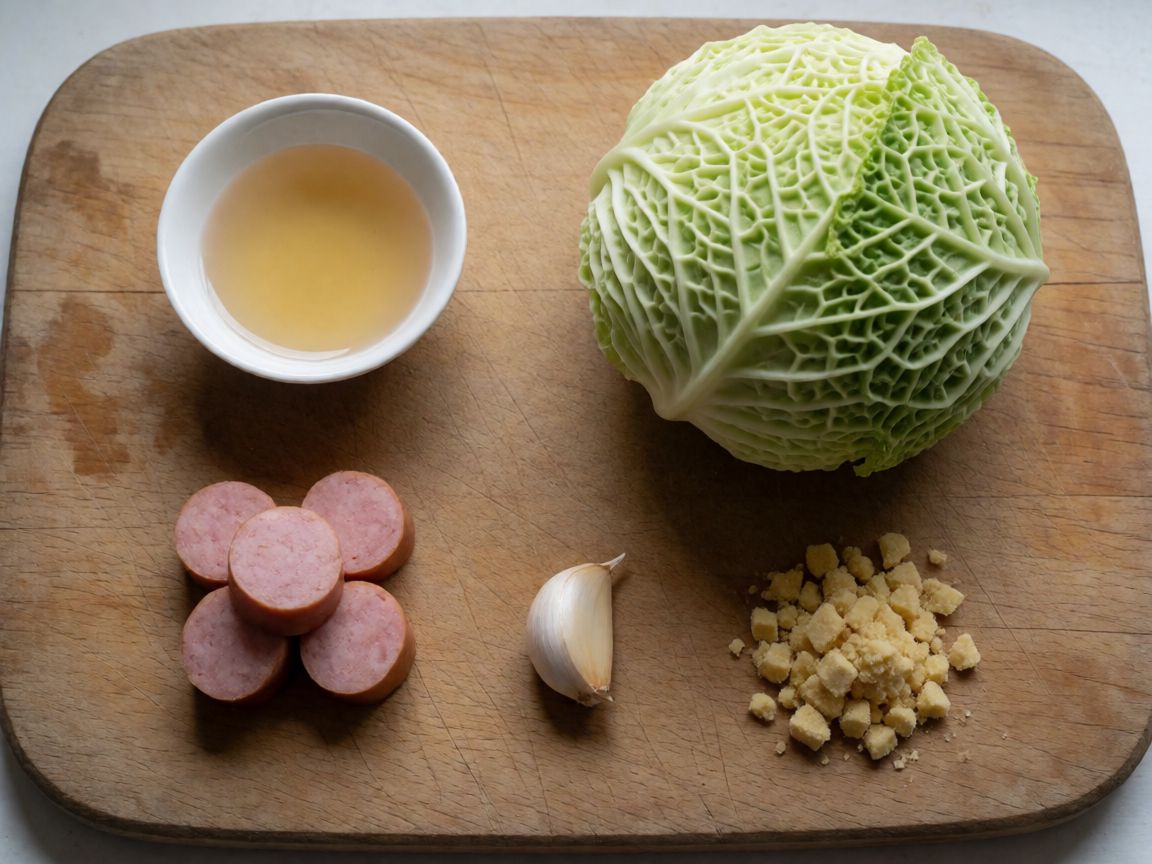
- 1 kg savoy cabbage
- 320 g sausage
- 1 clove garlic
- 2 tbsp white wine vinegar
- 1 tsp granulated stock
- olive oil to taste
- salt to taste
- black pepper to taste








Steps
Rinse each leaf of the savoy cabbage and remove the central core. Pat the leaves dry with paper towel and slice into thin strips.
Cut the sausage, skinned, into pieces about 5-6 cm long.
Heat the olive oil in a frying pan and fry the sausage on both sides until golden, until it reaches an internal temperature of 70°C.
Move the fried sausage to a plate; in the same pan, fry the crushed garlic clove.
Add the sliced cabbage and let it fry for a few minutes.
Cover with a lid and braise until the volume of the cabbage has reduced by half.
Season with a pinch of salt and black pepper, and cook for a further 20-25 minutes.
20 minMix 100 ml of water with a teaspoon of granulated stock, and add to the cabbage as needed.
Pour in the white wine vinegar and let it evaporate.
Add the fried sausage back in and cook for a further 5 minutes.
5 min
This is a pan dish pretending to be a braise, and that's not a criticism — it's just what a frying pan with a plate on top does instead of a proper lidded pot. Savoy cabbage, with its loose, blistered leaves and sweeter bite than the tight white ball, collapses down fast and takes on fat and smoke in a way that smooth cabbage won't. You fry the sausage first, hard, until it's properly coloured and cooked through — not browned for looks, cooked to 70°C at the core, because sausage meat is ground and packed loosely, and undercooked ground meat is where the trouble lives, not in a steak you can see is pink. You take it out. You don't want it stewing in liquid for twenty minutes; that just softens the skin you worked to colour and dries the inside.
What decides whether this works is not the cabbage, it's the fat it fries in. The sausage leaves behind rendered fat full of its own seasoning — that's what the cabbage fries in next, not fresh oil for its own sake. Skip that and you've got boiled cabbage with sausage dropped in at the end, which is a different, blander dish.
The garlic goes in before the cabbage, in the same fat, briefly — long enough to perfume the oil, not long enough to turn bitter. Garlic burns fast once it's past gold; that's the one moment in this recipe that punishes inattention.
Cabbage: savoy specifically, not a substitution point really, since the whole character of the dish — the slight sweetness, the way the ruffled leaf holds a bit of crunch even after braising — comes from this variety. If you only have a tight green or white cabbage, it'll work, but it braises down more watery and tastes blunter; cut it thinner to compensate, since it's denser than savoy leaf.
Sausage: 320g, skinned and cut into short lengths rather than left whole. Skinning it matters because a casing left on shrinks and toughens as it fries, and once it's cut into pieces there's no skin holding a shape worth keeping anyway. Use whatever sausage you'd put on a plate with mash — pork, a coarse Cumberland-style one with visible fat and seasoning works well, because that fat and seasoning is exactly what carries over into the cabbage. A bland, lean sausage gives you bland, lean cabbage.
Garlic: one clove, crushed, there to flavour the fat, not to be eaten as itself. If you haven't got a fresh clove, a pinch of garlic powder stirred into the fat does a passable job, though it won't give you that first sharp smell when it hits hot oil — that's part of what tells you the pan's ready for the cabbage.
White wine vinegar: two tablespoons, added near the end and cooked off, not stirred through raw. Its job is to cut the fat and the sweetness of the cabbage with a short sharp acidity, then it evaporates and leaves behind brightness without the raw vinegar bite. Any wine vinegar does this; cider vinegar is close enough if that's what's in the cupboard. Don't use balsamic — it's too sweet and dark, and it'll muddy rather than lift.
Granulated stock: a teaspoon in 100ml water, used "as needed" rather than all at once, because the cabbage releases its own liquid as it cooks and you're only topping up what's lost to steam, not drowning it. This is also the fix for the single biggest domestic-kitchen failure point here: a UK hob's "medium" burner runs hotter and less evenly than a gas ring in a professional kitchen, so a pan can run dry and catch at the bottom faster than the recipe timing suggests. Check the pan, not the clock, before adding more liquid.
Olive oil: "to taste" because its only job in step 3 is to stop the sausage sticking before it renders its own fat — after that, the sausage fat does the real work. Any neutral oil would do here too, since you're not after olive flavour, you're after a non-stick start.
On the plate-as-lid point, since this is a wide pan and not a kazan or a heavy casserole: a plate traps enough steam to braise but it's not airtight, so expect slightly longer than the 20–25 minutes stated if your pan is wide and shallow — surface area to depth ratio changes how fast that trapped steam condenses and drops back onto the cabbage. That's not a flaw in the method, it's just what a flat-bottomed frying pan does differently from a pot with a tight lid, and it's worth knowing rather than fighting.
Patience, finally, is the real ingredient in step 6 — letting the cabbage actually halve in volume before seasoning, rather than rushing to salt early. Salt pulls water out of vegetables; add it too soon and you're fighting the cabbage's own moisture instead of using it, and you end up with a wetter, longer braise than you need.