
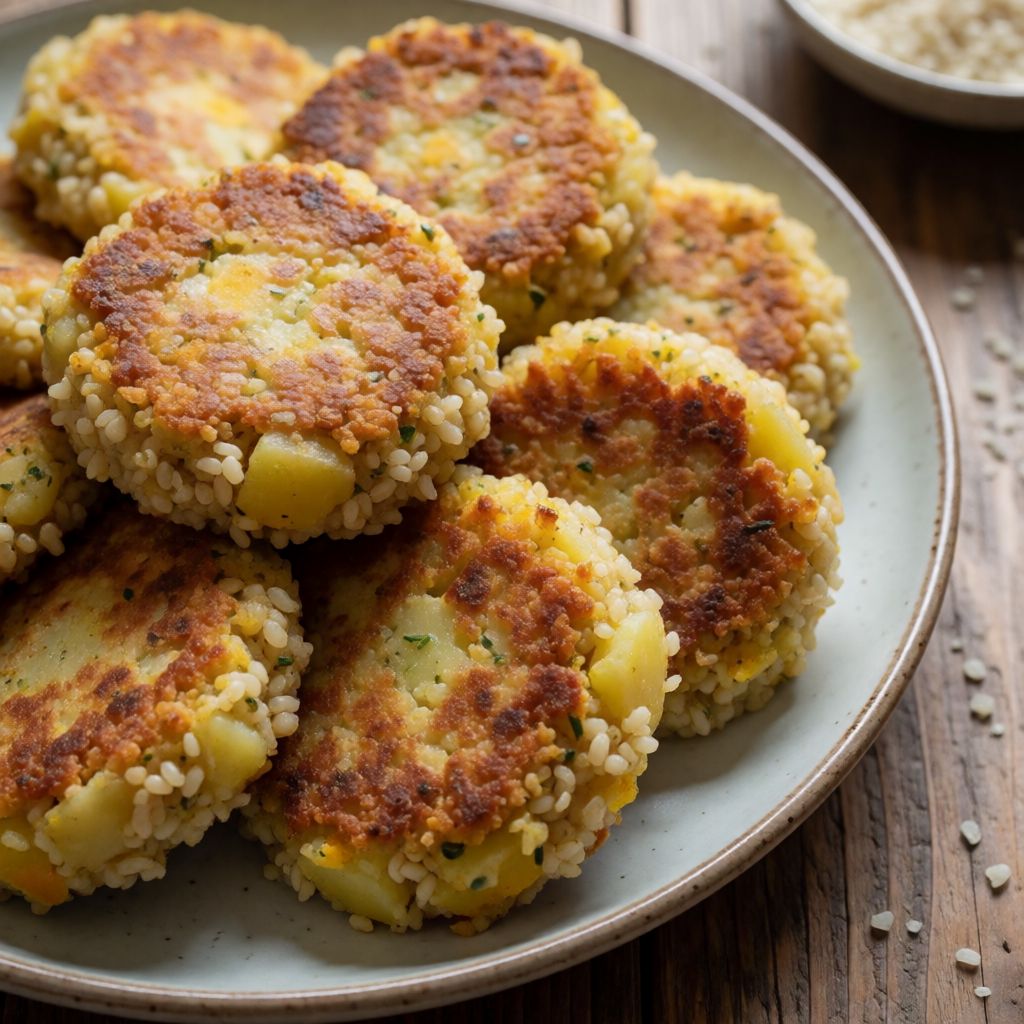
 AI photo
Bulgur Patties
A simple side dish of bulgur and potato patties, flavoured with cheese, turmeric and thyme.
Labels are worked out automatically from the ingredients and can be wrong. Check the packaging if it matters to you.
Ingredients







Steps
Bring salted water to the boil in a large saucepan, turn off the heat and add the bulgur.
Cover with a lid and leave the bulgur for 15–20 minutes to absorb all the water, then transfer to a bowl.
18 minWash and peel the potatoes, then boil them in a pan of water until soft.
Drain and mash the potatoes with a fork.
Add the potatoes to the bulgur, then stir in the Parmesan, turmeric, salt and dried thyme.
Mix everything by hand and shape into round patties.
Fry the patties in a pan with hot olive oil, or bake in the oven at 200°C for about 10 minutes.
10 minServe warm or at room temperature.
What was changed
The hard cheese has been changed to Parmesan for a closer match to the original Grana Padano.
This isn't a dumpling and it isn't a croquette — it's cooked grain and mashed potato glued into a disc and given a crust. The whole dish turns on one decision made early: do you boil the bulgur or steam it. Boil it in bubbling water and you get swollen, split grains with no bite — the patties fall apart in the pan because the starch that should hold them together has been cooked past the point of being useful glue. Pour boiling water over the bulgur, turn the heat off, cover, and leave it alone — the grain drinks what it needs and the surface starch stays just sticky enough for later.
What decides whether this works is moisture balance, not the clock. Bulgur that's absorbed properly looks dry and separate, no puddle at the bottom of the bowl. Potato mashed too wet, or mashed too hard, will turn your mix into something that sticks to your palms instead of holding a shape. You're aiming for a dough that keeps its form when you close your fist around it and doesn't weep.
The second decision is the crust — fry or bake. Nobody has a kazan in a London flat, so a wide, shallow pan with a thin film of hot oil does the job instead: browning by contact with hot metal, patty by patty. The oven at 200°C works differently — it's surrounding heat, not contact, so the crust comes slower and thinner, but it's the sensible choice if the oven's already on for a Sunday roast and you don't want a second pan going.
Bulgur is wheat that's already been parboiled, cracked and dried at the mill, long before it reaches your cupboard — that's the entire reason you don't cook it again on the stove, only rehydrate it. This is also why it became a kitchen staple across the Caucasus and the Middle East in the first place: it's already half-cooked, so it costs less fuel and less time to finish at home, which matters when you're feeding a family on a working day, not a feast day. Treat it like rice and boil it, and you undo that advantage — the groat breaks down and the patties lose the separate-grain structure that lets them hold together instead of going pasty. 250g is roughly a mug and a half dry — enough, with the potato, for four as a side, not a main.
Potato here is the binder, not the bulk. It's the starch in it, mashed and then cooling, that glues the bulgur together — the same mechanism that makes a good potato cake hold its shape, or makes yesterday's mash turn gluey if you beat it too hard. Mash with a fork, lightly — a blender or a heavy hand releases too much starch and the whole mix turns gummy instead of simply cohesive. 400g is about two to three medium potatoes; a floury variety like Maris Piper or King Edward breaks down properly, a waxy salad potato won't, it just sits there holding its shape and refusing to bind.
Parmesan does two jobs at once: it salts the inside and helps brown the outside, because its fat catches heat faster than the bulgur alone would. Any hard, dry, aged cheese that grates fine and doesn't go stringy when warm does the same work — mature Cheddar, Pecorino, a strong hard vegetarian cheese if you want to stay meat-free start to finish. A soft or young cheese won't do it; it adds moisture instead of drying and seasoning the mix, which is the opposite of what you need here.
Thyme and salt are seasoning, not structure, but taste before you shape — both bulgur and potato have been cooked in plain water, so the mix needs more salt than instinct suggests.
For the oil, use anything with no smell of its own if you'd rather not spend good olive oil on a shallow fry — a mild rapeseed or sunflower oil conducts heat to the crust just as well without arguing with the dish's own flavour. Keep anything peppery and green for drizzling over the finished patties, not for the pan.
And patience sits in this recipe twice. Once while the bulgur does nothing visible under its lid — don't lift it, don't stir it, that's the steam doing the work. And once more while the mash cools a little before you shape it: pack it while it's still hot off the stove and it won't hold in your hand, let alone survive the trip to a hot pan.