
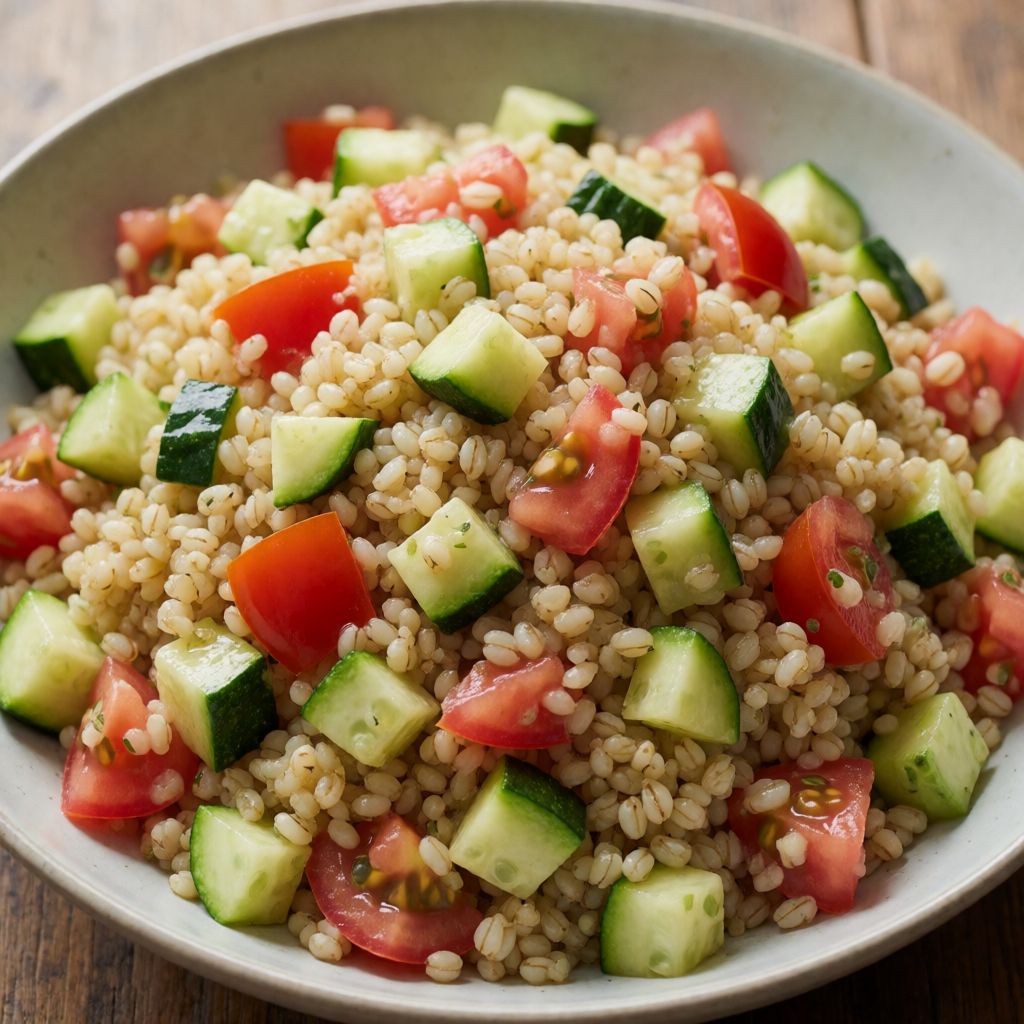
 AI photo
Cold Bulgur and Courgette Salad
A refreshing cold salad of bulgur, grilled courgette and tomatoes, dressed with lemon juice, olive oil and fresh mint.
Labels are worked out automatically from the ingredients and can be wrong. Check the packaging if it matters to you.
Ingredients
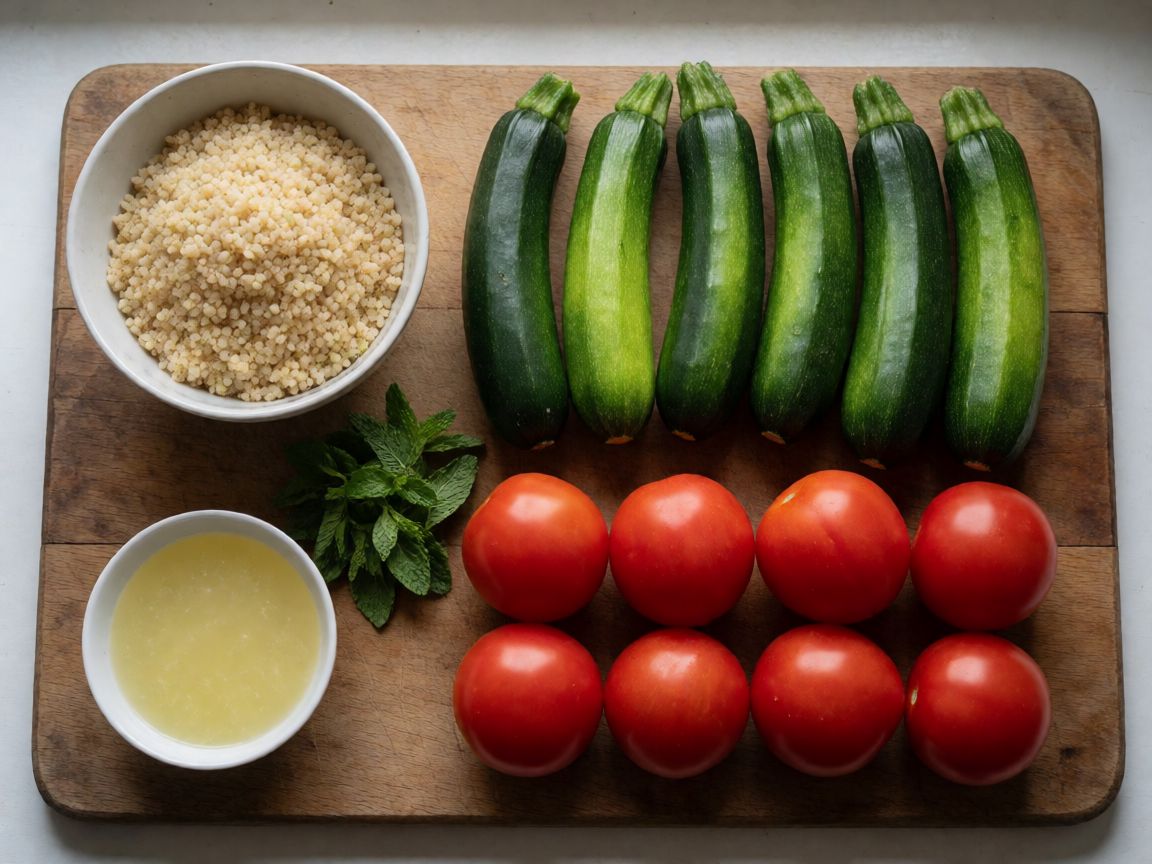
- 400 g Bulgur
- 6 pcs Courgette
- 8 pcs Tomato
- 2 pcs Lemon Juice
- Olive Oil
- Salt to taste
- Black Pepper to taste
- Mint fresh








Steps
Bring water (twice the volume of the bulgur) to the boil, add salt, stir in the bulgur and cook for about 20 minutes.
20 minWash the courgettes, pat them dry with kitchen paper, trim the ends and cut into thin slices.
Grill the courgette slices on a griddle pan, season with salt to taste and leave to cool.
Wash the tomatoes and slice them, draining off any excess liquid if needed.
Cut the cooled grilled courgettes into small pieces and add them to the bulgur.
Add the tomatoes to the salad and season with black pepper.
Dress the salad with olive oil and freshly squeezed lemon juice.
Let the salad cool at room temperature, then refrigerate for a few hours.
Garnish with fresh mint leaves and serve.
This is a dish built on contrast of temperature history: everything in it was hot once, and now it's cold, and that cooling is not a detail, it's the method. Bulgur is the body, courgette brings the only real "cooking" flavour in the bowl — char, not boil — tomato brings acid and water, lemon and oil tie it together, mint lifts it at the very end so it doesn't taste tired. What decides whether this works: does the bulgur stay as separate grains or collapse into porridge, and does the courgette actually brown or does it just go limp and grey.
Some say bulgur and couscous are the same thing, swap one for the other and nobody will notice. No — because couscous is rolled semolina, raw starch that needs steam to cook through, while bulgur has already been parboiled and dried at the mill. It is, in effect, pre-cooked. What you do at home with boiling water isn't cooking it from scratch, it's rehydrating something that was cooked once already and then put to sleep. That's why the ratio of water to grain matters more than the clock: double the volume, no more, because the grain will drink exactly that much and stop. Too much water and you've made wheat soup; too little and you've got crunchy centres that never woke up.
Bulgur: buy the coarse grade if you can find it — often marked something like "coarse" or a higher number on the packet — not the fine one used for kibbeh and stuffing, because fine bulgur swells fast and turns to paste exactly where you need separate grains holding dressing. If your shop only stocks fine, it will still work, just watch the water ratio closely and don't leave it bathing a second longer than it takes to absorb. No bulgur at all, and you want the same mechanism — something that drinks dressing rather than needing a sauce poured over it — reach for a coarse couscous substitute is the wrong direction; go for cracked freekeh instead, same parboiled-and-dried logic, slightly smokier.
Courgette: pick the smaller, firmer ones — big courgettes are mostly water cavity and seed, and that's exactly the water that will fight you on the griddle. No griddle pan in the house, which is common enough in a UK kitchen where the ridged pan sits unused behind the saucepans — use the grill (the overhead one, what Americans call a broiler) on its highest setting, rack close to the element, and watch the surface rather than the clock; you want the same scorch-stripe logic, just from above instead of below. Don't salt the slices before grilling — salt pulls water out in advance, and you'll be steaming again, the very fault the hot dry pan was meant to prevent. Salt after, once they've got colour and have gone quiet on the heat.
Tomato: ripe, so there's actual sugar to meet the acid of the lemon, not watery supermarket tomatoes that contribute volume and nothing else. The instruction to drain off excess liquid is not fussiness — tomato flesh around the seeds is basically a sachet of water, and if that water goes into the bowl unchecked, a few hours in the fridge turns your dressing into diluted tomato juice and the bulgur back towards mush, undoing everything the first step protected.
Lemon juice and olive oil: lemon because its acidity is clean and doesn't carry its own flavour the way vinegar sometimes does — a wine vinegar would do the job of brightening, but you'd taste the vinegar, not the dish. Olive oil here for its slight bitterness, which plays well against the sweetness of grilled courgette; if you don't like olive oil or don't have it, any oil with no smell of its own — a light rapeseed, say — will carry the lemon fine, you'll just lose that small bitter edge, not the structure of the salad.
Mint: added at the very end, not stirred through early, because its fragrance is volatile — crush it into a warm or even room-temperature mix and most of what makes it mint has gone by the time you eat. Tear it, don't chop it with a knife, since a bruised edge from a dull blade browns and turns bitter faster than a torn one.
As for timing — twenty minutes for the bulgur and a griddle session for the courgette are lower bounds, not a stopwatch to trust blindly. The bulgur is done when the water's gone and the grain gives slightly under a tooth, no raw crunch at the core; the courgette is done when the stripes have gone past gold toward brown and the slice has gone limp enough to fold without snapping. Four people, this feeds, generously, as a side to something grilled off the same hot pan while it's already out and hot.