
 AI photo
Burger Buns
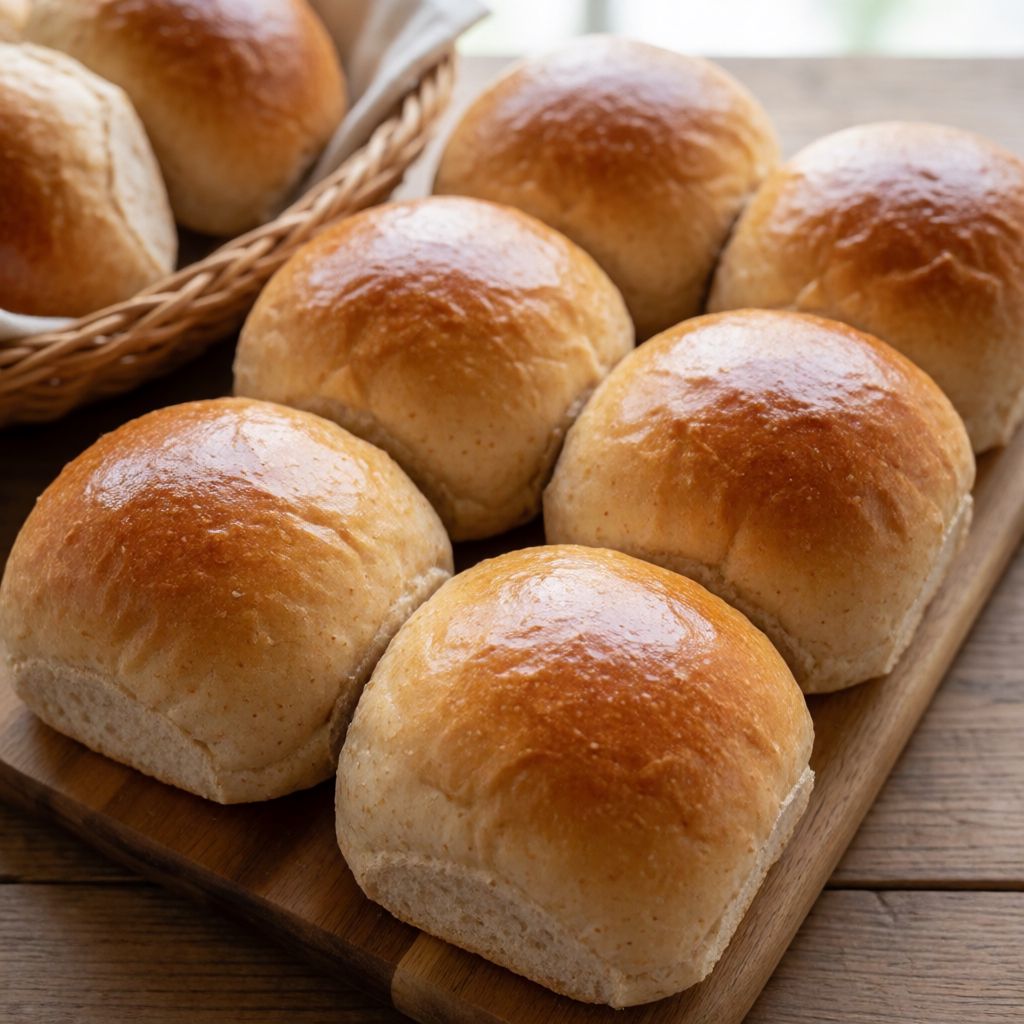
Soft, golden homemade burger buns topped with sesame seeds, ready to fill with your favourite burger.
Labels are worked out automatically from the ingredients and can be wrong. Check the packaging if it matters to you.
Ingredients
- 15 g Yeast
- 100 ml Milk
- 200 ml Water
- 2 tbsp Olive oil
- 1 pcs Eggs
- 100 g Wholemeal flour
- 1 tsp Salt
- 1 tbsp Sugar
- 375 g Plain flour
- 1 pcs Eggs for brushing
- 1 tsp Sesame seeds










Steps
Stir the yeast into the room-temperature water in a bowl, then add the milk, oil, egg, salt, sugar and wholemeal flour.
Mix the dough well with a mixer until it becomes soft, elastic and springy.
Add the plain flour and knead the dough on medium speed for eight to ten minutes.
10 minShape the dough into a ball and place it in a covered bowl.
Leave the dough to rise on the kitchen counter for 30 minutes.
30 minPut the dough in the fridge until the next day.
Turn the dough out onto a floured surface, cut into 8 portions and shape into round buns.
Leave the buns to rise, covered, on a baking tray lined with parchment paper for 30 minutes.
30 minGently brush the buns with beaten egg and sprinkle with sesame seeds.
Bake the buns in a preheated oven at 180°C fan for 17-20 minutes until golden.
20 minLet the buns cool on a wire rack until completely cold.
10 min
A burger bun is not bread that happens to be round. Bread wants an open, uneven crumb — big holes, chewy bite, crust that fights back. A bun wants the opposite: tight, even, soft enough that it compresses under your thumb and springs back, strong enough not to go soggy the second a beef patty's juice hits it. Everything in this recipe is built to get that compromise — enriched dough, long cold rest, a late shape.
What decides whether it works is the enrichment and the fridge. Milk, egg and oil aren't flavour extras here — they're what keeps the crumb soft after baking. Flour and water alone give you a crust by the next morning; fat coats the gluten strands and slows the staling, egg adds structure and that faint yellow crumb colour you expect from a "proper" bun. Skip the enrichment and you've baked a small boule, not a burger bun — fine bread, wrong job.
Some say you can skip the overnight fridge rest and just prove it twice as long on the counter. No — because the point of the cold rest isn't just time, it's temperature. A slow, cold rise lets the yeast work gently and lets the gluten relax and strengthen without the dough getting warm, gassy and slack. Rush it warm and fast, and you get bigger, more irregular holes — fine for a baguette, wrong texture for something that needs to hold a burger together without tearing.
Yeast — 15g is a lot for 475g of flour, almost a quarter of a standard sachet's worth per 100g flour. That's deliberate: this dough is going into the fridge overnight, where cold slows yeast activity right down. A smaller amount would barely wake up again when it comes out. If you only have fast-action dried yeast, use about 7g — it's more concentrated — and dissolve it in the water exactly the same way, so it hydrates before it meets flour.
Milk and water together, not all water — milk's proteins and sugars brown the crust faster and keep more moisture in the crumb than water alone. If you're out of milk, water with an extra teaspoon of sugar does a reasonable job, though the crumb will be a touch drier.
Olive oil at two tablespoons is the fat that coats the gluten and slows staling — any oil with no smell of its own does the same job; a fruity extra-virgin oil will fight with the egg wash and taste faintly wrong in a bun that's meant to taste of nothing but itself. Sunflower or a flavourless rapeseed oil is the honest swap, and melted butter works too, cooled first so it doesn't scald the yeast.
The wholemeal flour (100g) against the plain (375g) isn't nutrition dressing — it's there for a slightly nuttier flavour and a touch more structure, since wholemeal's bran acts almost like scaffolding. Go all plain flour and the bun will be a shade blander and a shade softer; go higher than this ratio of wholemeal and the bun gets heavy, because bran cuts gluten strands short. Strong bread flour, if that's what's in your cupboard, works fine for the plain-flour portion — it just needs slightly more liquid, a tablespoon at a time, since it drinks more.
The egg in the dough is structure and colour; the second egg, for brushing, is shine and the glue that holds the sesame seeds on. Brush gently — pressing hard deflates the proofed dough, which is the real cause of a bun that bakes flat and pale on one side. No egg to spare for washing? Milk alone gives a duller, softer-gloss finish — still fine, just not as glossy on a Sunday-roast burger night.
On your hob and oven: 180°C fan is a true setting on most UK fan ovens, so trust the dial rather than guessing by eye — these are small, enriched buns, and they go from golden to over-dark quickly because of all that milk and egg sugar caramelising. Check at 17 minutes, not 20, the first time you make them in your own oven, since every oven runs its own few degrees hot or cool.
And patience is the real ingredient the ingredient list doesn't mention. The overnight fridge rest, the two separate proofs — none of that is optional padding, it's where the texture actually gets made. Rush any of it and you've made a soft white roll, which isn't a bad thing, just not this thing.