
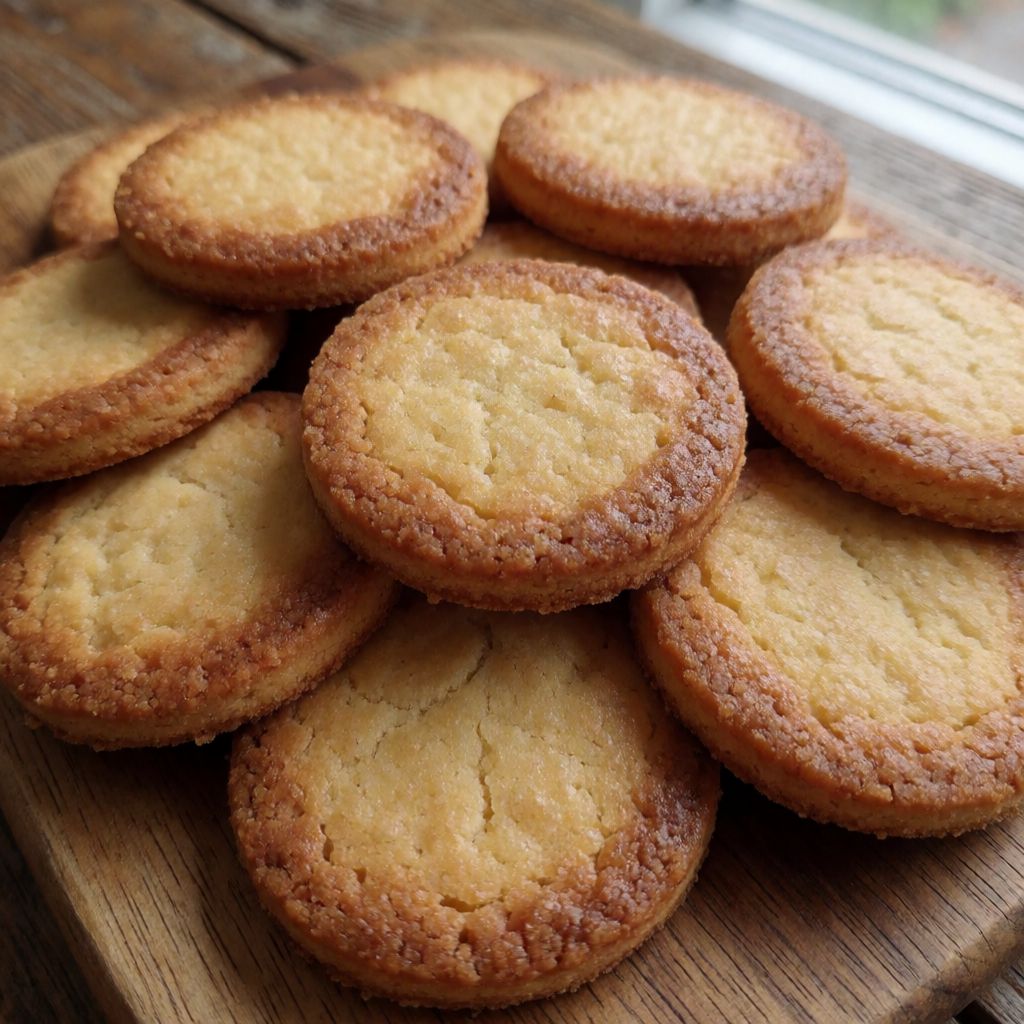
 AI photo
Caramel Biscuits
Crisp, golden caramel biscuits with a lovely toffee flavour, inspired by classic Swedish treats.
Labels are worked out automatically from the ingredients and can be wrong. Check the packaging if it matters to you.
Ingredients
- 200 g Butter
- 150 g Sugar
- 80 g Golden syrup
- 300 g Plain flour
- 1½ tsp Baking powder
- 1 tsp Vanilla powder
- 1 pinch Salt a pinch







Steps
Put the butter, sugar and golden syrup in a bowl and beat until light and fluffy.
In a separate bowl, mix the flour, baking powder, vanilla powder and salt, then fold into the batter. Do not overwork the dough — just bring it together.
Roll the dough between two sheets of baking parchment to a thickness of about 2mm. Remove the top sheet and transfer the dough onto a baking tray lined with parchment.
Cut the dough into pieces of the desired size — the classic Swedish biscuits are cut into long strips, but you can also cut diamonds, as here. Transfer the biscuits to the baking tray along with the parchment.
Bake in a preheated oven at 180°C (fan) for 9–12 minutes.
11 minRemove the tray from the oven, then transfer the biscuits to a wire rack to cool. Once cooled, they will become crisp.
These are the thin, cuttable caramel biscuits the Swedes call kolasnittar — the ones baked in a long slab and sliced into strips while still warm, though diamonds work just as well if you don't own a ruler and don't care to. What makes them caramel rather than plain shortbread is golden syrup standing in for part of the sugar, and that single swap decides almost everything else about how the dough behaves and how the finished biscuit bites.
Golden syrup is sugar that's already been partly broken down — inverted — before it ever reaches your oven. Inverted sugar holds onto moisture and resists turning back into hard crystals, which is why this dough feels soft and slightly sticky under your palms instead of sandy like a plain butter biscuit. It's also why these caramelise at the edges rather than just browning: syrup colours and deepens in a way granulated sugar alone won't.
The 2mm roll isn't a style choice, it's a heat-management one. At that thickness the dough browns at the rim at almost the same moment the centre finishes drying out, so you get an even, thin snap edge to edge. Roll it thicker and you're fighting physics — sugar-heavy dough is a poor conductor of heat, so the middle stays gummy long after the rim has gone past gold into bitter.
Butter is doing two jobs: flavour, and trapping air when you beat it with the sugar. Use it properly soft — a thumb should sink in without fighting it — because cold butter won't take air, and a dough with no air beaten into it comes out dense rather than short. Unsalted lets you control the salt yourself; if you only have salted, just drop the pinch at the end. Margarine will hold the structure in a pinch, but it carries a flavour of its own that butter doesn't, and here, where the taste is meant to be butter-and-caramel and nothing else, you'll notice.
Sugar's job in the creaming stage is mechanical as much as sweet — its crystal edges cut tiny air pockets into the fat as you beat. Caster sugar does this more evenly than coarse granulated simply because the crystals are smaller and there are more of them; if all you have is granulated, it still works, you just beat a little longer.
Golden syrup is the one ingredient here with a history worth knowing, because it explains why it's cheap and why bakers reach for it. It's a leftover of sugar refining — the sticky, pale fraction that didn't crystallise into white sugar — and in both Britain and Scandinavia it became the baker's sugar once refined white sugar got expensive to buy in quantity. That's the whole story; no magic, just thrift. If you're out of it, the criterion for a stand-in is simple: any syrup that's mostly invert sugar, pale, and carries no flavour of its own beyond sweet-and-caramel — light corn syrup fits. Honey doesn't: it brings its own perfume and a touch of acidity that will argue with the vanilla. Black treacle is the same family but far too strong and bitter — it'll turn these into something else entirely.
Flour here is a binder, not the main event, which is why step 2 tells you not to overwork it. Gluten needs working to develop, and developed gluten means chew — fine in bread, wrong in a biscuit that's supposed to snap clean. Fold it in just until it disappears into the batter and stop.
Baking powder at this quantity isn't there to make these rise — a biscuit this thin has nowhere to go. It's there to stop the syrup setting into something closer to a boiled sweet: a small lift of gas keeps the crumb slightly open so it stays a biscuit, not a toffee disc. Vanilla powder is chosen over extract for the same reason you'd choose dry over wet anywhere in this dough — it adds aroma without adding liquid that the syrup balance doesn't need; a scraped vanilla pod works the same way, extract is fine too if that's what's in the cupboard. And the pinch of salt earns its place the way it does in any caramel — it sharpens the sweetness rather than fighting it, the same trick as salted caramel sauce, just without the theatre.
On thickness and the tray: roll between two sheets of parchment not for neatness but because it's the only reliable way to get an even 2mm without working extra flour into the dough, which would dry it out and throw off the syrup's ratio. In a British fan oven at 180°C the air moves evenly enough that you shouldn't need to rotate the tray; in an older conventional oven without a fan, the top runs hotter than the bottom, so check them a minute or two early and don't be surprised if you need to turn the tray halfway through. Seventy-five biscuits from this one batch is a tin for sharing, not a single pot of tea's worth — think Sunday-afternoon-after-the-roast, with the milk already in the pot, and a tin that'll keep a good week once they're properly cooled, because there's nothing in them to go stale except patience, and that you've already spent.