
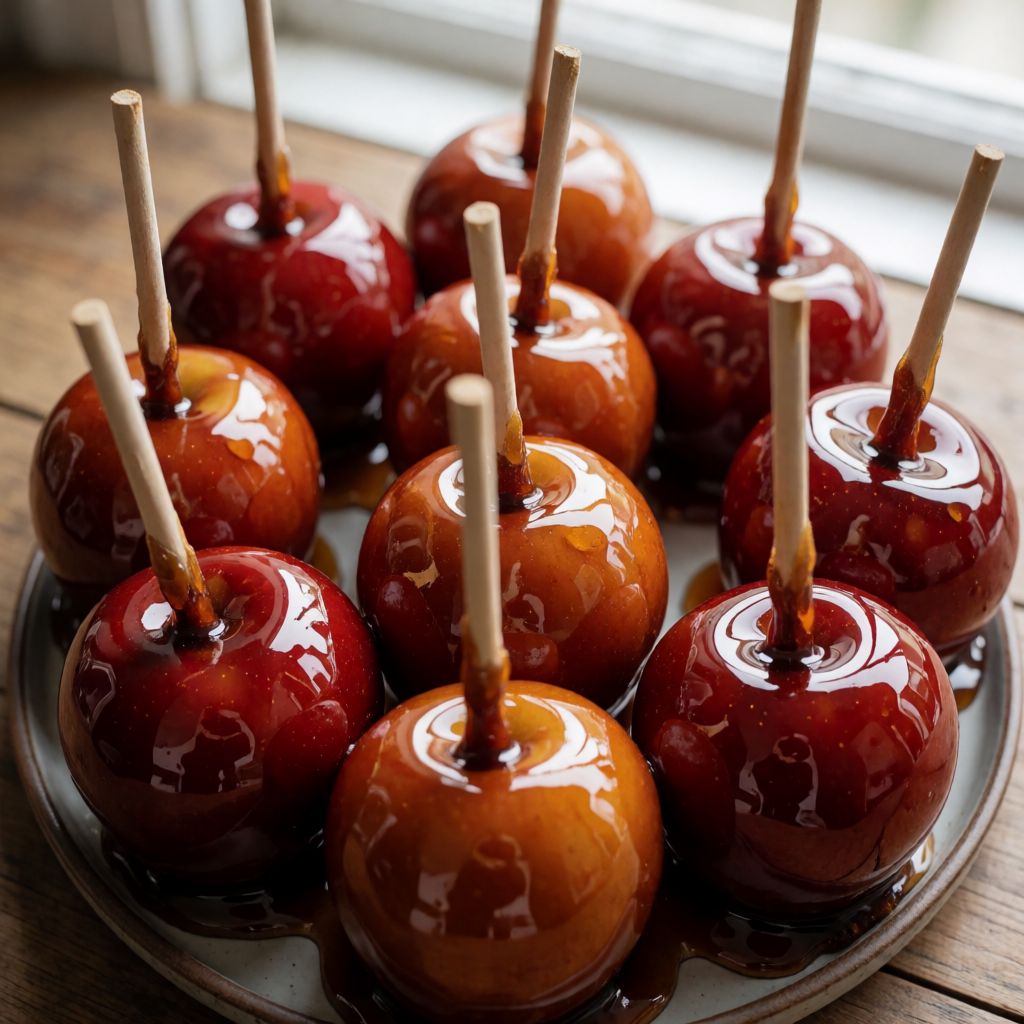
 AI photo
Toffee Apples
A classic treat of apples dipped in a glossy toffee shell, perfect for an autumn afternoon.
Labels are worked out automatically from the ingredients and can be wrong. Check the packaging if it matters to you.
Ingredients
- 250 g Caster sugar
- 100 ml Water
- 1 tsp Apple cider vinegar
- 2 tbsp Glucose syrup
- 1 pinch Red food colouring paste optional, for colour
- 4 pcs Apples red
- 4 pcs Wooden sticks for skewering the apples
- 35 g Desiccated coconut





Steps
In a saucepan, bring the sugar, water, apple cider vinegar and glucose syrup to the boil.
Cook for a few minutes, stirring. Check the syrup is ready by lifting a little on a spoon.
3 minRemove the syrup from the heat and stir well. If you like, add a pinch of red food colouring.
Push a wooden stick into each apple and dip into the syrup. Roll in the desiccated coconut to coat.
Leave the toffee apples to cool for a few minutes before serving.
5 min
What was changed
Wooden sticks was used to hold the apples, and Desiccated coconut was used for the coating, as coconut flour is a baking ingredient, not a coating.
A toffee apple is a sugar experiment with a piece of fruit trapped inside it. You're not cooking the apple at all — it stays raw, crisp, cold at the core while you build a thin sheet of sugar glass around it. That's the whole trick: get sugar syrup concentrated enough that when it cools it sets hard and clear, like a boiled sweet, rather than staying soft and sticky or turning back into sand.
What decides whether it works has nothing to do with minutes. It's whether the syrup gets past the point where sugar and water are just a thick liquid, into the point where cooling makes it snap rather than bend. You check this the old way — not a thermometer, a spoon. Lift some out, let it fall back or drop a little into cold water: if it goes soft and stretchy, it's not there yet; if it hardens at once and cracks when you bend it, it's ready. Pulling it off the heat a minute early gives you toffee that never sets, stays tacky on the apple for days. A minute too long and the sugar starts to colour and taste of bitterness before you even notice — a domestic ring doesn't give you the gentle, even heat of a fairground copper, so don't crank it to rush things; it'll catch at the edges of the pan while the middle's still thin syrup.
Caster sugar is the base for a reason beyond habit: it's fine enough to dissolve fully before the syrup gets hot, and an undissolved grain left on a spoon or the side of the pan is exactly what starts the whole batch crystallising into grit instead of glass. Granulated will work, it just needs a slower hand at the dissolving stage — give it the time, don't rush to a boil while sugar is still sitting on the bottom.
The vinegar and the glucose syrup are doing the same job from two directions: stopping that gritty recrystallisation. Pure sugar syrup, boiled on its own, wants to go back to being sugar crystals the moment it cools — that's its natural, lower-energy state. A little acid (the vinegar) breaks some of the sucrose down into simpler sugars that can't line up into a crystal lattice as neatly; glucose syrup brings in sugars that are already in that non-crystallising form. Together they're the difference between a shell that shatters clean and clear, and one that looks frosted and tastes of sand. If you've got no cider vinegar, any mild acid does the same job — lemon juice, a pinch of cream of tartar. No glucose syrup in the cupboard, golden syrup or light corn syrup covers the same role: anything that's mostly non-sucrose sugar and resists setting back into crystal.
Red food colouring is pure costume — it's there because fairground "candy apples" in America went red and the British toffee-apple trade borrowed the look for Bonfire Night stalls, where this thing started as a cheap, sticky, easy-to-eat-with-no-plate treat for a crowd standing around a fire in the cold. Skip it and you get an amber, honey-coloured shell instead, which tells you more honestly how far the sugar's actually been cooked.
The apple itself: you want something firm enough that the bite through sugar glass meets resistance, not mush, and tart enough to cut the sweetness rather than add to it — a crisp eating apple does the job; red is for looks, not mechanism, so any firm variety you trust will work once it's washed free of wax and dried properly, because a wet or waxy skin is the single most common reason toffee slides off rather than sets on.
Desiccated coconut earns its place by economics as much as taste — it was always the cheaper option next to chopped nuts, fine and dry enough to roll on in a single pass while the toffee is still wet, which is the only window it'll stick in. Wait even a minute after dipping and the surface skins over; the coconut just falls off instead of gripping. Any dry, fine, neutral coating does the same job if you've none — crushed digestive biscuit, finely chopped toasted nuts.
For four apples, stand them upright and separate on a sheet of greaseproof paper rather than touching each other or the tray itself — pooled toffee welds apples together or glues them flat-sided to whatever they're resting on, and you only find that out once it's set. And give the cooling its own time: a sugar glass needs to come down through warm into properly set before it holds its shape under a bite — patience here isn't optional, it's the last ingredient in the list, just not written down.