
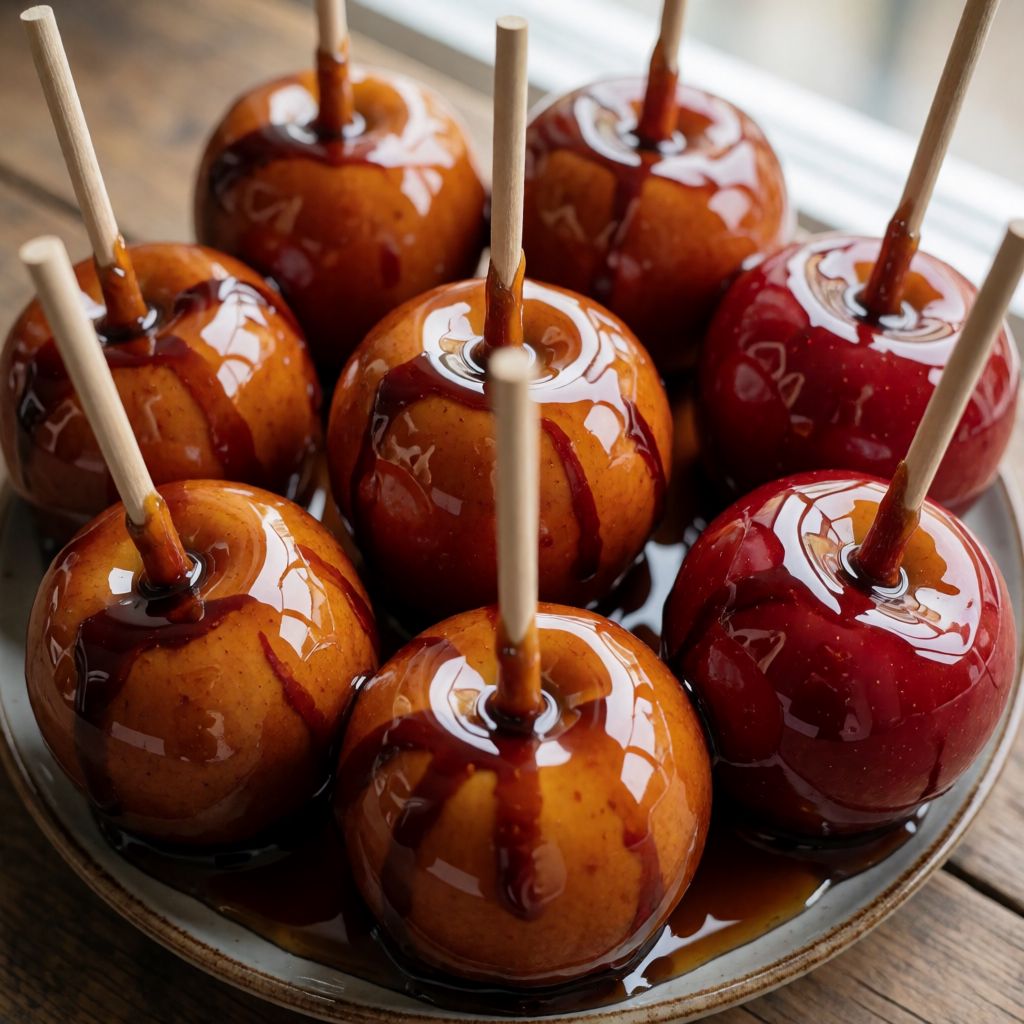
 AI photo
Toffee Apples
A festive treat of crisp apples dipped in glossy red toffee and mounted on sticks.
Labels are worked out automatically from the ingredients and can be wrong. Check the packaging if it matters to you.
Ingredients




Steps
Combine the water, sugar and honey in a saucepan and place over heat.
5 minThoroughly wash the apples under running water.
2 minDry the apples with a kitchen towel and lightly rub the skin.
2 minRemove the stalk from each apple and insert a wooden stick in its place.
1 minAs soon as the syrup comes to the boil, add the red food colouring.
1 minUsing a kitchen thermometer, check that the syrup has reached 150°C, then dip the apples in one by one.
10 minTwist each apple to coat it evenly in the toffee, then set it on a wire rack.
1 minRepeat with the remaining apples.
5 minArrange the apples on a tray and leave to cool completely at room temperature.
30 min
This is sugar doing a magic trick: turning liquid into glass, right on the skin of an apple. The whole dish succeeds or fails on one number — 150°C — and on whether your apples are bone dry before they go anywhere near the pot.
A toffee apple is not really about apples. It's about sugar syrup pushed past the soft, sticky, gooey stages into hard crack — the point where nearly all the water has boiled off and what's left is so concentrated it can only do one thing on cooling: set as a thin, brittle glass. Below that point you get chewy toffee, which slides off and pools at the bottom. Push it past 160-odd and the sugar starts to scorch and turns bitter. 150°C sits in the narrow window where the coating shatters cleanly under your teeth instead of gumming up your fillings.
Some say you need a special "toffee thermometer" and without one you're lost — no, because sugar workers did this for centuries with nothing but a bowl of cold water. Drop a bead of syrup in; if it hardens into a thread that snaps clean rather than bends, you're at hard crack. A thermometer is just a shortcut that saves you fishing hot syrup out of water with your fingers, which is its own kind of lesson in patience.
The sugar itself is the structure — 260 g for six apples is enough to give each one a shell with some thickness, not just a glaze. Table sugar (sucrose) is what you want; it's cheap, neutral, and crystallises predictably, which matters because the honey and water are there specifically to stop it crystallising wrong.
Honey is doing chemistry, not flavour. It's mostly fructose and glucose — what's called invert sugar — and a small amount of it breaks up the orderly rows that sucrose molecules want to form as they cool. Without something like it, syrup can seize into a grainy, sandy mass the moment a stray sugar crystal (off the side of the pan, off a wet spoon) drops back in and starts a chain reaction. A tablespoon of honey, or the liquid glucose the recipe itself allows, is cheap insurance against that. Golden syrup, which most UK kitchens already have in the cupboard for puddings, does the same job — it's the same family of invert sugar, just made industrially instead of by bees.
Water is only there to dissolve the sugar in the first place and then it has to leave entirely — 150 ml boils down hard before you hit 150°C. This is also why you don't stir once it's boiling: stirring splashes syrup up the cool sides of the pan, it crystallises there, and if a crystal falls back in, the whole pot can seize solid in seconds. Swirl the pan if you must move the syrup around; don't put a spoon in it.
The apples: red, firm ones are specified for a reason beyond colour. A tart, dense variety — something closer to a Granny Smith than a soft Gala — gives you acidity to cut against a very sweet, very hard shell, and firmness that holds up under hot syrup instead of starting to cook and go mealy. A soft apple under 150°C syrup for even a few seconds can start to soften right under the coating, and then you've got a crisp shell over mush, which is unpleasant in a way that's hard to disguise.
The stick isn't decoration, it's structural — it has to bear the weight of a whole apple plus a shell of hardened sugar while you twist it in the pan and then while it sets. Any sturdy skewer that won't splinter or burn through does the job; this is one place where a kebab skewer from the cupboard is a perfectly honest substitute for a proper confectioner's stick.
The red colouring is the one ingredient with no mechanism at all — it changes nothing about how the sugar behaves. It's there because the deep amber of plain caramelised sugar doesn't look festive enough, and toffee apples in Britain are bound up with bonfire night and fairgrounds, where a bright, almost lacquered red is part of the appeal, not the chemistry. Leave it out and you get an apple in dark gold glass instead of red — exactly as crisp, just less theatrical.
Last point, and it's the one people rush: the thirty minutes of cooling at the end isn't dead time, it's when the glass actually sets. Move the apples too soon, stack them, or put them in a fridge to speed things up, and you either crack the shell or get condensation weeping under it, which turns crisp into sticky. Patience here isn't optional — it's the step that finishes the dish.