
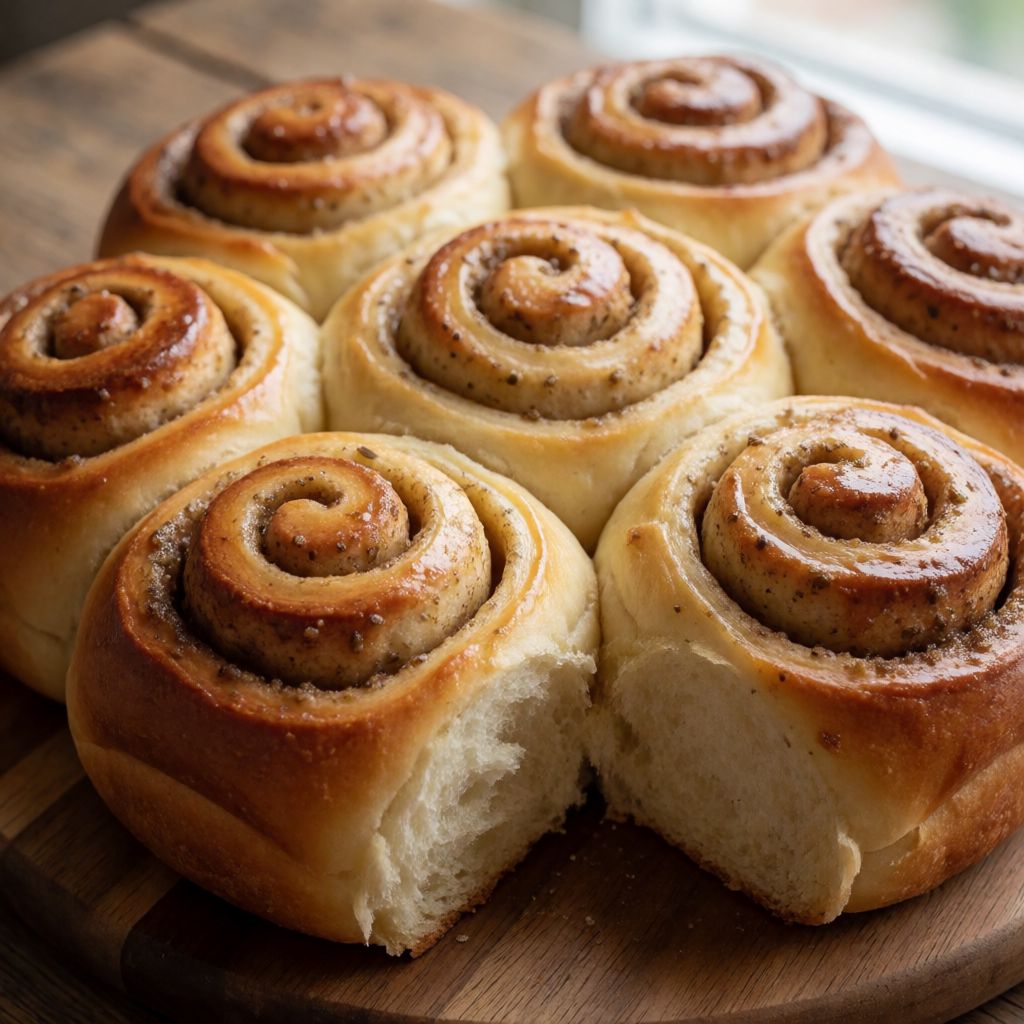
 AI photo
Warm Cardamom Buns
Soft, fragrant cardamom buns, perfect warm with tea.
Labels are worked out automatically from the ingredients and can be wrong. Check the packaging if it matters to you.
Ingredients







Steps
Toast the cardamom in a dry frying pan over medium heat until lightly fragrant, then turn off the heat.
Stir the yeast into the milk in a bowl, then add the eggs, sugar, cardamom, salt and flour.
Knead the dough well in a mixer for 2–3 minutes.
3 minAdd the cold diced butter and knead in the mixer for a further 10 minutes on low-medium speed.
10 minShape the dough into a ball, place in a clean bowl and leave to rise for 2 hours on the kitchen counter, covered with a clean tea towel.
120 minTurn the dough out onto a floured surface, divide it and shape into round buns.
Place them close together, about 1 cm apart, on a small baking tray lined with baking parchment.
Cover with a clean tea towel and leave to rise for a further 2 hours in a warm spot in the kitchen.
120 minBake the buns in a preheated oven at 175°C (fan) for about 20 minutes, until golden brown and fully cooked through.
20 minLet the buns cool slightly on a wire rack before serving.
These are soft, pillowy buns built on two things most people rush: the cardamom and the butter. You toast whole cardamom in a dry pan for ten seconds of heat, not to cook it but to wake up the oils sitting in the seed. Ground cardamom from a jar lost that smell months ago sitting on a shelf — toasting a bought ground spice does very little, so if you can, crack open pods and grind the seeds yourself, then toast those. The whole method depends on this smell being present, not theoretical.
What decides whether these work is temperature discipline with the butter, not the yeast. You cream nothing — the butter goes in cold, cubed, after the main dough is already formed. Some say soft butter mixes in faster — no, because warm butter melts into the gluten strands before they've had a chance to set, and you end up with a bread that's dense and greasy rather than one with that laminated, pulled-apart softness. Cold butter smears into thin sheets as the mixer works it, and those sheets are what you taste as tenderness later, not fat sitting heavy in the crumb.
Yeast first: 20g is fresh yeast, not the small sachets of fast-action dried stuff sold in UK supermarkets. If fresh yeast isn't to hand, use about 7g fast-action dried yeast instead — roughly a third the weight, because dried yeast is more concentrated. Stir it straight into room-temperature milk, not hot milk: heat above body temperature starts killing the yeast cells before they've done any work, which is the real reason recipes keep saying "room temperature" rather than it being fussiness.
The milk itself just needs to be unskimmed enough to carry some fat for softness — whole milk is right, skimmed will give a leaner, slightly tougher crumb. Eggs bind and add richness; at room temperature they blend into the dough faster than fridge-cold eggs, which can seize the butter later into little hard lumps instead of sheets.
Sugar here (just a tablespoon) is not for sweetness, it's food for the yeast in the early stage before the gluten network is strong enough to trap its gas efficiently on its own. Don't be tempted to add more thinking it'll make them "bakery-sweet" — that's not what finishes these buns; the glaze or a dusting of sugar after baking does that job if you want it.
Flour: plain flour, not strong bread flour, and that's deliberate — too much gluten-forming protein would fight against the tenderness the cold butter is trying to build. If you only have strong flour in the cupboard, cut it with a bit of cornflour or cake flour to soften it, roughly one part cake flour to four parts strong flour.
The butter is the one ingredient worth buying well for: use a butter with no odd flavour of its own, salted or unsalted doesn't matter much since there's already measured salt in the dough, but it must be properly cold and firm, straight from the fridge, cubed just before it goes in. Any substitute — margarine, a dairy-free spread — needs to hold its shape cold the same way; most spreads are softer at fridge temperature and will behave like warm butter, undermining the lamination.
The final egg wash is just for colour and shine; it has no structural job, so if you're avoiding egg, a brush of milk will still give you a matte gold rather than the deep shine, but the bun underneath won't know the difference. Bake until they're the colour of strong tea with milk — the 20 minutes at 175°C fan is the lower bound, not a guarantee; ovens lie, so trust the colour and a hollow-sounding tap on the base over the clock.