
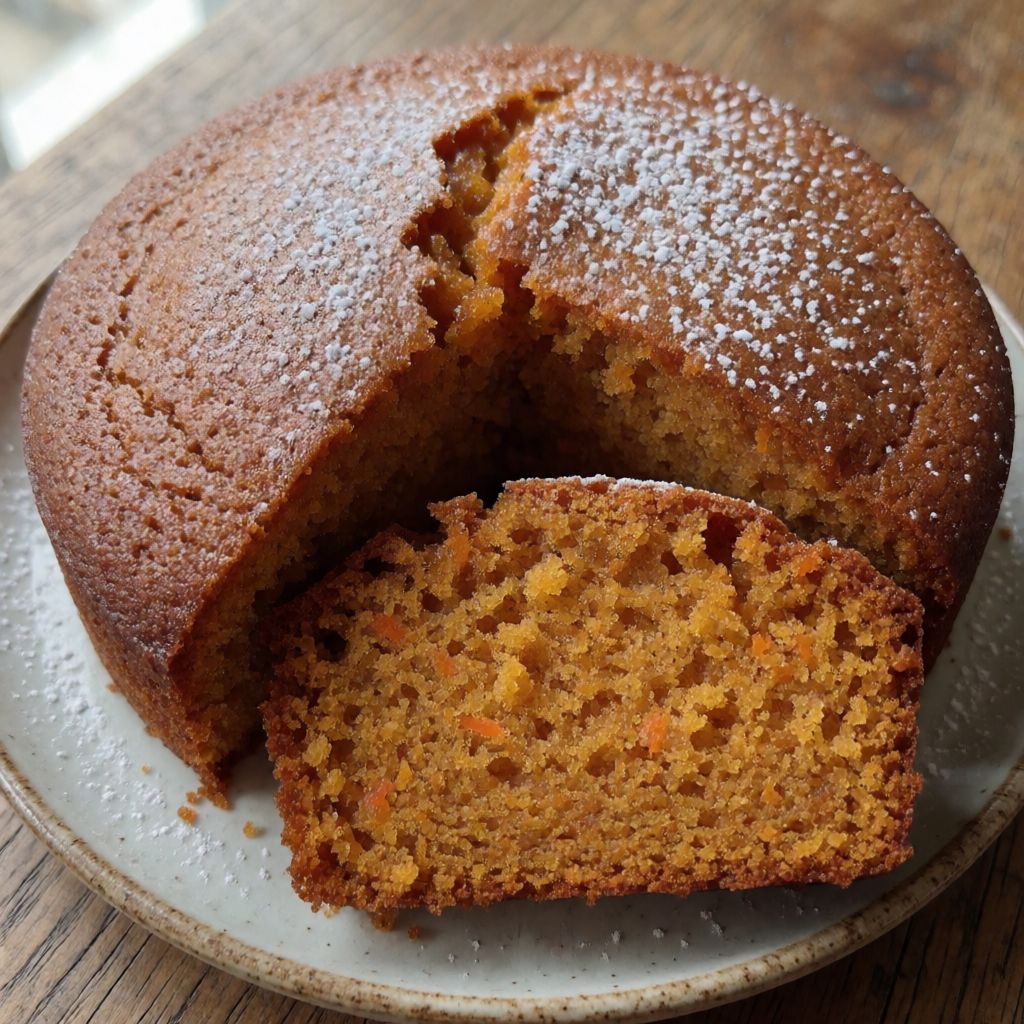
 AI photo
Carrot and Almond Cake
A moist carrot and almond cake with a hint of lemon and rum, perfect with a cup of tea.
Labels are worked out automatically from the ingredients and can be wrong. Check the packaging if it matters to you.
Ingredients
- 6 pcs Eggs
- 300 g Sugar
- 5 tbsp Water warm
- 1 pcs Lemon
- 1 pcs Rum
- 1 tsp Baking powder
- 150 g Plain flour
- 500 g Carrot
- 300 g Almonds
- 1 pcs Butter










Steps
Crack the eggs, separating the yolks from the whites. Beat the yolks with the warm water, gradually adding the sugar, lemon juice and rum.
Whisk the whites into a thick, stable foam and gently fold into the yolk mixture.
Add the sifted flour, almonds, carrot and baking powder. Mix well until smooth.
Grease a 22 cm tin with butter and dust with flour, then pour in the batter.
Bake in a preheated oven at 180°C.
55 minRemove from the oven, let the cake cool and serve.
Forget the British café idea of carrot cake, the sliced brick under cream cheese icing. This one is something else: an almond cake with carrot folded through it, held up by whipped eggs rather than by flour and oil. Flour is only 150g against six eggs, 300g almonds and 500g carrot — it's a skeleton, not the body. The body is almond and egg.
What decides whether it works is two separate engines running at once. First, the whipped egg whites — with so little flour and only a teaspoon of baking powder, they're doing almost all the lifting, so they need to be whipped to a stable, standing foam, not just frothy, and folded in without being beaten flat. Second, the carrot's water — grate it right and it cooks through evenly and keeps the crumb moist; grate it wrong (too fine, almost pureed) and it dumps its water into the middle in one go, and you get a gluey centre under a cooked edge.
Some say a carrot cake needs oil to stay moist — no, because moisture and grease are not the same thing. The moisture here comes from the carrot itself and from the eggs. Oil on top of that just makes it greasy without making it any more moist, and this cake has no oil in it at all for exactly that reason.
One honest note on the oven: 180°C means something different depending on whether your oven is fan-assisted or not — fan ovens run noticeably hotter for the same number on the dial, often by about 20 degrees' worth of effect. So treat 55 minutes as a floor, not a verdict. Judge it by a skewer coming out dry and the top springing back when you press it, not by the clock.
Eggs — six, and the separating isn't ceremony. Whites need to be completely free of yolk, because fat breaks the protein structure that lets them whip into a stable foam; one speck of yolk and you'll whisk for twice as long for half the volume. That foam is the cake's main lift, so this step is the one place you cannot rush or cut corners on.
Sugar, 300g, goes in early with the warm water and yolks so it dissolves smoothly before the mixture gets stiff with whipped whites — undissolved sugar sitting in a finished batter stays gritty, it won't melt properly once baking starts. The water's only job is to help that dissolving happen evenly; it's not there for volume.
Lemon cuts the richness of six yolks and the earthy sweetness of 500g carrot — without it the cake tastes flat and a bit eggy. Any juicy lemon does this, there's no special variety required. Rum adds a dark, sugary top note, and most of its alcohol cooks off in nearly an hour in the oven — what's left is aroma, not punch. If you keep none in the house, brandy is the nearest substitute; orange zest is a different but honest alternative if you'd rather skip spirits altogether.
Baking powder is backup, not the engine — a teaspoon is cheap insurance for a whisk arm that got tired before the foam was fully stable. Flour, sifted, is there only to bind the almond and carrot together into a crumb; push past 150g and the cake turns bready in a duller, heavier way than an undercooked carrot-wet centre.
Carrot is the real source of moisture and natural sugar, and the grate size matters more than people expect: medium holes, like short matchsticks, not the fine side that turns it to mush. Too fine and it releases all its water at once into the middle of the cake; too coarse and the threads stay raw while everything round them is done. Almonds, ground not whole, do half the job flour would otherwise do — they're the real body of this cake, which is why it's rich without needing butter in the batter itself. Ground hazelnuts work almost as well if that's what's in the cupboard; walnuts give something heavier and more bitter, still good, just a different cake.
Butter only appears once, for greasing the tin, followed by a dusting of flour — two defences, not one, because the sugars in a carrot cake caramelise against bare metal and weld the cake to it. Parchment is a fair domestic shortcut if you'd rather not deal with it, you just lose the thin crust that butter-and-flour gives you. And once it's out of the tin, let it cool properly before you cut it — the carrot is still setting as it cools, and a cake sliced warm will collapse under the knife instead of holding its shape. At 22cm it feeds six comfortably, and it sits better with a cup of tea the next day than straight after a Sunday roast — it's dense, and wants a quiet moment, not a crowded table.