
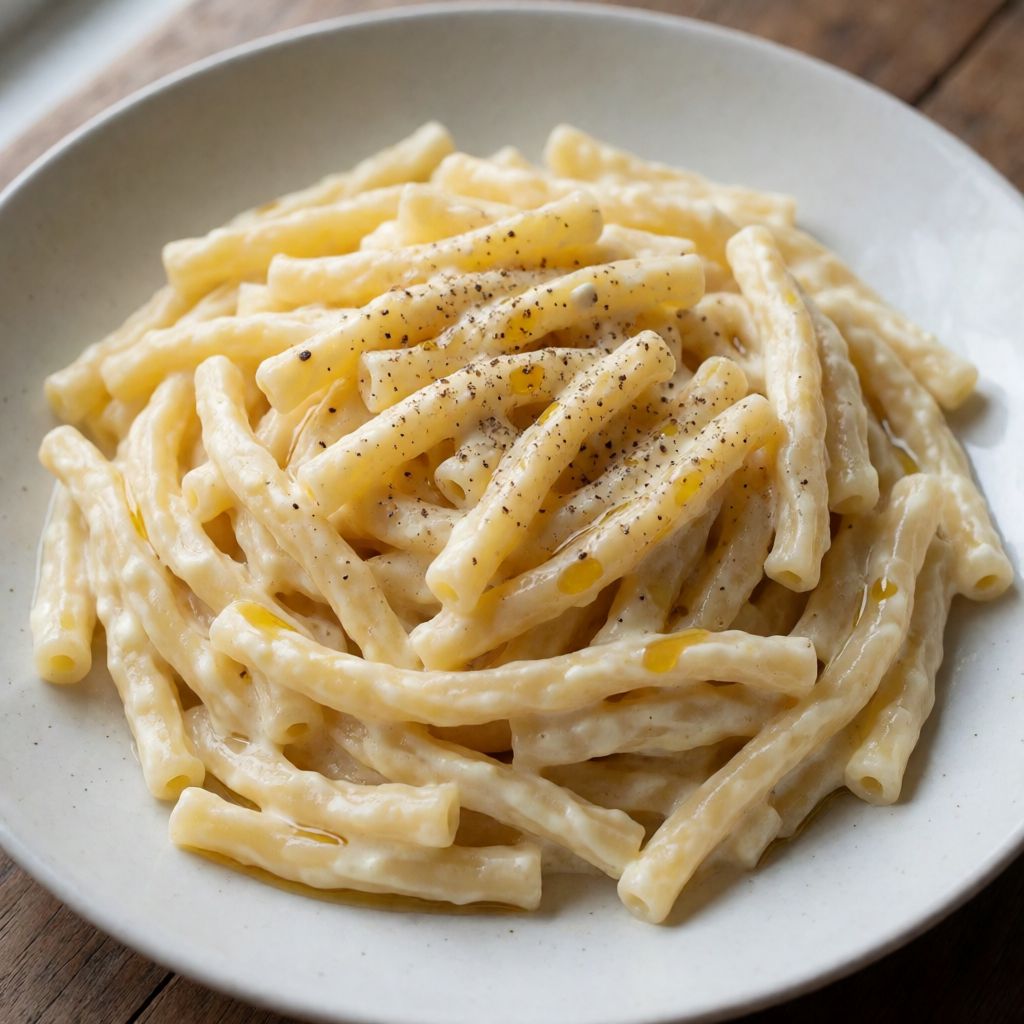
 AI photo
Casarecce Pasta with Ricotta and Saffron
A simple pasta dish of casarecce tossed with creamy ricotta, saffron and shallot, finished with Parmesan.
Labels are worked out automatically from the ingredients and can be wrong. Check the packaging if it matters to you.
Ingredients









Steps
Cook the pasta in plenty of salted boiling water until al dente.
Heat the olive oil in a pan and gently sauté the shallot, taking care it doesn't brown or colour.
Season with salt, then add the ricotta and a spoonful of pasta cooking water to loosen the mixture.
Stir in the saffron and mix until smooth.
Drain the pasta and transfer it to the pan with the sauce.
Toss together, adding black pepper and Parmesan.
Serve immediately.
What was changed
We swapped in Ricotta, which is easier to find in British shops, as the original already allowed it.
This is not a cooked sauce. It's barely a sauce at all — ricotta loosened with starchy water, tinted and scented with saffron, carried onto the pasta by nothing more than the heat the pasta itself brings with it. Nothing here gets a hard fry. Which means the whole dish stands or falls on two small, quiet moments, not on anything dramatic.
First: the shallot. The instruction says gently, no colour, and that's not fussiness — it's physics. The moment an allium starts to brown, its sugars caramelise, and caramelised sugar brings bitterness and a brownish cast with it. Fine in a ragù, where you want depth. Wrong here, where the whole point is a pale, milky base that lets the saffron's gold sit on top of it, not fight it. So the shallot goes in on the weakest heat your hob will hold a shimmer at, and you watch it go soft and translucent, never gold. If it starts to catch at the edges, you've already lost the dish's colour.
Second: the saffron. Some people think you just drop the threads in and they do their work wherever they land — oil, cream, doesn't matter. No — saffron's colour (crocin) and most of its scent are water-soluble, not fat-soluble. Thrown dry into oil or straight into thick ricotta, half of what you paid for never comes out. Let it sit a minute in a spoonful of the hot, salted pasta water before it meets the ricotta, and the whole packet earns its keep. And more is not better: oversaturate and saffron turns from floral to medicinal, almost metallic. The packet is small because the plant is stingy and because your tolerance for it is too — both are true at once.
Casarecce is chosen for a reason that isn't decoration: it's a short strand rolled into a loose tube with a seam, so it has both a hollow and a groove. A cream-based, no-cook sauce like this one needs somewhere to sit rather than slide off, and casarecce gives it two places at once. If you can't get it, look for the same logic in fusilli or gemelli — anything with a twist or a channel. Smooth tubes like penne will just let the sauce run through.
Ricotta: use the fresh, wet kind sold loose or in a tub with liquid pooling at the top, cow's milk as stated. That wetness is not a flaw to drain off — it's exactly what lets you build a sauce with just a spoonful of pasta water rather than needing cream. The dry, compressed, shelf-stable ricotta sold for baking will sit heavy and grainy no matter what you do to it; if that's all you have, add more pasta water than the recipe implies and accept it won't be quite as silky.
Saffron comes in a tiny packet because the flower gives up almost nothing: each crocus yields three stigmas, picked by hand, and it takes thousands of flowers for a few grams. That's the whole of its price and its history in one sentence — not magic, just extremely slow, manual harvest, the kind of crop that only survives as a luxury trade good, which is exactly how it travelled out of Persia and Kashmir centuries ago. Treat the packet as what it is: enough for four, no more, and bloom it rather than scatter it, as above.
Shallot rather than onion because it's milder and sweeter, with less of the sharp sulphur bite that a raw or half-cooked onion carries — here, where nothing gets properly browned to cook that bite away, a stronger allium would stay harsh. If you only have onion, use less of it, finely diced, and give it a minute longer over the gentle heat to soften that edge.
Parmesan and black pepper are both finishing ingredients, not cooking ones — they go in once the pasta is already off the heat, essentially raw, for salt, savour, and the small heat-release of freshly cracked pepper's oils. Pre-ground pepper has already lost most of that to the air; grind it at the table if you can. Parmesan can be swapped for any hard, aged, salty cheese — pecorino will push it sharper and saltier, which isn't wrong, just a different dish.
Parsley goes in at the very end, roughly chopped, because its aroma is volatile and starts leaving the moment the knife touches it — chop it while the pasta drains, not before. Its job is to cut through the fat of the ricotta and cheese with something green and sharp; without it the dish tastes rounder, flatter, a little one-note. And the olive oil is there only to carry the shallot gently — use something without a loud flavour of its own, a light olive oil rather than a heavily peppery extra virgin, so it doesn't compete with the saffron for the one aroma this dish is actually about. Patience is the last ingredient, and it's not optional: rush the shallot and you brown it; rush the saffron and you waste it; rush the final toss and the sauce breaks. None of that shows up in the ingredient list, but it's in every good plate of this.