
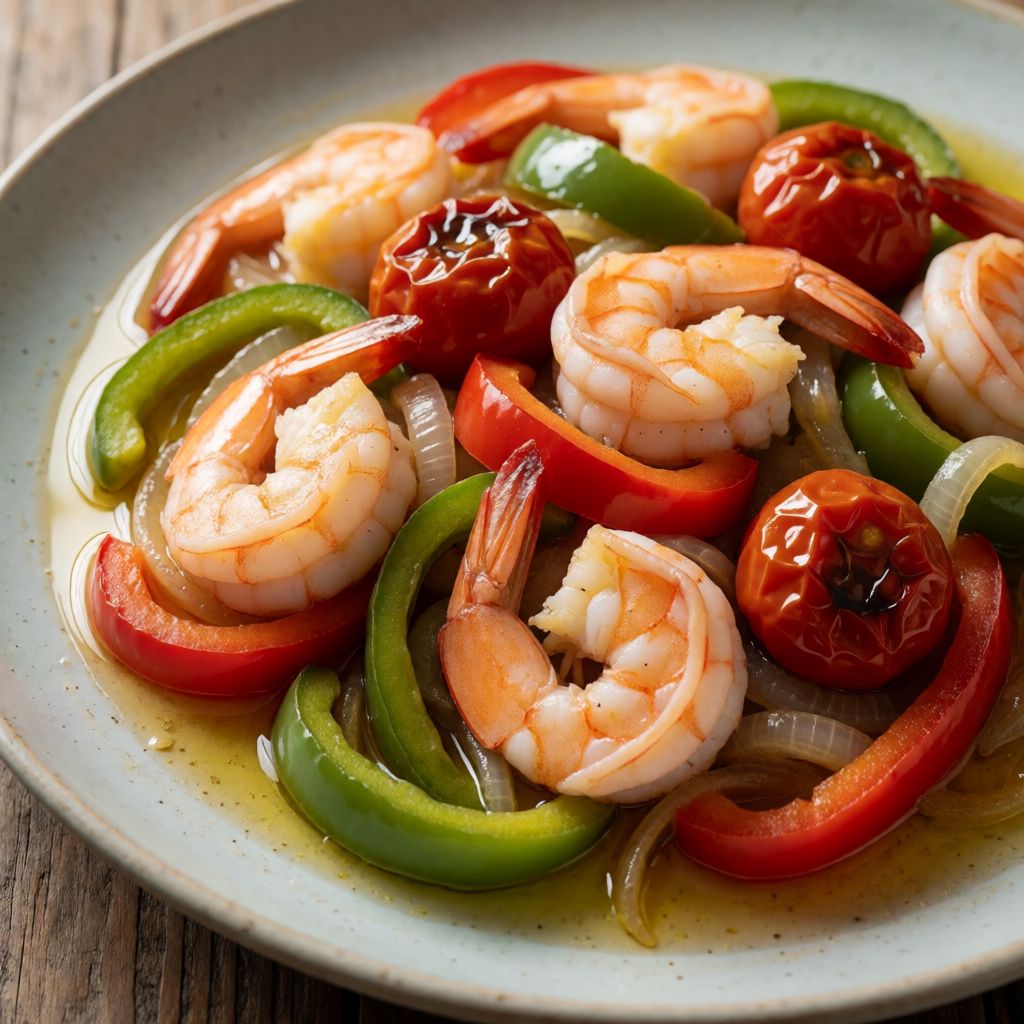
 AI photo
Catalan-Style Prawns
A quick pan of prawns, peppers and tomatoes with white wine and a touch of saffron.
Labels are worked out automatically from the ingredients and can be wrong. Check the packaging if it matters to you.
Ingredients










Steps
Clean the prawns: cut off the head, leaving the tail, slit along the back of the shell, remove the intestinal tract, and rinse.
Wash the peppers and cherry tomatoes. Halve the cherry tomatoes and finely dice the peppers.
Heat the olive oil in a pan, add the garlic and onion, and sauté until golden.
Add the cherry tomatoes, saffron and white wine, and cook for a few minutes.
Add the peppers and basil leaves, and cook for a further 10 minutes.
10 minAdd the prawns, cook for a couple of minutes, then turn off the heat. Doneness: internal temperature 63°C at the thickest part.
Plate up and serve.
What was changed
The tomatoes were swapped for Pendolino cherry tomatoes to match the small cherry tomatoes used in the original, keeping the halving step accurate.
This isn't a stew, it's a relay race with a very short last leg. You spend fifteen-odd minutes building a base — onion and garlic coaxed open, then tomato, wine and saffron reduced into something concentrated — and then you hand the whole thing to the prawns for barely two minutes before you turn the heat off. Nothing exotic in the name "Catalan": it's a coastal household economy, garlic and tomato cooked down with whatever came off the boat that morning, the same logic as a fisherman's wife using what she had rather than following a recipe card.
What decides whether this works is the clock, and it runs backwards from the prawns. They are the fastest thing that will ever go into that pan — seconds separate opaque-and-firm from tight, grey and rubbery. Everything before them exists purely to build a sauce strong enough to say something in the tiny window the prawns are willing to sit in it. If the sauce is thin and watery when they go in, the dish fails right there, not at the prawn stage.
Some will tell you to leave the prawns a bit longer "to be safe." No — past a point their flesh tightens, squeezes out its own moisture, and curls into a hard comma. The only honest marker is what you see and feel: firm, opaque through, barely curled, and if you want a number, 63°C at the thickest part. A couple of minutes is the lower bound you're told, not a target to hit exactly.
Start with the prawns, because they decide the whole order of the dish. Raw, head off, tail on, shell slit along the back to lift out the dark thread running through the flesh. That thread isn't dangerous, whatever you've heard — it's grit and bitterness, nothing more, and you're removing it for texture, not safety. The head comes off because the digestive matter inside turns grey and sour fast once the prawn is dead; the tail stays on for grip at the table and because the shell there gives the sauce a last whisper of sweetness as it sits in the pan for its brief couple of minutes. If you're using frozen raw prawns — perfectly fine — thaw them slowly in cold water, not a microwave, or you'll have started cooking them before they've even reached the pan.
The cherry tomatoes do a specific job: small, thin-skinned, high sugar relative to water, so halved they burst and give up their juice into the oil almost immediately. That speed is why Pendolino or any small sweet variety is chosen over a big beef tomato, which would need far longer to break down and water everything out in the meantime. Any ripe, sweet tomato chopped small will stand in; if it's underripe, a small pinch of sugar corrects the sourness, though it's a patch, not a cure for a tomato that was picked too early.
Onion and garlic are sautéed to gold, not brown. That colour change is the oil pulling sugars out of the onion gently; push past gold into brown and you're into the sulphur compounds that turn bitter, which is the real reason a burnt-garlic sauce tastes harsh — not "the heat was too high" in the abstract, but a specific chemical line you crossed. Watch the colour, not a clock.
The olive oil here isn't a neutral carrier, it's part of the flavour, which is why it's specified rather than left as "any oil." You want one that can stand a little heat without smoking before the onion turns, and that still tastes of something when the dish is plated. If all you've got is a light vegetable oil, use it and don't apologise — you'll lose a layer of flavour, not the dish.
Wine does two things at once: its acidity cuts the sweetness building from the onion and tomato, and a few minutes of simmering drives off the raw alcohol sting, leaving only the aromatic part behind. That's why it goes in and gets a few minutes before anything else joins it — it needs that time to lose its rawness. No wine in the house, lemon juice loosened with a splash of water will give you the acid, though not the same depth; that's a fair trade, not a cheat.
Saffron is a liquid-and-heat spice, not an oil one — it needs the wine and tomato juice to open properly, and it punishes greed. More saffron does not mean more flavour past a certain point; it tips into something medicinal and bitter, and the colour you're after arrives with very little. Treat "to taste" as a warning to start small, not an invitation. Basil goes in near the end with the peppers, not earlier, because its aroma sits mostly in volatile oils that cook off fast under heat — it wants to steep in the hot sauce for its last minutes, not simmer through the whole thing. And patience is doing real work in this recipe even though it only runs thirty minutes total: the reduction of tomato and wine is what gives the prawns something worth sitting in for those two final minutes, and there's no shortcut to that concentration except giving it the time it asks for.