
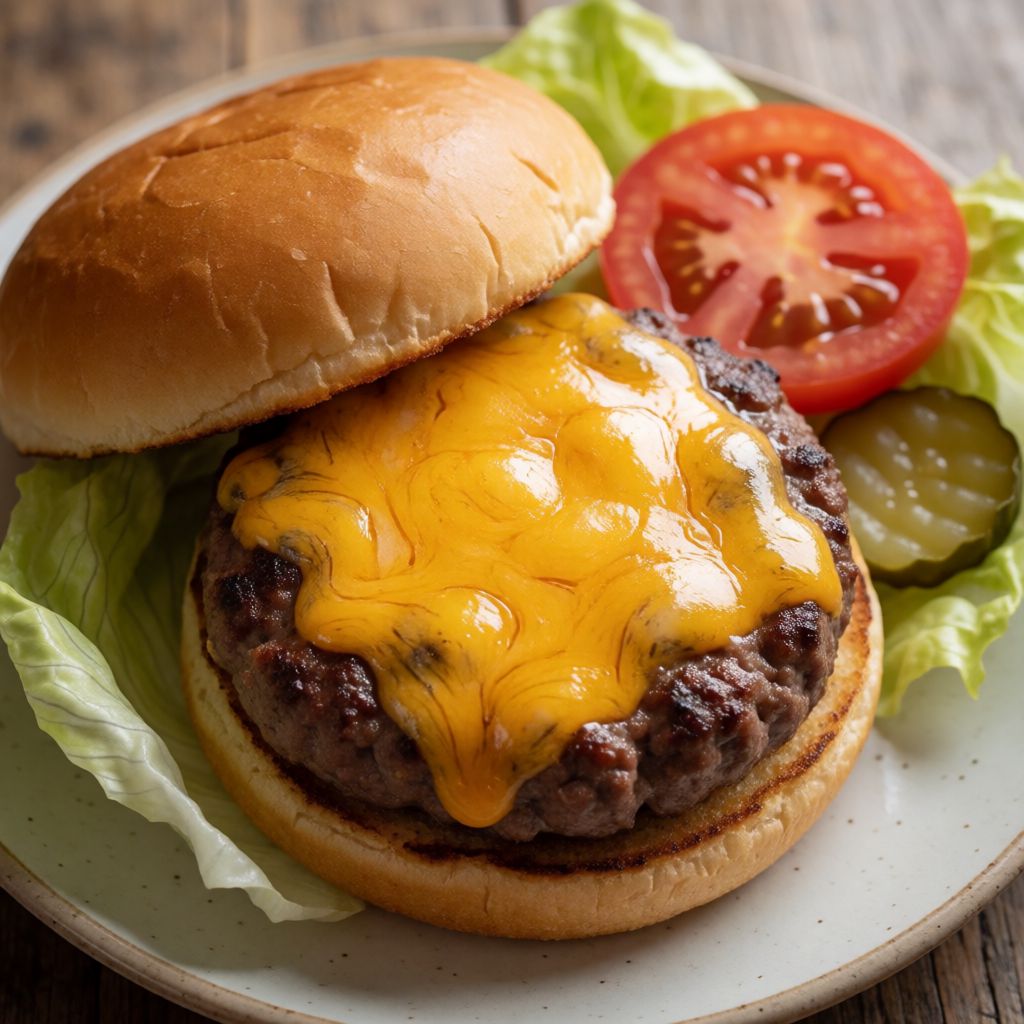
 AI photo
Cheeseburger
A juicy homemade beef cheeseburger with melted cheese, fresh salad and a quick homemade sauce.
Labels are worked out automatically from the ingredients and can be wrong. Check the packaging if it matters to you.
Ingredients
- 400 g Beef mince
- 4 pcs Burger bun
- 4 pcs Mature cheddar 2mm slices
- 4 pcs Lettuce leaves
- 1 pcs Tomato sliced
- Pickled gherkins to taste, thinly sliced
- Onion to taste, finely chopped
- Mayonnaise to taste
- Ketchup to taste
- Mustard to taste
- Tabasco to taste, a teaspoon for the sauce
- Worcestershire sauce to taste, a teaspoon for the sauce
- 2 tbsp Olive oil
- Salt to taste








Steps
Make the sauce: pour the ketchup into a bowl, add the Tabasco and Worcestershire sauce, mix and chill in the fridge for 5 minutes
5 minSeason the beef mince with salt and shape into 4 round patties, pressing firmly. If you like, mix finely chopped onion into the mince before shaping
Wash and dry the lettuce leaves, slice the tomato, cut the cheddar into 4 slices about 2mm thick, and slice the gherkins thinly. Arrange on a plate
Heat a pan with olive oil and fry the patties until golden brown. The internal temperature should reach 71 degrees
Place the cooked patties on a plate lined with paper towel to drain the oil
Slice the buns in half. Preheat the oven to 150 degrees, place the buns on a rack and the patties on a tray. Cover the patties with cheddar and keep in the oven until the cheese melts
5 minSpread the bottom bun with mayonnaise, add a lettuce leaf, the patty with melted cheddar, 2 tomato slices, gherkins, and a spoonful of sauce
Spread the top bun with mustard, close the burger and press gently
What was changed
Fontina was swapped for Mature cheddar, the cheese British shoppers reach for on a cheeseburger.
A cheeseburger is not a sandwich with meat in it. It's an engineering problem: how do you get a hot, juicy disc of beef, a sheet of melted cheese, cold crisp vegetables and a soft bun all at the peak of their own condition, at the same moment, on the same plate. Everything in this recipe is there to solve timing, not flavour — flavour mostly looks after itself if beef, salt and heat behave.
What decides whether it works is the patty, and specifically what happens to it between the pan and your mouth. You fry it hard for colour, then you don't serve it straight away — you let it rest on paper towel while the cheese melts separately in the oven. That gap matters more than any sauce recipe. A patty straight off the heat is still clenched tight from the shock of frying; cut into it and the juice runs out onto the plate instead of staying in the meat. Rest it a few minutes and the fibres relax and reabsorb what they were holding. This is the same logic as resting a roast — you already do this every Sunday without thinking about it.
Some say a burger needs a kazan-hot griddle and nothing else touches it until it's one giant crust. No — because a home pan on a UK hob can't hold that heat evenly across a 2–3cm thick patty; the outside burns before the inside is safe to eat. Here the fix is honest: fry for colour and crust, then finish doneness gently in a cool oven while the cheese melts. You're separating two jobs that a professional grill does at once — browning and cooking through — because your hob can't do both without wrecking one of them.
The mince is the one ingredient you can't disguise, so buy it fatter than you think you need — somewhere around 20% fat if the label lets you choose, not the leanest pack on the shelf. Lean mince fries dry and crumbly; fat is what keeps the patty together and what carries flavour, since fat is where flavour physically sits in meat. If all you've got is very lean mince, work in a spoon of oil or a knob of soft butter by hand before shaping — it won't be the same, but it fixes the dryness, which is the actual defect you're avoiding, not a texture you're chasing for its own sake.
Salt the meat just before shaping, not long before. Salt draws out protein and water from mince; leave it sitting salted for an hour and you get a tighter, almost sausage-like bind instead of a loose, tender one. Press the patties firmly enough that they hold their shape in the pan but no more — overworking the mince is how you get a hockey puck instead of a burger. If you fold raw onion in, know it releases moisture as it cooks, which softens the bind further — fine if you like a looser patty, something to watch if yours falls apart.
The cheddar wants to be mature, because mild cheddar is mostly fat and salt with no backbone — against beef, ketchup, mustard and pickles it just disappears. Mature cheddar has enough acidity and sharpness to cut through all that richness instead of adding to it. Any firm, meltable cheese with real flavour does the same job — a good Red Leicester or an aged Gouda would stand in without complaint. What doesn't work is pre-sliced "burger cheese" — it melts beautifully because it's built to, but it tastes of almost nothing.
The sauce is ketchup carrying two borrowed punches: Tabasco for heat, Worcestershire for the savoury depth ketchup doesn't have on its own. Chilling it for five minutes isn't about food safety, it's about the sauce actually tasting cold and sharp against a hot patty — serve it warm from sitting on the counter and the contrast you're after is gone. If you've no Worcestershire sauce, a splash of soy sauce does a similar job of adding salt-savouriness without sweetness.
Lettuce, tomato and gherkin are there for three different kinds of contrast, not decoration — crunch, acidity, and sharp brine against a soft, rich, fatty centre. Dry the lettuce properly; wet leaves water down the mayonnaise and make the bottom bun soggy before you've taken a bite. Olive oil in the pan is just a frying medium here, nothing more — any oil with no strong smell of its own works, a neutral vegetable or sunflower oil will do exactly the same job and won't fight with the beef the way a very grassy extra virgin can.
Patience is the real ingredient in the middle of this recipe, between frying and oven. Rush the resting stage because you're hungry and the burger punishes you for it with a dry patty and a wet plate. Five minutes doesn't feel like cooking, which is exactly why people skip it — but it's doing more work for the final result than the frying itself.