
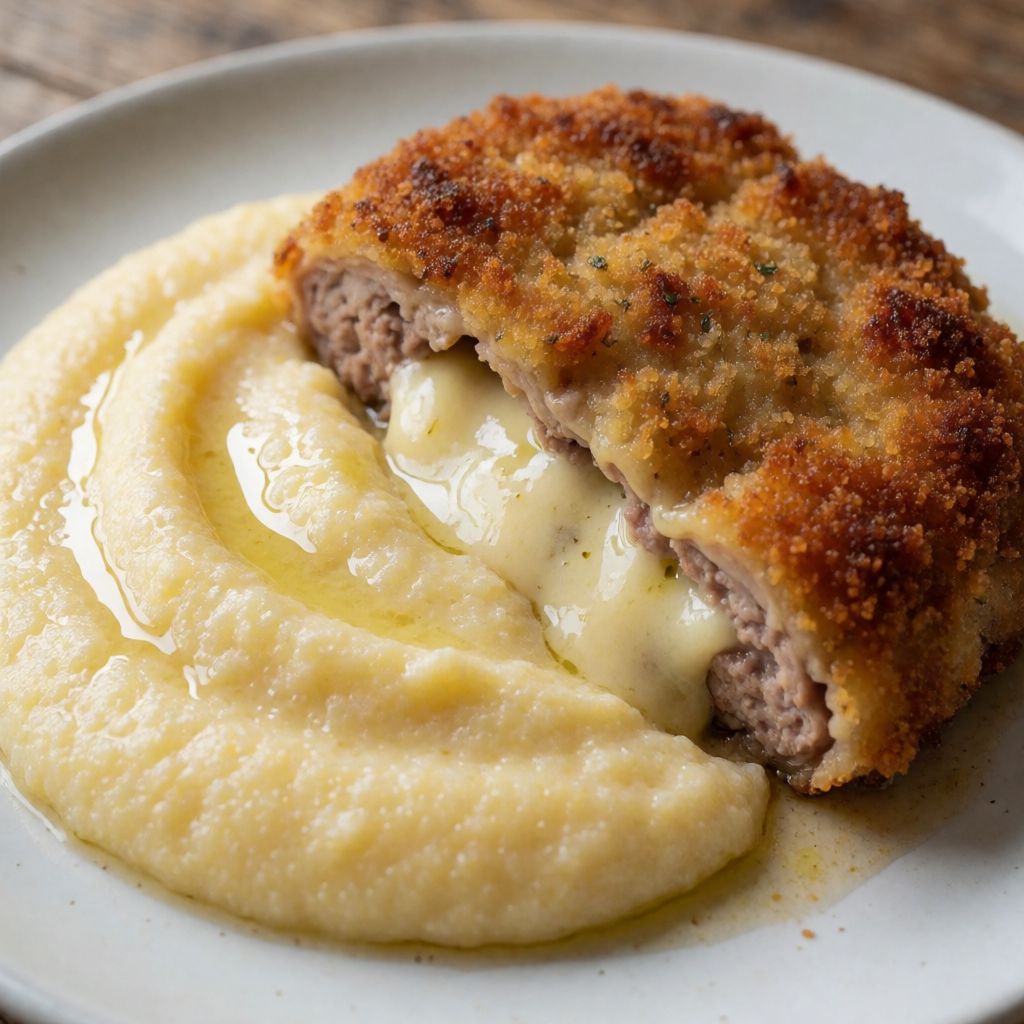
 AI photo
Cordon Bleu with Polenta
A crispy fried cordon bleu made from set polenta discs, filled with ham and melting cheese.
Labels are worked out automatically from the ingredients and can be wrong. Check the packaging if it matters to you.
Ingredients
- 2 l Water
- coarse salt to taste
- 500 g Cornmeal
- Olive oil to taste
- 250 g Ham
- 8 pcs stretchy, Edam-style cheese such as scamorza or pasta filata
- 2 pcs Eggs
- Breadcrumbs gluten-free, to taste
- Groundnut oil to taste







Steps
Bring salted water to the boil and pour in the cornmeal in a steady stream, whisking constantly.
Cook the polenta for the time stated on the packet, stirring constantly.
Pour the polenta onto a tray lightly greased with olive oil, or onto a sheet of baking paper, and quickly spread it into a layer 1-1.5 cm thick.
Let the polenta cool and set.
Cut rounds about 8 cm in diameter from the cooled polenta.
Take two rounds, place a slice of ham and a slice of cheese on one, then sandwich with the other.
Coat the cordon bleu in egg beaten with a pinch of salt, then in breadcrumbs. Repeat the process.
Heat the groundnut oil in a tall, narrow pan and fry the cordon bleu one or two at a time until golden.
Drain on kitchen paper to remove excess fat and serve hot with seasonal vegetables.
Forget veal, forget breadcrumbed chicken — this cordon bleu is polenta playing the role of the meat. Two rounds of cooled, set cornmeal stand in for the escalope, ham and cheese are sandwiched between them, and the whole thing gets the classic egg-and-crumb treatment before it hits hot oil. What you end up with is a polenta "cutlet" with a molten cheese centre, which is a clever bit of substitution logic as much as a recipe.
What decides whether it works is the polenta's set. Loose, warm polenta is porridge; cold, firm polenta is a slab you can cut discs from with a glass. The dividing line is temperature, not time on a clock — you're waiting for starch to cool and bind water into a gel, which is the same mechanism that makes a cold risotto cake hold together. Rush this and your "cutlet" collapses into mash the moment it hits oil.
The second thing that decides success is the seal around the edge. You're not frying a flat disc, you're frying a sandwich with molten cheese trying to escape through any gap. The egg-and-crumb coat isn't decoration, it's the gasket. Coat it once, you get patchy cover; coat it twice (step 7 says so, and it's not fussiness), you get a shell that holds while the inside goes soft and the cheese turns liquid rather than leaking into your oil.
Some say polenta can't be fried because it "just falls apart" — no, it falls apart when it's cut warm, or when the crust around it is thin. Treat it like a cutlet that needs a jacket, and it behaves like one.
Cornmeal here is standard polenta cornmeal, not the fine "instant" sachets unless you want a softer disc that's harder to cut cleanly — coarser ground holds a sharper edge once set, which matters because you're cutting rounds, not spooning servings. Water to cornmeal here is roughly 4:1 by volume, which is a loose porridge ratio deliberately: you want it thin enough to spread to 1–1.5 cm before it starts setting on you, because polenta firms up fast once off the heat and you won't get a second chance to smooth it.
Salt the water, not the polenta afterwards — cornmeal swells as it cooks, and salt added late sits on the surface instead of seasoning the grain. This is the same logic as salting pasta water: season the thing that's absorbing, not the thing that's already absorbed.
Ham: a standard sliced cooked ham, thin enough that it doesn't stop the two polenta rounds from sitting flush together. Thick-cut ham is a false economy here — it makes a lump, not a filling, and the sandwich won't close properly, which is exactly the gap the egg-and-crumb coat then has to fight.
Cheese is specified as a stretchy, Edam-style, pasta filata type — scamorza is named, but the criterion is "melts into strings, doesn't split into oil." Mozzarella works; a crumbly or oily cheese (feta, a very mature cheddar) does not, because it either won't bind the two halves together when it melts or it'll leak fat through your crumb coat and turn the frying oil cloudy fast. If you're in the UK and scamorza isn't to hand, a block mozzarella (not the wet ball — too much water) is the honest substitute; even a mild, firm raclette-style cheese will behave.
Groundnut oil is chosen for one reason: it has a high smoke point and no flavour of its own, so it fries hot without tasting of anything and without smoking out your kitchen. The rule for substitution isn't "groundnut or nothing," it's "any oil with a high smoke point and no smell of its own" — sunflower or a refined vegetable oil does the same job; extra virgin olive oil does not, it'll smoke and taste bitter before the crumb goes golden.
The pan is called "tall and narrow" for a reason worth taking seriously on a domestic hob: it means less oil does more depth, and it means the oil holds its heat better than a wide shallow pan where the same volume of oil gets thin and cools the moment you drop food in. On an ordinary UK hob without a deep-fryer, a small, deep saucepan beats a wide frying pan for this job — you want the cordon bleu properly submerged, not skating in a puddle, or the crumb browns unevenly and the cheese inside doesn't get consistent heat to melt through.
Frying one or two at a time isn't caution for its own sake — overcrowd the pan and you drop the oil temperature all at once, which is how you get a soggy, pale crumb that's absorbed oil instead of sealing against it. Patience at this stage is the ingredient that actually protects the result: let the oil recover its heat between batches rather than rushing all six through together.
Doneness here isn't a timer, it's a colour and a sound: golden crumb, and if you listen, the hiss calms down once the crust is holding rather than still releasing steam from a wet surface. Drain on paper not for show but because a hot crumb crust sitting in its own oil goes limp in minutes — the paper is doing the last bit of the oil's job of leaving the surface crisp.