
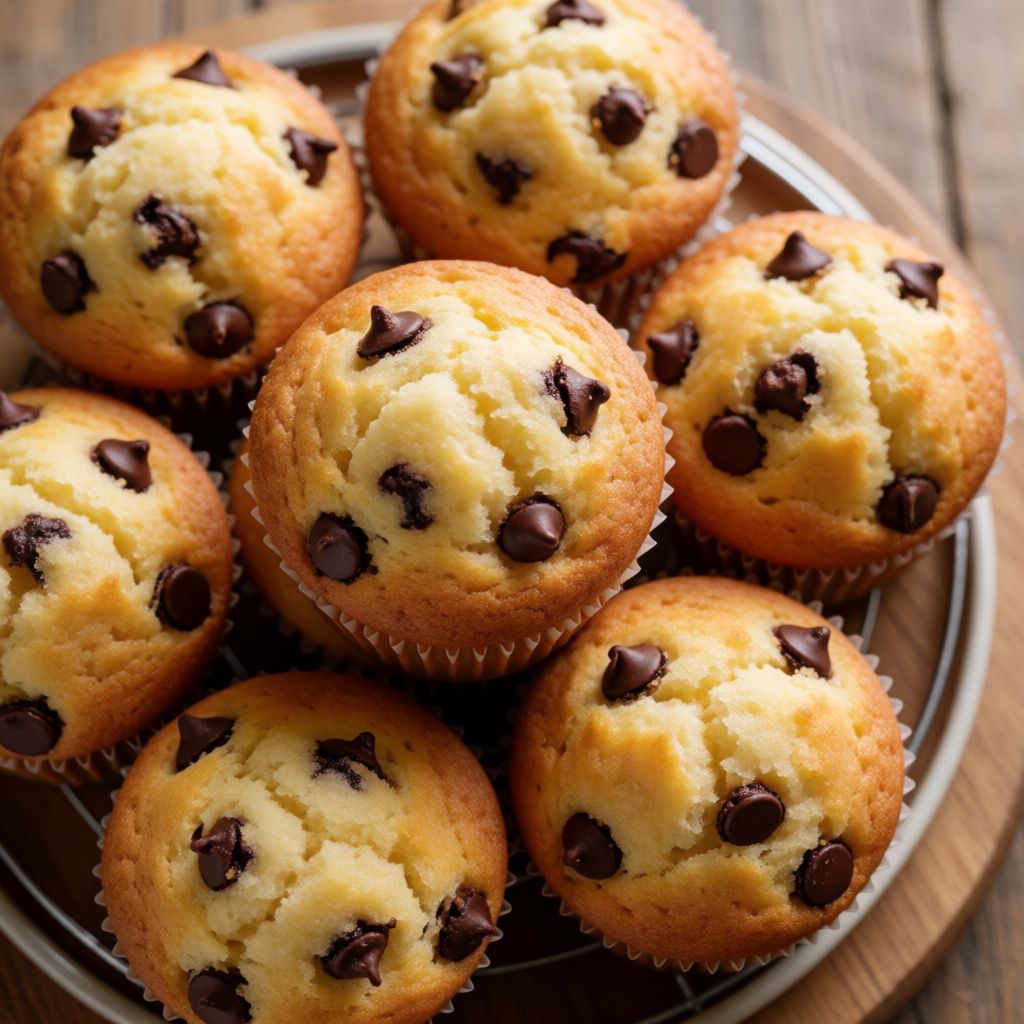
 AI photo
Chocolate Chip Muffins
Simple chocolate chip muffins with a soft, moist crumb — lovely for an afternoon treat with tea.
Labels are worked out automatically from the ingredients and can be wrong. Check the packaging if it matters to you.
Ingredients
- 9 pcs Eggs
- 500 g Sugar
- 500 g Plain flour
- 250 ml Milk
- 1 pcs Baking powder
- 0.5 l Olive oil
- Chocolate chips to taste







Steps
Beat the eggs with the sugar.
Add the flour, milk and baking powder, then the oil, and mix until smooth.
Spoon the batter into muffin tins.
Bake in an oven preheated to 180°C for 20 minutes.
20 min
What you've actually got here, under the muffin-tin disguise, is a pound cake — a quatre-quarts, as the French call it, because the old rule was equal weight of eggs, sugar, flour and butter. Nine eggs, 500g sugar, 500g flour, half a litre of fat: that's the same proportion, just oil instead of butter and a splash of milk to loosen it. Nothing wrong with that lineage. What's wrong is calling it two servings — a batch this size, baked in a standard muffin tin, gives you a dozen or more, not a snack for two people.
The thing that decides whether these rise properly isn't the baking powder. It's the eggs. There's no butter here to cream with the sugar and trap air mechanically the way a Victoria sponge does — oil can't hold a bubble, it just slides. So all your lift comes from how much air you beat into the eggs and sugar before anything heavy goes in. The baking powder is there to finish the job with gas once the oven heat hits it, not to start it.
Some say mix until smooth, because that sounds like good technique. No — for this batter, smooth is the enemy. The moment flour meets liquid, gluten starts forming strands, and strands mean chew. Beat a cake batter past the point where the flour has simply vanished and you get muffins that are dense, slightly rubbery, sometimes with little tunnels running up through them — that's steam fighting its way out through gluten it can't push aside gently.
Nine eggs is a count, not a weight, and that's the one wrinkle in the quatre-quarts logic here — the old rule only works cleanly if you weigh the eggs and match that weight in the other three. UK eggs vary by size, so what you're really doing is beating them with the sugar until they go pale and thick, almost ribbon-like, because that's the stage where enough air is actually locked in. Stop too early and you've got a flat, eggy, dense result no amount of baking powder will rescue.
The 500g of sugar isn't just sweetness — it's also doing structural work, dissolving into the egg and helping hold the air you've beaten in, and it draws moisture that keeps the crumb from drying out in the oven. But it also tells you what kind of muffin this is: with sugar matching the flour gram for gram, you're closer to cake than to a light bakery-counter muffin. Don't expect airy — expect rich, closer to a pound cake crumb studded with chocolate.
Olive oil is the one choice I'd push back on. It has a flavour of its own — grassy, sometimes peppery — and in a sweet bake full of chocolate chips, that flavour has nowhere good to go. The rule for a fat in a recipe like this is simple: it should carry no smell of its own, so the eggs, sugar and chocolate are what you taste. Sunflower oil, a light rapeseed oil, or any neutral vegetable oil does the actual job — moisture and tenderness — without arguing with the rest of the bowl. Save proper extra virgin olive oil for where its taste is the point, not buried under 500g of sugar.
Milk here isn't structural, it's a release valve — it loosens a batter that would otherwise be too stiff from all that flour and sugar to spread or rise evenly. Any milk works, dairy or plant, because its job is moisture, not flavour or protein.
The baking powder — one packet, however it's labelled where you shop — needs to be level, not heaped, when you measure it from a tub rather than a pre-measured sachet. Too little and the muffins sit flat and dense regardless of how well you beat the eggs; too much and you get an odd soapy, metallic aftertaste along with a batter that rises fast then sinks, because the structure collapses before it's set enough to hold the gas. Add it with the flour, not the wet ingredients, so it's distributed before any liquid activates it.
For the chocolate, go dark if you can — with sugar already at 500g, milk chocolate just doubles down on sweet with nothing to balance it. Chips hold their shape better through baking than chopped bar chocolate, which melts into streaks — pick whichever texture you actually want, both are correct, they're just different outcomes. And line your UK muffin tin with paper cases: without butter to grease the metal, a batter this oil-heavy will stick exactly where you don't want it to, at the base, right where the crust needs to lift off clean.