
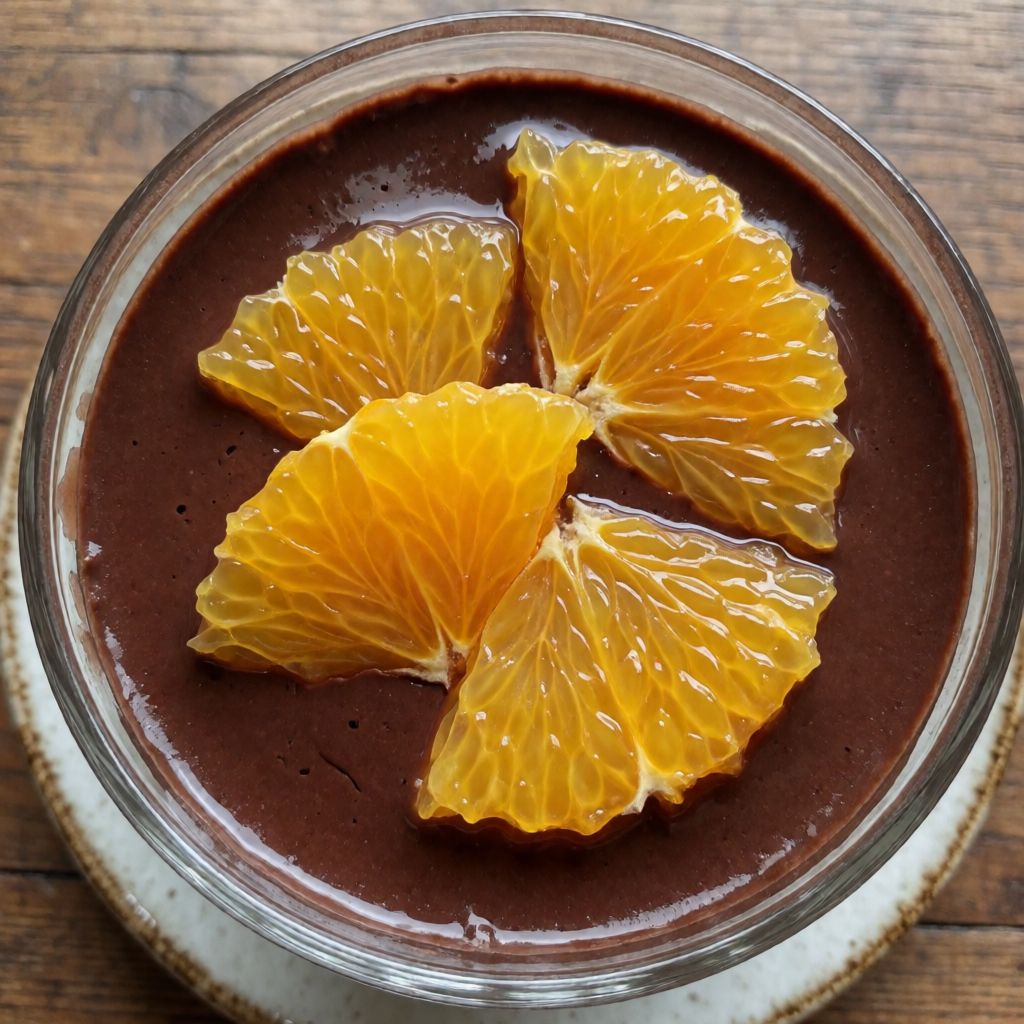
 AI photo
Chocolate Cream with Wild Oranges
A silky chocolate cream infused with the juice of wild oranges, chilled overnight and blended until smooth.
Labels are worked out automatically from the ingredients and can be wrong. Check the packaging if it matters to you.
Ingredients
- 12 pcs Oranges wild variety; ordinary oranges work well too
- 100 g Dark chocolate
- 4 g Cinnamon
- 3 g Agar-agar
- 40 g Sugar unrefined




Steps
Peel the oranges, remove the flesh and squeeze out the juice by hand, crushing the oranges with your fingers.
Strain the juice, add the cinnamon and the chocolate grated on a fine grater, then bring to the boil in a saucepan.
Add the agar-agar mixed with the sugar and whisk over the heat for up to 60 seconds.
1 minPour into a stainless steel pan and leave to cool in the fridge.
The next day, blend with a hand blender until smooth and silky.
Serve as it is or use in various desserts.
This is not a dairy cream at all — there isn't a drop of cream, milk or butter in it. The silkiness comes from a trick: you set the orange-chocolate juice into a firm gel with agar-agar, let it sit a full day, then take a blender to it and smash that gel into fine crumbs. Those crumbs, blended long enough, reform into something that pours and coats a spoon like a cream. The name describes the texture you arrive at, not what you started with. If you think "cream" means fat, you've been misled by the word, not the dish.
What decides whether it works is almost entirely upstream of the final blend. First, did the agar actually dissolve when you boiled it with the juice and sugar — properly dissolve, not just sprinkle in and hope? Agar granules need real heat and about a minute of contact to hydrate; skip that and you get grit in the final cream, little hard flecks that no amount of blending later will soften, because they were never in solution to begin with. Second, did you give the set gel its full day in the fridge, or did you rush it? Agar sets harder and more completely over time in the cold — not just colder, but more finished — and a half-set gel doesn't break into clean crumbs under the blender, it tears into a wet, stringy mess instead.
Oranges — the recipe calls for a wild variety, which in practice means smaller, more acidic, more bitter fruit than the sweet ones sold by the kilo in British supermarkets. That bitterness matters: it's what cuts against the chocolate so the dessert reads as sharp-dark rather than just sweet. Some people assume "wild" oranges are a lesser, barely-edible fruit, fit only for marmalade — no, because here the sharpness is the whole point, balanced on purpose by the sugar and softened by the chocolate's own bitterness. Ordinary eating oranges work, as the recipe says, but if yours are very sweet, you've lost some of that contrast — a squeeze of lemon into the juice brings a little of the edge back. Hand-squeezing rather than machine-juicing isn't sentimentality: crushing the flesh with your fingers drags a bit of pulp and membrane oil into the juice along with the liquid, giving the base more body than a clean extracted juice would.
Dark chocolate, grated fine on a box grater before it goes anywhere near the heat — the grating is not decorative, it's about surface area. Fine shavings melt through in seconds in hot juice; a broken bar takes longer and risks you over-boiling the liquid just to chase the last lump, which thickens and over-concentrates the acidity. As a substitution rule: pick a chocolate dark enough that you taste cocoa and nothing else competing with it — no strong vanilla, no milk sweetness fighting the orange. Something around 60–70% cocoa does that job; anything lighter turns the dessert into chocolate milk with fruit notes.
Cinnamon, by weight here, which suggests ground — it simply stays suspended as fine flecks through the cream, which is fine and traditional enough. If you only have a stick, simmer it in the juice during the boil and fish it out before the agar goes in; agar needs to dissolve into clean liquid, and a stick sitting in the pan does nothing for the texture, it just infuses flavour slower and less evenly than ground cinnamon would.
Agar-agar and sugar, mixed together dry before they meet the hot liquid — this isn't fussiness, it's the standard trick for any powdered setting agent, agar included: added straight into liquid, the granules clump on contact and form little swollen lumps that never fully let go of their water. Pre-mixed with the dry sugar, the granules are kept apart from each other, so when they hit the hot juice they disperse rather than clump. It's the same logic as mixing cornflour with cold liquid before adding it to a hot sauce — spread the particles out before they can seize.
For the setting vessel, stainless steel earns its place because metal pulls heat out fast and evenly, so the gel sets in a thin, uniform layer rather than staying warm and soft in the middle of a thick bowlful. In an ordinary flat without a kazan, any shallow metal tray will do — a roasting tin, a baking tray with edges, something wide and not deep. Depth is the enemy here: a deep dish sets unevenly, slow in the centre, and an unevenly set gel blends unevenly too.
Equipment-wise, a hand blender is honestly all this needs, and it's worth doing the blending in a tall, narrow jug rather than a wide bowl — the blade needs the gel pulled up against it repeatedly, not just spinning in open space, to break it down into the fine texture you're after rather than leaving bigger set lumps floating in liquid round the edges.