
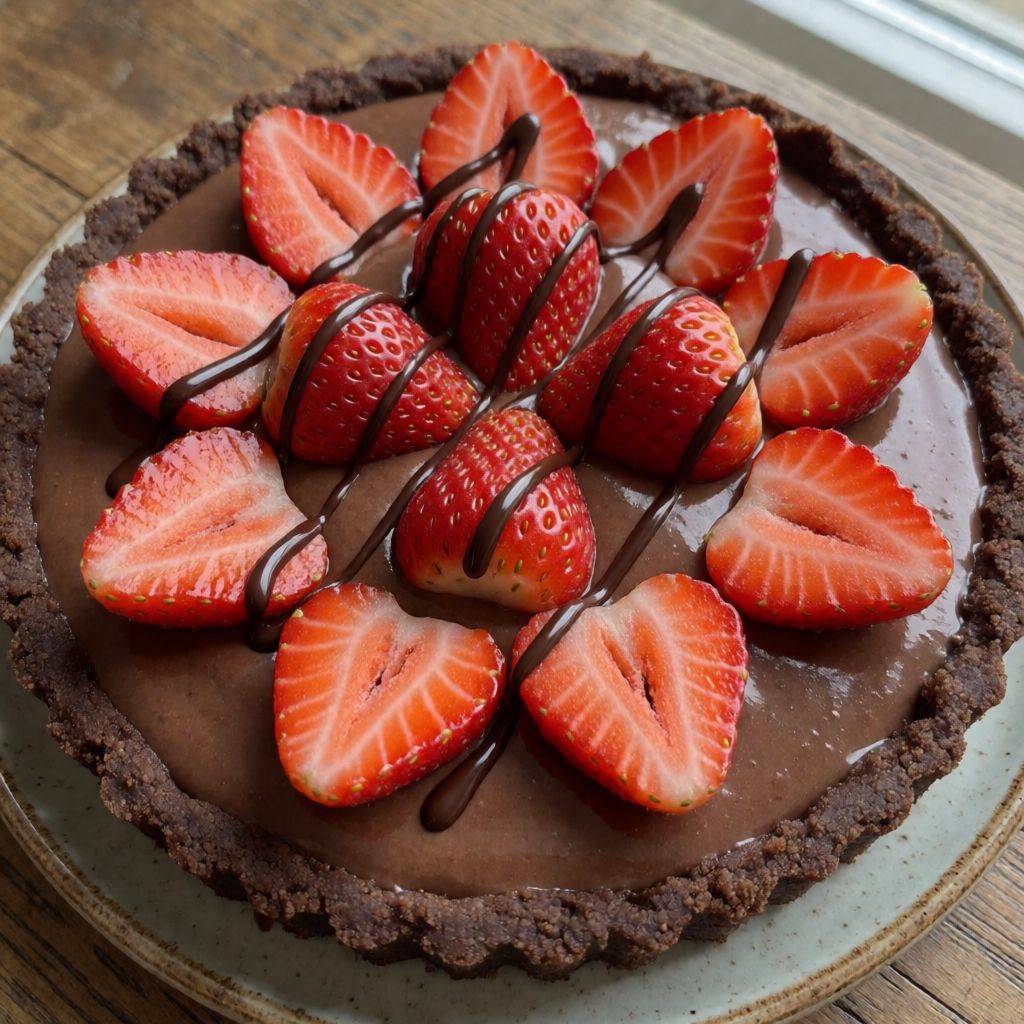
 AI photo
No-Bake Chocolate Strawberry Tart
A rich no-bake chocolate tart on a buttery biscuit base, topped with fresh strawberries and chopped pistachios.
Labels are worked out automatically from the ingredients and can be wrong. Check the packaging if it matters to you.
Ingredients
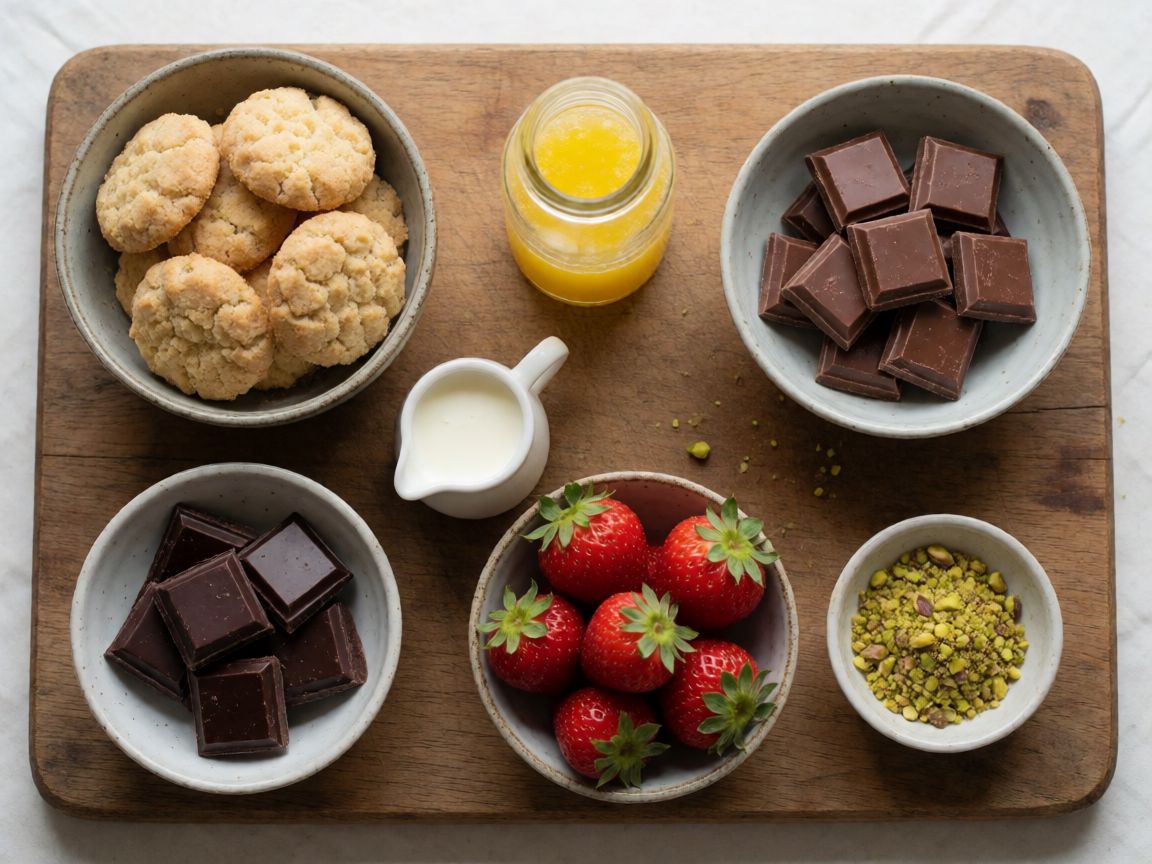
- 330 g Chocolate biscuits
- 110 g Butter melted
- 200 g Milk chocolate
- 100 g Dark chocolate
- 200 ml Double cream
- 300 g Strawberries
- Pistachios chopped, to taste




Steps
Blitz the biscuits in a blender into fine crumbs, transfer to a bowl, add the melted butter and mix well.
Press the crumbs firmly over the base and sides of the tin using the back of a spoon.
Chill the base in the fridge for 30 minutes to set.
30 minBring the cream to the boil in a small saucepan.
Break the milk chocolate and dark chocolate into a bowl, pour over the hot cream and leave for a few minutes.
Stir quickly until the chocolate has completely melted and the mixture is smooth and glossy.
Wash the strawberries, remove the green tops and pat dry.
Take the base out of the fridge, spread the chocolate ganache over it and smooth the surface well.
Arrange the strawberries on top in an even pattern and chill the tart in the fridge for at least 4 hours.
240 minBefore serving, decorate with chopped pistachios if you like, then bring the tart to the table.
This is a cold-set chocolate cheesecake wearing a tart's clothes. No oven touches it at any point — the whole thing stands or falls on two things cooling can do: butter locking crumbs into a solid base, and cocoa butter in the chocolate locking cream into a solid filling. Flavour is almost beside the point here. What decides whether this works is structure — does the base hold its shape when the knife goes through, and does the filling cut clean instead of oozing.
Some people hear "no-bake" and assume it's the lazy version, the one that gets away with less. It's actually less forgiving, not more. An oven corrects a lot of sins with heat and time — a wet base firms up, a loose filling sets through coagulation you can watch happen. A fridge has none of that drama. It just slowly pulls heat out, and if the fat inside hasn't been given the right conditions to crystallise properly, nothing fixes it afterwards. You can't rebake a tart that never went in.
The two places this tart actually fails are both patience failures, not skill failures. Cut it before the four hours are properly up and the ganache is still a thick sauce — it looks set on the surface, it is not set underneath, and it will slide rather than slice. Skimp on pressing the crumb into the tin — do it loosely, with your fingers instead of the back of a spoon forcing out the air pockets — and the base will crumble the moment a fork meets it, because air gaps are exactly where a biscuit base breaks.
Start with the biscuits. You want something crisp and dry enough to pulverise into fine, even sand — not big gritty shards. Coarse crumb leaves pockets of air in the base, and air pockets are structural weak points; that's where the base cracks when you cut it, not from bad luck. A food processor gives you that fine, even crumb reliably; bashing biscuits in a bag with a rolling pin works too, it's just slower and less even, so press a little harder and a little longer to compensate. Chocolate digestives are the obvious choice in a British kitchen — but any dry, plain biscuit does the job, add a spoon of cocoa if you want the colour and bitterness digestives already carry.
Melted butter is the glue, and it only glues because of what it does on the way back down to fridge temperature — it resolidifies, gripping every crumb particle in place. This is why the fat has to actually be butter, or something that behaves like butter: solid at cold, liquid when warmed. A liquid vegetable oil won't set at fridge temperature, so a base made with oil instead of butter stays loose and sandy forever, no amount of chilling will rescue it. Unsalted gives you control over sweetness; salted butter isn't a disaster here, it just nudges the whole thing slightly savoury against the sugar, which some people like better with all that chocolate.
The ganache is cream and chocolate forming an emulsion — fat and water held together, with the chocolate's own lecithin doing the holding. This is why double cream specifically: it carries enough fat (close to half its weight) to emulsion properly. Single cream, thinner and leaner, doesn't have the fat reserve to hold the mixture together under its own weight once it cools, and you risk it splitting — looking fine hot, weeping liquid cold. Pouring the hot cream over the chocolate and leaving it a few minutes before stirring isn't idle waiting — it's letting the heat travel into every piece of chocolate evenly before you touch it. Stir too early, while the pieces are still cold in the centre, and you get lumps that never fully melt, a grainy ganache that never goes properly glossy.
The mix of milk and dark chocolate is doing a structural job as much as a flavour one. Milk chocolate, loaded with milk solids and extra fat, melts beautifully smooth but sets soft — all milk chocolate and the filling never firms up enough to hold a clean slice. Dark chocolate, higher in cocoa solids, sets firm and cuts the sweetness — all dark and you get something closer to a chocolate brick, firm to the point of cracking, and bitter against the strawberries instead of balancing them. The two together give you a filling that sets but still gives slightly under the fork, which is the whole point of a ganache rather than a set custard.
Strawberries bring acid into a dessert that otherwise has none — without them this is just very rich chocolate on a biscuit, pleasant for about three bites and then heavy. Buy them actually in season if you can; out-of-season strawberries are often more water than flavour, and water is exactly the enemy here, which is why they get washed, dried properly, and never taken anywhere near being wet when they land on the ganache. Pistachios at the end are only there for crunch and colour against all that smooth dark surface — any toasted nut, chopped, does the same job, there's no mechanism to respect, just contrast.
Finally, the tin. The recipe doesn't name a size, so judge it by the quantity: 330 g of crumbs going up the sides and across the base of what's usually a loose-bottomed flan tin around 20 cm — any similar tin works, as long as it has some way of getting the tart out again without demolishing the base, because a fixed tin with no removable bottom is where a perfectly good base gets wrecked at the last step, not during the making of it.