
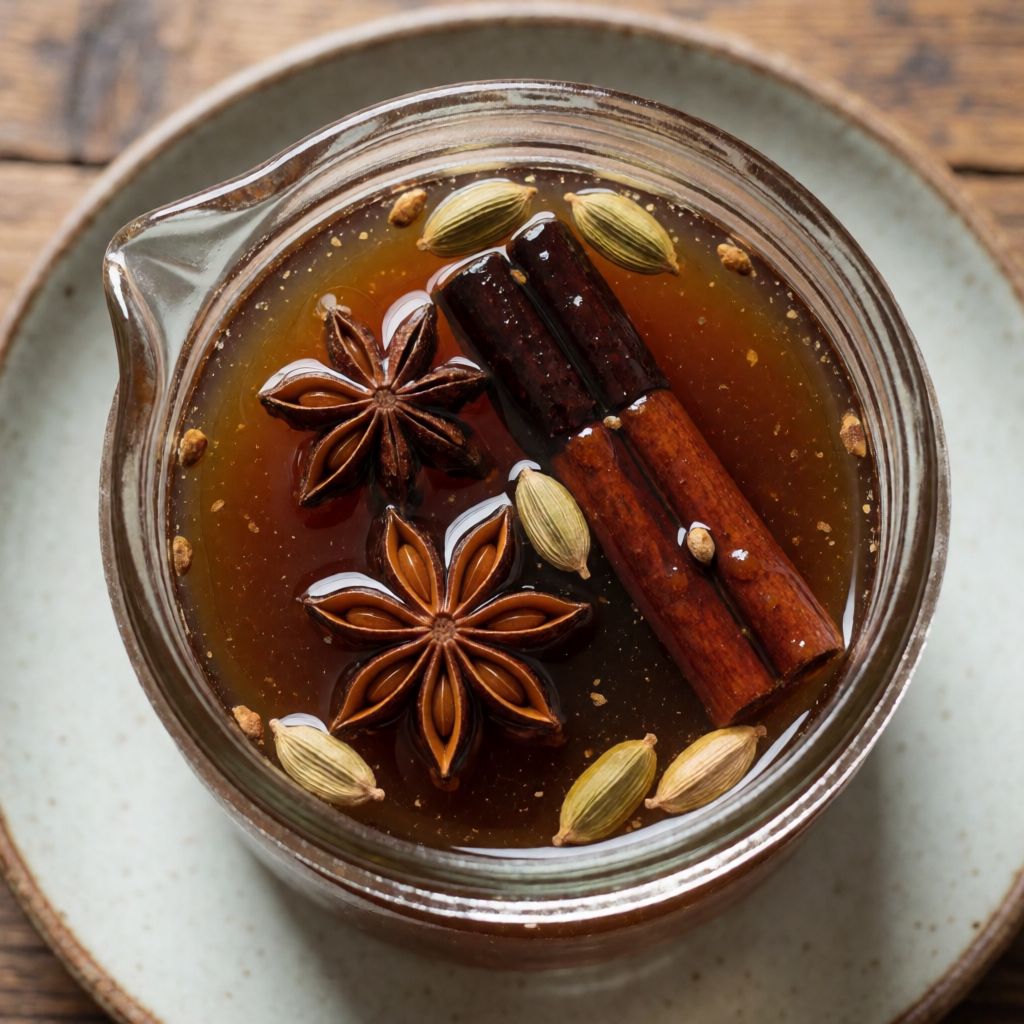
 AI photo
Christmas Syrup
A warm, spiced syrup made with vanilla, orange juice and festive spices — perfect for drizzling or mulling at Christmas.
Labels are worked out automatically from the ingredients and can be wrong. Check the packaging if it matters to you.
Ingredients
- 1 pcs Vanilla Pod
- 130 g Sugar
- 400 ml Orange Juice
- 2 pcs Cinnamon Sticks
- 1 tsp Cardamom
- 2 pcs Star Anise
- 4 pcs Cloves







Steps
Cut the vanilla pod lengthways and scrape out the seeds. Mix the seeds with the sugar, orange juice and spices (cinnamon, cardamom, star anise, cloves) in an uncovered pan.
5 minSimmer over medium heat, uncovered, for 15–20 minutes, stirring occasionally and keeping an eye on the syrup.
18 minStrain through a sieve and pour into a scalded, clean bottle or jar.
This isn't really a recipe with steps, it's a reduction. You take orange juice, drop sugar and whole spices into it, and boil off water until what's left is thick enough to cling to a spoon instead of running off it. The "Christmas" in the name is just the spice list reading festive — cinnamon, clove, star anise, cardamom and vanilla were the expensive, imported spices a household saved for the one feast that mattered, which is exactly why that combination still smells like December to us and not, say, August.
What decides whether this works is evaporation, not minutes. The pan stays uncovered the whole time, and that's deliberate. Some people reach for a plate to put over the pan out of habit — a lid keeps heat in, so why not use one here? Because here you don't want to keep anything in. You want water to leave. Cover it and the steam condenses on the plate and drips straight back into the juice; you end up with hot spiced orange juice that never thickens, no matter how long you leave it.
"Medium heat" means the surface should be gently rolling — small bubbles breaking steadily, not a hard boil throwing liquid up the sides. Push it harder thinking you'll save time and the sugar at the base of the pan concentrates and catches before the bulk of the liquid has reduced, and you get a scorched, bitter edge in an otherwise sweet syrup. That's what the occasional stir is actually for — not tradition, just making sure nothing sits still long enough to burn.
Start with the vanilla pod, because it does the least glamorous but most necessary job. Scraping the seeds into the sugar spreads vanillin through the mix before any liquid touches it, so it has the full simmering time to diffuse rather than sitting as a lump at the bottom. Drop the scraped husk in too, not just the seeds — it still has flavour to give up over fifteen minutes of heat, and you fish it out with everything else at the sieve. If all you've got is vanilla extract, add it off the heat at the very end: boil extract and you boil off the alcohol that's carrying most of its smell, and you're left with less than you started.
Cinnamon, star anise and cloves go in whole for a reason that has nothing to do with looks. Whole spices release their oils slowly and evenly across the whole simmer, which is what gives you a clean amber syrup rather than a muddy, over-concentrated one. Ground versions dump their flavour fast and cloud the liquid permanently — no amount of straining clears a fine powder once it's dispersed. If whole is all you can't find and ground is all you've got, add it in the last few minutes instead of the first, and accept the syrup will stay slightly hazy.
Cardamom at a teaspoon is almost certainly meant ground, which is fine — it's the quickest-acting of this group anyway. If you've only got whole pods, crack the shell with the flat of a knife before they go in; the shell itself is nearly flavourless, it's the seeds inside that carry the oil, and an unopened pod just floats there doing very little.
Orange juice is the base, and either fresh-squeezed or carton works, because the sieve at the end sorts out the difference. Fresh juice carries more pulp and pectin, so your reduced syrup comes out slightly thicker and cloudier; carton juice is more consistent in acidity and gives a cleaner strain. Neither is more correct, they just land in slightly different places.
Sugar should have no voice of its own here — plain white granulated is right precisely because it disappears behind the spice. Caster sugar dissolves a shade faster thanks to its finer crystal, which matters less for flavour and more for avoiding undissolved grains sitting on the pan base where they're first to scorch.
Scalding the jar before you pour the syrup in isn't ceremony, it's arithmetic: a sugar-and-juice liquid is exactly the kind of thing mould finds first in a fridge, so a quick rinse with boiling water (or a hot dishwasher cycle) buys the syrup real shelf life instead of a week. Treat the finished jar as a concentrate, not a drink — a spoonful goes into a pot of tea instead of sugar, into mulled wine, or brushed over the ham before it goes back under the grill at the end of your Sunday roast. One batch, spread across a lot of cups and glasses, is the whole point of it.