
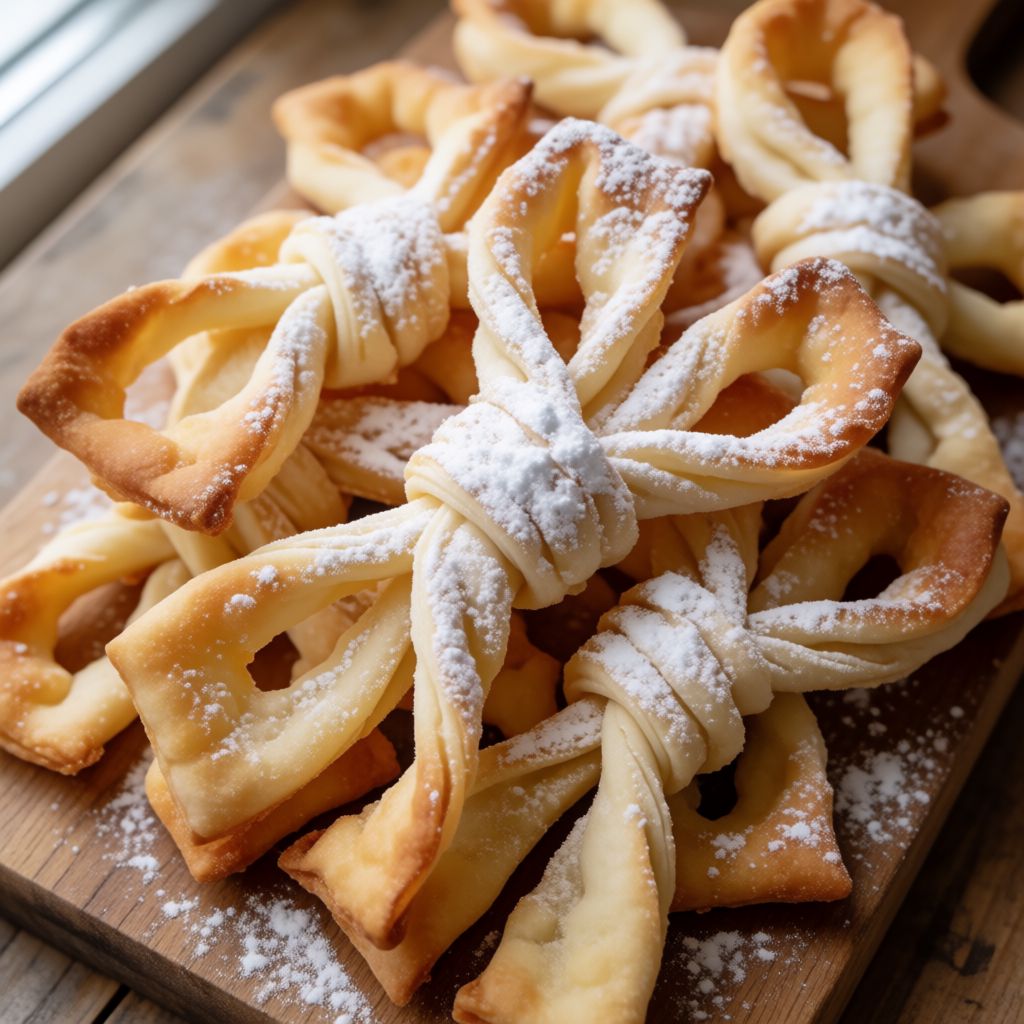
 AI photo
Gluten-Free Grappa Khvorost
A gluten-free take on crispy fried pastry bowties flavoured with grappa and lemon zest, dusted with icing sugar.
Labels are worked out automatically from the ingredients and can be wrong. Check the packaging if it matters to you.
Ingredients
- 500 g Gluten-free flour mix
- 160 g Sugar
- 100 g Butter
- 40 g Grappa
- 40 g Water
- 4 pcs Eggs
- 1 tsp Baking soda
- 1 pcs Lemon zest
- Peanut oil for frying
- Icing sugar for dusting





Steps
Take the butter out of the fridge at least 20 minutes before starting and cut it into cubes.
Sift the gluten-free flour mix together with the baking soda, add the sugar and lemon zest, and mix with a whisk.
Pour the dry mix onto the work surface in a mound and make a well in the centre. Crack the eggs into it and mix with the flour.
Add the room-temperature water and grappa, and mix vigorously by hand.
Work in the diced soft butter and knead until the dough is smooth and even.
Wrap the dough in cling film and chill in the fridge for about 30 minutes.
30 minTake the dough out of the fridge, knead briefly by hand and divide into two equal parts.
Roll out each part using a pasta machine or a rolling pin on the work surface.
Pass the dough through the rollers 2-3 times until the sheet is smooth, then narrow the rollers down to 1 mm thickness.
Transfer the rolled sheets onto baking paper and cut into 12x6 cm rectangles with a fluted pastry wheel.
Make two vertical slits in the middle of each rectangle.
Heat the peanut oil in a pan to about 170°C.
Dip 2-3 pieces of dough into the hot oil and fry for about 20 seconds.
Lift the pastries out with a slotted spoon and place on paper towels.
Serve warm, generously dusted with icing sugar.
Khvorost is fried dough pretending to be festive — strips of pasta-thin dough, slashed, dropped into hot fat for seconds, and buried in icing sugar. This gluten-free version with grappa is the same idea wearing a different coat. The Italian cousin of this dish uses wine in the dough instead of grappa; the alcohol isn't flavour theatre, it's chemistry. Alcohol evaporates faster than water and interferes with gluten formation — except here you have no gluten to worry about, so the grappa's real job is fragrance and a thinner, crisper bite once it fries off.
What decides whether this works isn't the recipe, it's the thickness of the sheet and the heat of the oil. Roll it thick and you get a soft, bready crisp — chewy, sad, nothing like khvorost. Roll it to something near a millimetre and it puffs, blisters, and shatters when you bite it. That's the whole dish in one sentence: thin dough, hot fat, seconds not minutes.
Gluten-free flour here isn't a dietary afterthought, it's doing a job. Without gluten there's no elasticity to fight when you roll it thin — the dough won't spring back and resist you the way wheat dough does. That's actually an advantage for khvorost: you want crisp, not chewy-stretchy. The trade-off is structure — gluten-free doughs can crumble at the edges, which is why this one leans on egg and butter to hold itself together instead.
Flour first. "Gluten-free flour mix" means a blend — usually rice flour, starch (potato or tapioca), maybe xanthan gum already in there for binding. Check the bag: if it has no gum listed, your dough will be more fragile at the edges and you should handle the rolled sheets gently, lifting with the paper rather than your fingers. If you don't do gluten-free at all and this isn't a dietary requirement, plain flour works and you'll get a slightly more elastic, classic khvorost — but then it isn't this recipe anymore, it's the original.
The eggs and butter are the glue gluten-free dough needs. Egg proteins set when they hit hot oil and hold the structure that gluten would normally provide; butter, worked in soft rather than melted, coats the starch granules and keeps the fried result from tasting like cardboard. Butter must be properly soft — the twenty minutes out of the fridge isn't a suggestion, it's preventing lumps of cold fat sitting in your dough instead of blending through it, which would show up later as greasy spots when you fry.
Grappa you can swap for any strong, clean spirit with no sweetness of its own — white rum, vodka, even a dry sherry if that's what's open. The criterion is: colourless or near it, not sweet, decent proof. Sweet liqueurs will make the dough brown too fast in the oil before the inside cooks through. If you're avoiding alcohol entirely, use water in its place and accept the texture will be very slightly less crisp — the alcohol's quick evaporation in the fryer is part of what helps the sheet puff and blister.
Lemon zest is there for the same reason it's in most fried dough across the Mediterranean and the Caucasus — fried things taste flat without something bright cutting through the fat, and zest does that without adding liquid the way juice would.
On the oil: peanut oil is specified because it has a high smoke point and almost no flavour of its own — the actual rule is "any neutral oil that can sit at 170°C without smoking or protesting." Sunflower or a light, flavourless vegetable oil does the same job in a British kitchen; olive oil does not, its own taste will fight the lemon and sugar, and cheaper ones smoke before you get anywhere near frying temperature. You won't have a thermometer rated for oil in every kitchen — a dry breadcrumb or a small offcut of dough dropped in is your gauge: it should sizzle immediately and rise within a couple of seconds, not sit sullenly at the bottom.
In an ordinary flat, your "kazan" is a wide, heavy pan — a sauté pan or a deep frying pan, enough oil to float the pieces but not so much that your hob can't hold the heat steady once you start adding dough and cooling the oil down. Fry in small batches — two or three pieces as the steps say — because dumping in more drops the oil temperature all at once, and that's the real cause of khvorost gone soggy and oil-logged, not "bad luck" or "bad flour." A slotted spoon and a plate lined with paper towels or napkins stand in fine for a wire rack; you're just giving the fat somewhere to go that isn't back into the pastry.
Patience here isn't about long cooking — it's the opposite. The whole dish lives in short, repeated moments: thirty minutes of chilled rest, twenty seconds in the oil, a batch at a time. Rush the chilling and the dough tears when you roll it thin. Rush the frying by crowding the pan and you get pale, oily pieces instead of blistered, golden ones. The patience is in doing it in small enough pieces, calmly, batch after batch, not in watching a pot for an hour.