
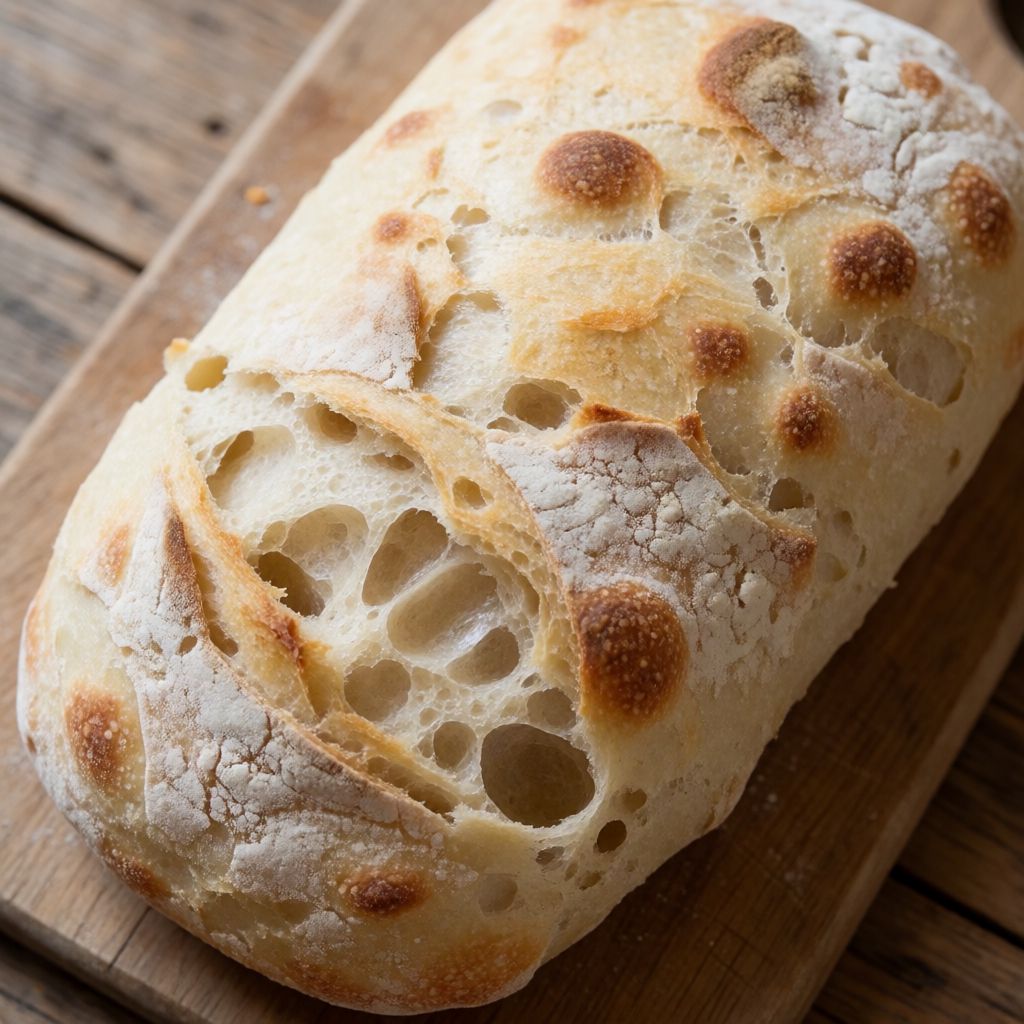
 AI photo
Sourdough Ciabatta
A long, slow sourdough ciabatta with a crisp crust and open, airy crumb.
Labels are worked out automatically from the ingredients and can be wrong. Check the packaging if it matters to you.
Ingredients
- 400 ml Water room temperature
- 400 g strong white flour wheat
- 80 g durum flour
- 125 g sourdough starter ready to bake
- 1½ tsp Salt
- 1 tbsp Olive oil for the bowl






Steps
Mix the water, strong white flour and durum flour in a bowl until combined. Cover and leave the dough to autolyse for 1 1/2 hours.
90 minAdd the sourdough starter to the dough and knead, preferably in a stand mixer on low-medium speed, for 10 minutes.
10 minAdd the salt and knead for a further 5 minutes, until the dough is smooth and glossy on the surface.
5 minTransfer the dough to an oiled bowl, cover and leave to rest on the kitchen counter for 30 minutes.
30 minFold the dough in the bowl: wet your hands with cold water, take hold of the dough and fold it 3-5 times, until it becomes a little firmer and more elastic.
Let the dough rest again for 30 minutes and repeat the folding. Repeat until the dough has been folded a total of 3 times.
30 minThen leave the dough to rest on the kitchen counter for a further 2 hours without folding.
120 minAfter this, put the dough in the fridge on the coldest shelf — at the bottom of the fridge, just above the vegetable drawer — for 10-16 hours.
600 minPut a baking stone or steel plate in the oven and preheat the oven with fan to 250°C for 45 minutes, until the tray is well heated.
45 minCarefully tip the soft dough onto a flour-dusted surface and cut it into pieces for the ciabatta.
5 minCarefully place the pieces onto a sheet of baking paper with a little space between them.
1 minDust with a little durum flour, put the bread in the oven and reduce the temperature to 180°C with fan.
30 minBake for 30 minutes.
30 minRemove the baking paper from under the bread, raise the oven temperature to 230°C and bake for a further 15 minutes or until golden with a good crust.
15 minLet the bread cool on a wire rack.
20 min
Ciabatta means "slipper" — a flat, ugly-looking loaf that got its shape not from any baker's artistic vision but from a dough too wet to hold any other. That wetness is the whole point. This recipe runs at roughly 85% hydration if you count the water alone, and the starter brings more moisture with it. Wet dough makes big, irregular holes and a crust that shatters rather than bends, because there's enough free water to flash into steam in the oven and force the crumb open before the structure sets. Dry the dough down to something easy to handle and you've made a different bread — a pleasant one, but not this one.
What decides whether it works is almost entirely gluten development without the usual tool for it, which is kneading muscle. You can't knead a dough this wet in the normal sense — it'll stick to everything, including your resolve. So the method substitutes time and folding for force. The hour-and-a-half autolyse (just flour and water, no starter yet) lets the flour hydrate and the gluten start linking up on its own, enzyme-driven, no effort from you. Then the folding every half hour — three times — does in gentle stages what kneading would do all at once: it stretches the gluten sheets taut without tearing them, the way you'd rather fold a wet bedsheet into shape than wring it. Skip the autolyse and knead a slack dough straight away and you'll fight it for twenty minutes and still get a torn, uneven structure.
The flour mix is doing structural work, not just flavour work. Strong white flour (12%+ protein, usually labelled "strong" or "bread flour" in the UK — your supermarket own-brand strong white is fine) supplies the gluten network that has to hold a dough this wet together at all. Durum flour, the hard amber wheat usually milled for pasta, brings a different protein character — it's lower in the gluten-forming proteins but gives the crumb a faint yellow tinge and a slightly nutty, almost sweet edge, plus a bit of extra chew in the crust where it's dusted on at the end. If you can't get durum, semolina flour (the coarser grind of the same wheat) works at a pinch, or just top up the strong white — you'll lose the colour and a little of the flavour, not the structure.
The starter — 125g, ready to bake, meaning fed and risen to its peak — is your leavening and your flavour source combined. "Ready to bake" matters more than people think: a starter added too early, before it's doubled and domed, hasn't got enough active yeast and bacteria yet, and you'll get a dense, sour-but-flat loaf because the rise can't keep pace with the long fermentation ahead. A starter added past its peak and starting to collapse has already eaten through its food and is turning acidic and weak — you'll taste it as a sharp, almost vinegary note rather than a rounded tang. If you don't keep a sourdough starter, you cannot just swap in commercial yeast and expect the same bread — the whole 24-hour schedule, especially the cold ferment, is built around sourdough's slower, more forgiving timeline; dried yeast would either need a fraction of the time or turn boozy and over-proved sitting in the fridge that long.
Salt goes in after the first ten-minute knead, not before, and that's not fussiness — salt tightens gluten strands on contact, and added too early it fights the autolyse's whole purpose, which is to let the gluten relax and link up loosely first. Add it with the flour at the start and you're asking the dough to develop structure and resist it simultaneously. One and a half teaspoons for this quantity of flour is on the lighter side of normal bread salt (around 2% of flour weight) — don't be tempted to cut it further for a "healthier" loaf; under-salted dough ferments faster and less predictably, because salt also slows the yeast down, and that timing is calibrated to the whole schedule above.
The olive oil for the bowl is purely a release agent — any neutral-tasting oil does the same job, a flavoured oil here would be wasted since it never touches the crumb in any meaningful quantity. Water at room temperature, not cold, not warm: cold water would slow the autolyse's early gluten-forming reactions right when you want them starting, and warm water would wake the yeast up too early, before the dough has the structure to hold a rise. Room temperature is the one that lets the schedule — autolyse, then ferment, then cold retard — happen roughly on the clock given.
On the oven: a domestic fan oven won't give you the sudden blast of radiant heat a wood-fired bakery oven gives risotto-like steam and crust in the first few minutes, so the stone or steel plate, preheated for a full 45 minutes, is your substitute — it's thermal mass that doesn't drop in temperature the second you open the door, which a thin baking tray would. Starting at 250°C and dropping to 180°C mimics what a proper oven does naturally as its initial blast fades: it gives the crust its violent first expansion, then lets the inside finish cooking without burning the outside. The final 15 minutes back up at 230°C with the paper pulled away is there to dry and colour the crust directly against the stone's heat — leave the paper under the whole bake and the bottom stays pale and slightly steamed rather than properly crusted, the most common disappointment people report with home ciabatta.
Some say a loaf this wet can't be shaped, only poured and prayed over — no, because shaping here isn't about pulling and tucking, it's about cutting. Tip the risen dough onto a well-floured surface, handle it as little as possible (every poke knocks out gas you spent eighteen hours building), and cut rather than mould. The ragged edges and odd shapes are correct — a neat rectangle means you've worked the dough enough to degas it, which is the opposite of what you want. Patience is the real ingredient in this bread: there is no shortcut through the eighteen-odd hours of autolyse, fold, rest and cold ferment, and trying to rush any stage of it gets you something that resembles ciabatta but tastes of flour and nothing else.