
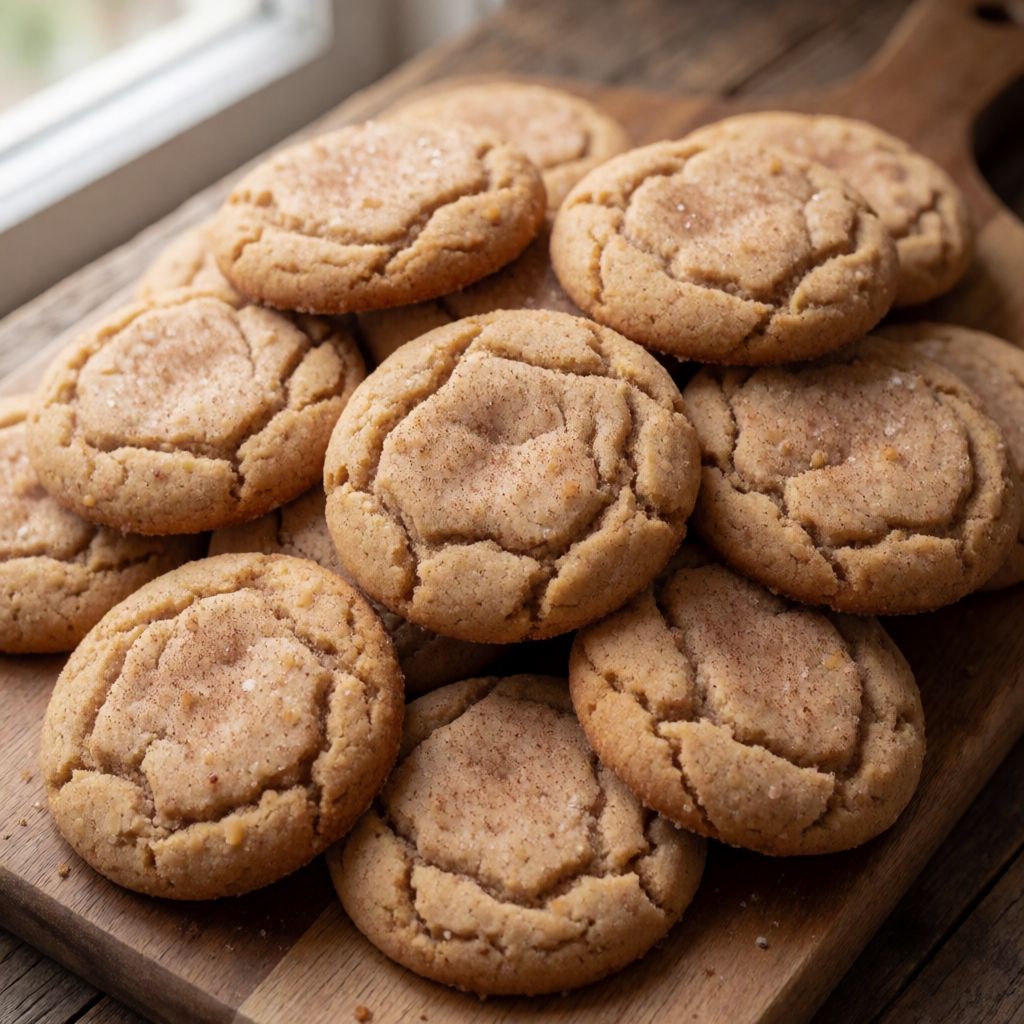
 AI photo
Christmas Cinnamon Cookies
Traditional spiced Christmas cookies with cinnamon and almonds, perfect for the festive season.
Labels are worked out automatically from the ingredients and can be wrong. Check the packaging if it matters to you.
Ingredients
- 150 g Plain flour
- 70 g Caster sugar
- 1 pinch Baking powder
- 125 g Butter
- 0.5 pcs Egg beaten
- 2 tbsp Caster sugar
- 1 tbsp Cinnamon ground
- 25 g Almonds peeled and chopped







Steps
Mix the flour, sugar and baking powder well. Rub the butter into the flour mixture until it resembles fine crumbs.
Quickly bring the dough together with half of the beaten egg (keep the other half for brushing).
Shape the dough into a roll about 5-6 cm in diameter. Wrap in baking parchment and place in the freezer for 30 minutes.
30 minCut the dough into thin rounds and arrange on a baking tray lined with baking parchment.
Brush with the remaining beaten egg and sprinkle with the cinnamon sugar and almonds.
1 minBake in a preheated fan oven at 180°C for 7-8 minutes. Watch closely so the biscuits don't burn - the edges should turn only lightly golden.
8 minLet cool on a wire rack.
What was changed
The traditional hartshorn leavening agent is replaced with Baking powder, since it's hard to find in the UK, and the oven temperature is rounded to .
This is a slice-and-bake cookie, the kind that German and Austrian kitchens turn out by the hundred in December — not because the dough is special, but because you make one roll, chill it, and keep cutting discs off it for as long as the roll lasts. Thirty biscuits from 150 g of flour is not a boast, it's arithmetic: thin dough, thin discs, a tray that holds a dozen at a time, and you go round twice.
What decides whether it works is not the oven, it's the hand. You rub cold butter into flour until it looks like crumbs — that's not texture for its own sake, that's you coating every grain of flour in fat so water can't get at it and build gluten. Skip that and your cinnamon cookie turns into a chewy biscuit, which is a different animal and not the one you're making here. Some say rubbing-in has to be done with ice-cold hands — no, the butter has to stay solid, that's all; if your kitchen is cool and you work quickly, warm hands are fine, the enemy is butter turning to paste, not your body heat.
The freezer step earns its place for a plainer reason than 'chilling improves flavour'. A soft roll squashes when you cut it — you get ovals, torn edges, uneven thickness, and uneven thickness means some discs are done while others are still pale. Thirty minutes firms the butter enough that the knife goes through clean, like cutting cold soap, not like cutting Play-Doh.
Flour here is doing one job: structure, kept to a minimum. Plain flour is lower in protein than bread flour, so it builds less gluten when the egg's moisture hits it — which is exactly why you don't want to reach for strong flour as a substitute; it will make the biscuit tough instead of short. If plain flour isn't in the cupboard, cutting ordinary flour with a spoon or two of cornflour gets you closer to the same low-gluten result than bread flour ever will.
The pinch of baking powder is not there to make these rise — there's no room for rise in a 5 cm dough log sliced thin. It's there so the crumb doesn't compact into something closer to shortbread-as-a-brick. Leave it out by accident and you'll get a denser, flatter bite; it still works, just less kindly on the teeth.
Butter should be a fat with body: unsalted, so you control the only salt note yourself (there's none added here, which tells you the dough leans on butter's own flavour, not seasoning). Margarine or a spreadable fat won't rub into crumbs the same way — too much water in them, and water is exactly what the rubbing-in is trying to keep away from the flour until the last moment.
Sugar comes in two forms doing two different jobs. The caster sugar in the dough dissolves fine enough during rubbing-in that you don't end up with gritty pockets — granulated sugar would leave hard crystals that don't fully disappear into the fat. The caster sugar mixed with cinnamon for the topping needs that same fineness so it clings to the egg-washed surface instead of rolling off onto the tray.
The egg is halved for a reason worth noticing: half goes into the dough as the only binder, because any more liquid starts building gluten and softening the short texture you worked for in step one. The other half is pure glue for the topping — brush it on, and the cinnamon sugar and chopped almond actually stay put instead of scattering across the tray when you move it. Almonds should be blanched — skin-on almonds carry a tannic bitterness and dark fleck that fights the cinnamon; if almonds aren't to hand, any nut that toasts without weeping oil works, hazelnut being the obvious swap, though it carries its own smell into the mix.
A word on the oven, since a UK kitchen usually means a fan oven as standard: 180°C fan is the number as written, no conversion needed. If your oven is conventional only, the honest rule of thumb is to add roughly 20°C, because a fan oven moves heat onto the food faster than a static one — but that's a guide, not a law, so still go by the rim of the biscuit, not the dial.
And once they're out, get them onto a wire rack, not left flat on the tray. A hot tray under a hot biscuit traps steam against the base, and that steam is what turns a crisp bottom soft within minutes. The rack lets air move underneath, and the sugar on top sets hard as it cools — that's the crunch you're actually after, and it only arrives once the biscuit stops being hot, not while it's still on the tray looking finished. Patience here is not sentimental — it's the last ten minutes of the actual cooking.