
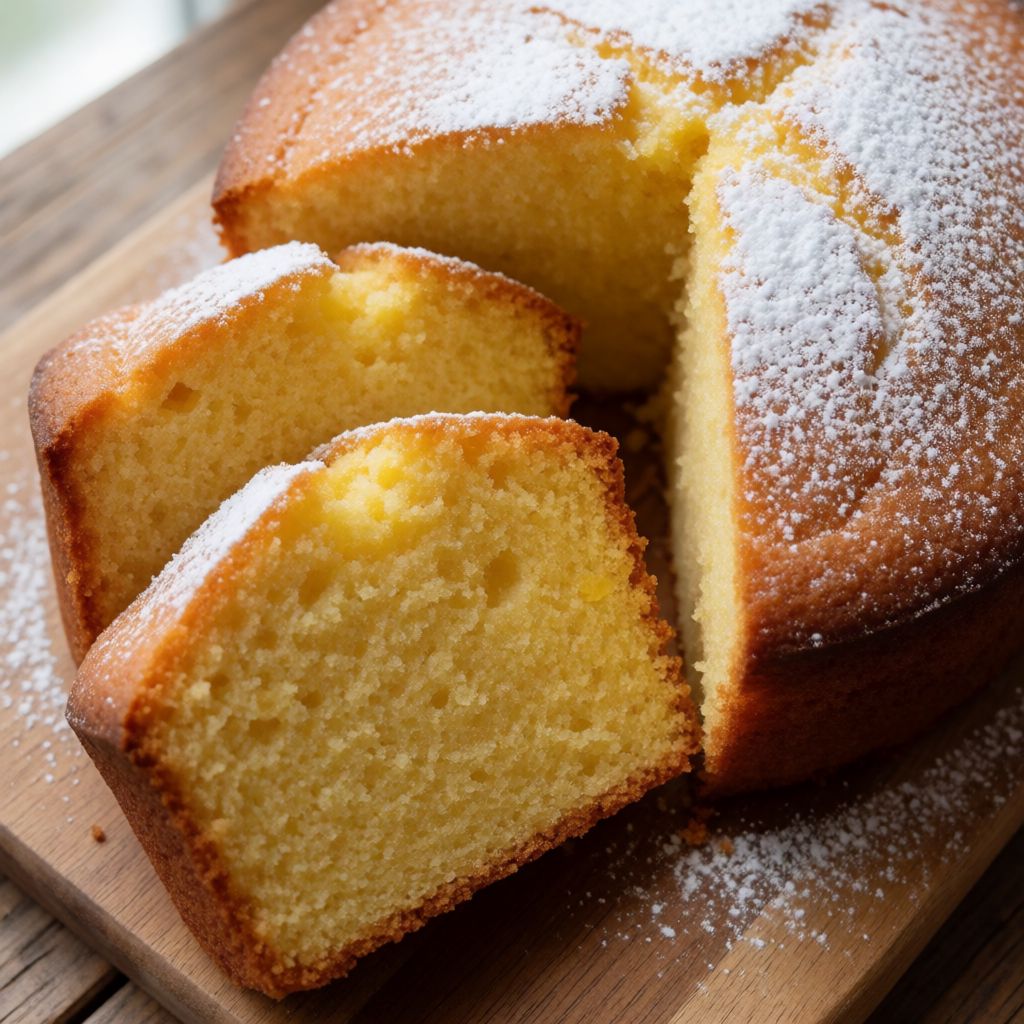
 AI photo
Citrus Cake
A buttery citrus cake with marzipan mixed through the batter, finished with a tangy lemon icing and dried lemon zest.
Labels are worked out automatically from the ingredients and can be wrong. Check the packaging if it matters to you.
Ingredients
- 250 g Butter soft, at room temperature
- 125 g icing sugar
- 110 g Caster sugar
- 1 tsp vanilla sugar
- 3 pcs Eggs
- 3 pcs egg yolks
- 250 g Plain flour
- 1 tsp Baking powder
- 1 pcs Lemon zest and juice
- 125 g Marzipan cut into small cubes
- 75 g Caster sugar
- 50 g Butter soft, at room temperature
- 2 pcs Eggs
- 1 pcs Lemon juice and zest
- 150 g icing sugar










Steps
Beat the butter, icing sugar, caster sugar and vanilla sugar until light and fluffy.
Add the eggs one at a time, then the yolks one at a time, mixing until smooth.
Combine the flour with the baking powder, sift into the batter and mix.
Add the lemon juice and finely grated lemon zest, and mix.
Mash the marzipan with the sugar until smooth, then add the butter and mix.
Mix in the eggs one at a time until the batter is smooth.
Combine the marzipan batter with the first batter until evenly distributed.
Pour the batter into a greased 24 cm tin lined with baking paper.
Bake in a preheated fan oven at 170°C for about 45 minutes, until fully cooked through.
45 minFor the lemon icing: peel the zest from a lemon and let it dry on a paper towel for 1 hour while the cake bakes and cools.
60 minWhisk the icing sugar with the lemon juice to a thick, white icing.
Spread the icing over the cooled cake and finish by sprinkling with the dried lemon zest.
This is a pound cake with a second, richer cake folded into it. Classic pound cake — butter, sugar, egg, flour in roughly equal weight — is dense because there's nothing to lighten it but the air you beat in at the start and the lift from baking powder. Marzipan batter, mixed in separately and then folded through, brings almond fat and ground-almond structure that a plain pound-cake crumb doesn't have: it sits in pockets, slightly denser, slightly damper, so you get two textures in one slice instead of one uniform one.
What decides whether it works is the creaming at the very start and the folding at the very end — everything else is arithmetic. Butter and sugar beaten until pale and fluffy isn't about taste, it's about trapping air in tiny bubbles around sugar crystals; that air is most of your rise, because baking powder alone can't lift a batter this heavy. Skip that stage or rush it cold, and the cake comes out tight and flat no matter how long it bakes. Then at the end, when you combine the lemon batter with the marzipan batter, you're protecting that same air — stir hard and you knock it back out, and you've wasted the first ten minutes of beating.
The lemon does two jobs, not one: zest for scent, juice for acid, and the acid matters because it reacts with the baking powder and gives a sharper edge against all that butter and almond. Icing on top is just icing sugar and lemon juice whisked to a thick white paste — no egg white, no cooking, just sugar dissolving into enough acid liquid to go spreadable, then setting hard again as the water evaporates.
Butter has to be properly soft, not melted — melted butter can't hold air bubbles, it just coats the sugar and sits there. Some say warm it a little in the microwave to speed things along: no, because a half-melted edge collapses the structure before you've even started, and the whole cake rides on that structure. Leave it out a few hours; if your kitchen's cold, a warm radiator shelf does the job, not heat applied directly.
Icing sugar plus caster sugar plus vanilla sugar in the main batter isn't fussiness — icing sugar dissolves instantly and gives a finer, tighter crumb, caster sugar holds a bit more structure and sweetness, vanilla sugar is there for scent rather than sweetness at all. If you've only got caster sugar in the cupboard, use it for the lot; the cake will be very slightly coarser and you won't notice in a loaf this rich.
Eggs and yolks go in separately, one at a time, for the same reason the butter has to be soft: each one has to be beaten fully into the fat before the next goes in, or the batter splits — you'll see it curdle, fat and liquid refusing to hold together — and a split batter traps less air and bakes heavier. If it does split, a spoonful of your measured flour beaten in will pull it back together; that's not cheating, that's just giving the egg something to grip onto.
Flour and baking powder get sifted together and folded in last and briefly, because flour develops gluten the moment it's wet and worked, and gluten in a cake is what you don't want — it's what makes bread chewy and cake tough. Mix until the flour disappears and stop. Plain flour, not self-raising, because you're controlling the lift yourself with a measured amount of baking powder; self-raising flour's built-in rise varies by brand and you lose that control.
Marzipan is almond paste bound with sugar — in Britain it's cheap and reliable off the supermarket shelf, which is itself a small piece of economics: almonds were once the luxury, now the sugar-bound paste is an everyday baking aisle item, so a cake that reads as special costs you very little. It has to be cut small before mashing with sugar, because a lump of marzipan won't break down in a mixer the way butter does — it's dense and slightly oily rather than creamy, and left in chunks it stays as chunks in the finished cake. If you can't get marzipan, ground almonds plus a little almond extract and extra sugar gets you most of the way, though you lose the dense, slightly chewy pocket marzipan gives.
The lemon zest for the icing gets dried on a paper towel for the hour the cake bakes and cools — not for show, but because wet zest sinks and bleeds colour into white icing, dry zest sits on top and stays where you put it. A plate over the cooling cake instead of a proper cake dome works fine in a normal kitchen; you just want the zest somewhere open to the air, not sealed under anything.
Tin size matters more than most recipes let on: 24 cm is wide enough that the centre of this heavy, almond-dense batter actually cooks through in the time given rather than staying wet in the middle while the edges dry out. Go smaller and you're either under-baked in the centre or burnt at the edge — there's no good version of that trade. "Fully cooked through" is a skewer coming out clean, not a clock; forty-five minutes is where to start checking, not where to stop.
This feeds twelve in reasonably restrained slices, which given the butter content is probably wise — it's a cake for a crowd with tea rather than a quick slice standing at the counter. Patience is the real ingredient twice over here: once at the start, letting butter and sugar actually go pale and fluffy rather than just combined, and once at the end, letting the cake cool properly before icing goes anywhere near it — warm cake melts icing straight off the top and you lose the finish for nothing.