
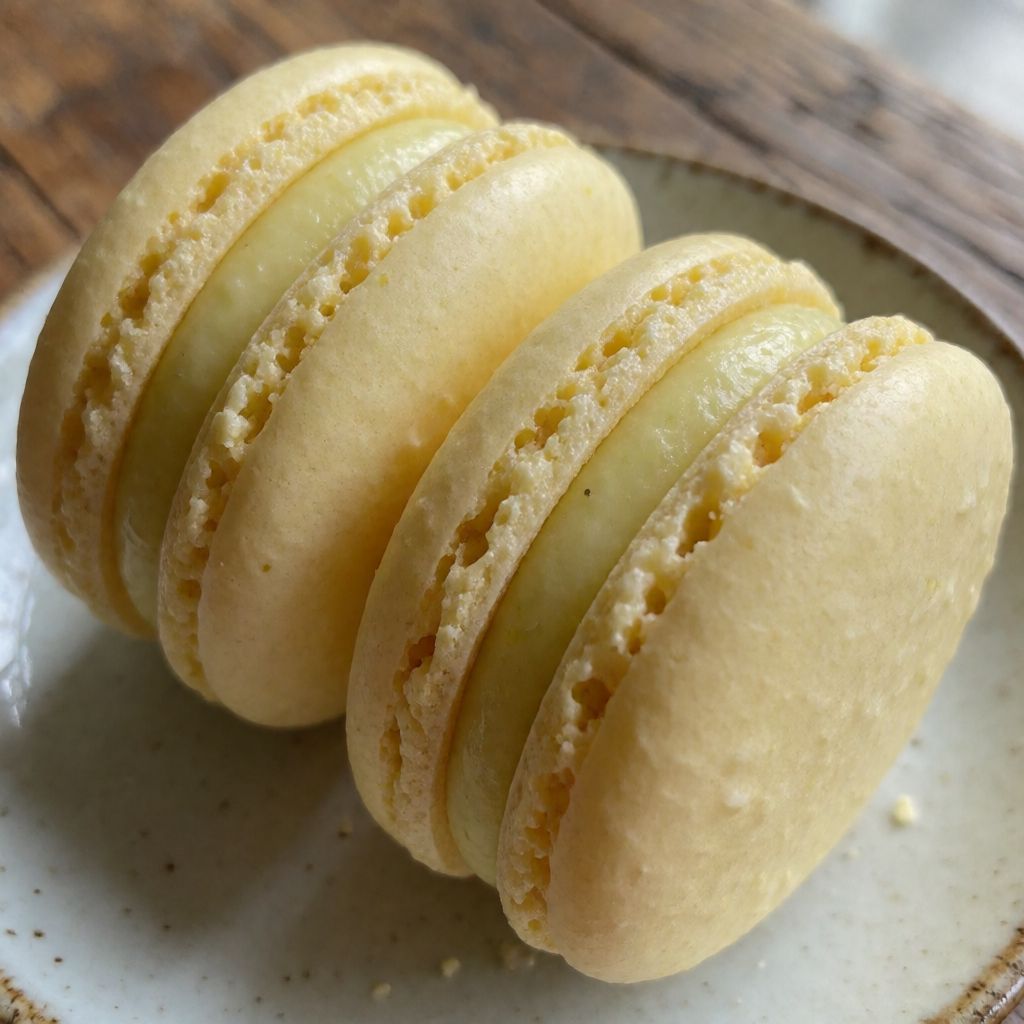
 AI photo
Citrus Macarons
Delicate macarons filled with tangy lemon and lime curd.
Labels are worked out automatically from the ingredients and can be wrong. Check the packaging if it matters to you.
Ingredients
- 150 ml Lemon juice
- 3 pcs Eggs
- 200 g Caster sugar
- ½ pcs Lemon finely grated zest
- 90 g Butter
- 8 pcs Lime juice of
- 3 pcs Eggs
- 200 g Caster sugar
- ½ pcs Lime finely grated zest
- 90 g Butter
- 300 g Ground almonds
- 300 g Icing sugar
- 220 g Egg whites
- 2 pinch Food colouring paste yellow and green
- 70 g Water
- 300 g Caster sugar







Steps
Whisk the lime/lemon juice, zest, eggs and sugar in a saucepan and heat gently to 65°C, stirring constantly.
Gradually whisk in the butter, stirring until the curd thickens, keeping the temperature no higher than 80°C.
Strain the curd through a sieve and pour it into a jar.
Put the curd in the fridge to cool.
Sift the ground almonds, add the icing sugar and half the egg whites, and beat until smooth.
Put the water and sugar in a saucepan and bring to the boil at 118°C.
Whisk the second half of the egg whites to stiff peaks, pour in the sugar syrup and fold in the colouring.
Gently fold the meringue into the almond mixture until smooth.
Pipe 3 cm round discs onto baking parchment.
Leave the macarons to dry at room temperature for 45 minutes.
45 minTransfer to a baking tray and bake at 160°C for about 10 minutes.
10 minLeave the macarons to cool on the parchment on a wire rack.
Pipe the curd onto half the shells and sandwich with the remaining shells.
Macarons are a chemistry demonstration dressed up as a biscuit. Everything that makes people fear them — the cracked tops, the hollow shells, the "pieds" that never form — comes down to three things: how much air is in the egg white, how that air is treated once it's there, and whether you let the batter rest before it meets the oven. Get those three right and the shape looks after itself.
This version splits into two jobs that don't touch each other until the end: a lime curd and a lemon curd, made the same way, and a macaron shell flavoured only by colour, because almond and sugar don't carry citrus — they carry air. You're not making one dessert, you're making two components that happen to share a technique, then marrying them at the last step.
The thing that decides success isn't the oven, it's the resting time on the parchment before baking. That's rule one: patience is an ingredient here, not a suggestion. Skin the piped discs in the air and you get a dry surface that holds the rise underneath it — a little roof. Skip it, and the steam has nowhere to go but through the top, and it cracks. Some say you can bake macarons straight off the piping bag if your kitchen's dry enough — no, because a UK kitchen in winter with the heating on is drier than you think and in summer it's wetter than you think; don't trust the room, trust the skin. Touch it. If it doesn't stick to your finger, it's ready.
Start with the eggs, because they do two different jobs in this recipe and get treated differently each time. In the curd, whole eggs are the setting agent — their proteins coagulate gently with heat and trap the citrus juice into something spreadable instead of runny. In the shell, it's the whites alone, split in two: half goes in raw with the almonds (this is what gives you a smooth, flowing "macaronage" base, not a stiff one), half gets whipped and turned into a meringue with hot syrup — that's an Italian meringue, more stable and heat-tolerant than whisking sugar into raw whites, which is why professional kitchens lean on it for anything that has to survive piping and a 45-minute rest without collapsing. Use eggs a few days old rather than fridge-fresh if you can manage it — the whites are looser and whip with more volume. This isn't folklore, it's just less water tension in an older white.
The ground almonds and icing sugar together are called tant pour tant — equal weight, equal part — and their job is structure and flavour carrier, not taste on their own. Sift them hard. Any lump of almond that doesn't pass through is a lump that blocks your piping nozzle and shows up as a bump on the shell. If you can't get fine ground almonds, you can mill whole blanched almonds yourself, but pulse with some of the icing sugar in short bursts — grind too long and the oil comes out and you've made almond butter, not flour.
Butter in the curd is there for richness and for mouthfeel — fat coats the tongue and softens the sharp acidity of lime and lemon so it reads as rounded rather than sour. Use an unsalted one; salted butter fights the sugar balance you've already set. Any neutral fat that sets at fridge temperature would technically hold the curd together, but butter is doing flavour work too here, so there's no real substitute worth naming.
The sugar syrup cooked to 118°C is the part people are most afraid of and the part that needs the least feel — it's a number, trust the thermometer, not the bubbles. Below that and the meringue stays soft and weeps later in the oven; go well past it and you risk caramelising, which would tint your careful yellow and green with brown. Some say you can skip the thermometer and judge by the "thread" the syrup pulls — no, because that judgement takes years of doing it daily, which a kazan-cook has and a Sunday baker doesn't. Buy the ten-pound sugar thermometer. It's cheaper than a wasted batch of almonds.
The food colouring is paste, not liquid, for a reason that has nothing to do with intensity of colour and everything to do with water content — liquid colouring adds moisture to a batter where moisture is the enemy of a crisp shell. If paste isn't in your cupboard, gel colouring behaves the same way; liquid drops from a supermarket baking aisle do not, and you'll fight a wetter batter all the way to the oven.
On your hob, 160°C means an oven thermometer, not trust in the dial — most domestic ovens drift by 10-15 degrees and macarons are unforgiving about that, since the whole pied (the little frilled foot at the base) only forms if the bottom heat hits the dried skin at the right pace, not too slow, not scorching. If your oven runs hot at the back, as most small UK ovens do, turn the tray halfway rather than trusting one static bake. Doneness isn't really the ten minutes — it's whether a shell lifts cleanly off the parchment without the base tearing. If it sticks, it needs longer, full stop; the clock is a floor, not a verdict.
Last point, on sandwiching: pipe the curd once the shells are fully cool, not warm — warm shells will let the curd melt and soak into the almond crumb, turning a crisp biscuit soft within an hour, which is why bakeries always build theirs the day before serving. That overnight rest in the fridge isn't neglect, it's the final step of the recipe — the moisture from the curd migrates slightly into the shell and turns it from "crisp outside, chewy inside" into properly macaron-textured all the way through. Eighty of these is a party platter, not a Tuesday treat, so plan the citrus work a day ahead of the baking and let the fridge do some of the labour for you.