
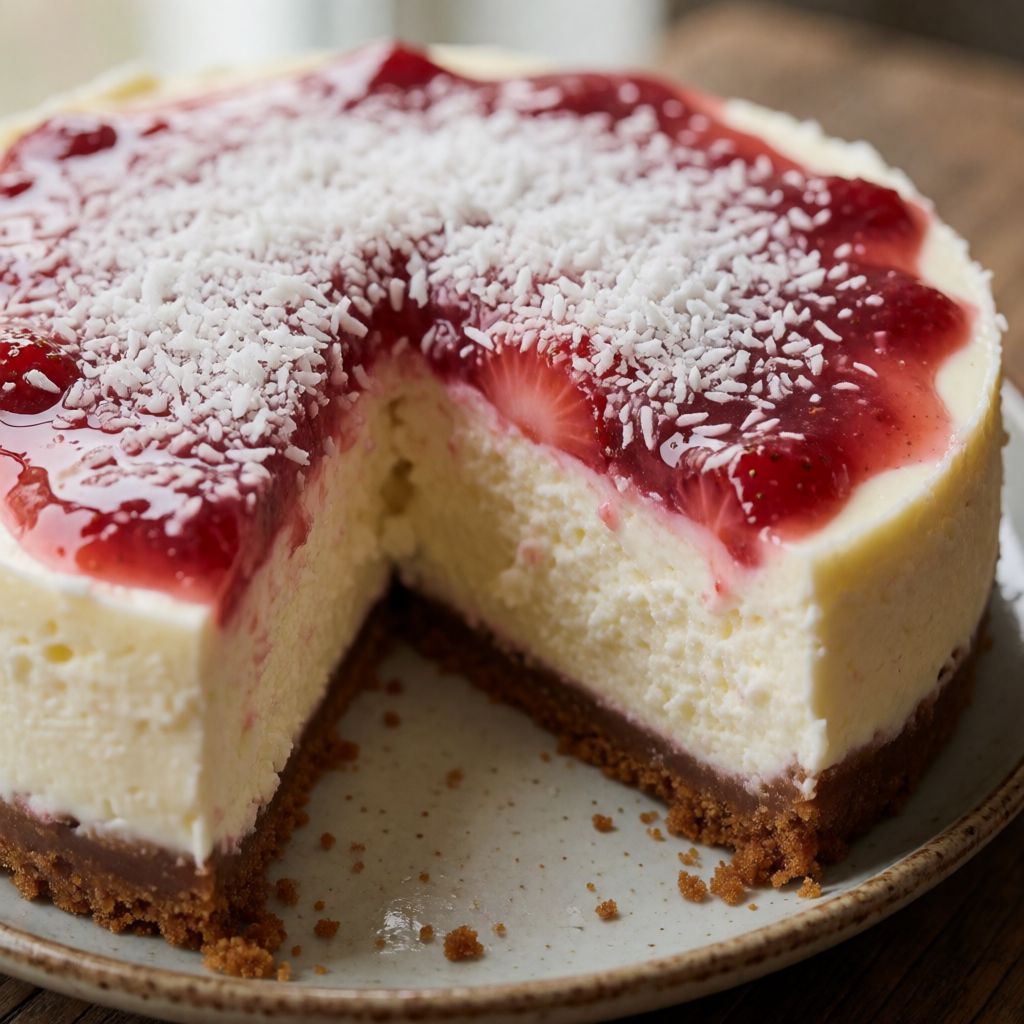
 AI photo
Coconut & Strawberry Cheesecake
A no-bake cheesecake with coconut, strawberries and a crisp biscuit base.
Labels are worked out automatically from the ingredients and can be wrong. Check the packaging if it matters to you.
Ingredients
- 250 g Digestive biscuits
- 100 g Butter melted
- 300 g Cream cheese
- 50 g Desiccated coconut
- 250 ml Double cream
- 60 g Icing sugar
- 120 g Strawberries washed and chopped
- 10 g Gelatine
- 180 g Strawberries halved lengthways







Steps
Blitz the biscuits in a food processor to fine crumbs, add the melted butter and mix until combined.
Press the mixture into the base of a 24 cm springform tin lined with baking paper, smoothing with the back of a spoon.
Chill the base in the fridge for about 30 minutes.
30 minSoak the gelatine in cold water for about 10 minutes, then squeeze out and dissolve in the hot cream until fully melted.
10 minBeat the cream cheese with a mixer, then add the desiccated coconut and chopped strawberries.
Pour the dissolved gelatine into the cream cheese mixture and stir through.
In a separate bowl, whip the remaining double cream with the icing sugar, then gently fold into the main mixture.
Take the base out of the fridge and arrange the halved strawberries around the edge of the tin.
Pour in the cream mixture and smooth the top with a spatula.
Chill in the fridge for at least 3 hours.
180 min
What was changed
Butter is used instead of ghee, and Cream cheese instead of goat ricotta, to suit UK shops.
This is a no-bake cheesecake, which means the whole dish is an argument against heat. The biscuit base holds together because melted butter coats the crumbs and then cools solid again — butter is the glue, the fridge is the oven. The filling sets not by egg and heat like a baked cheesecake, but by gelatine, which is why your fridge time isn't really "chilling", it's setting a structure. Get the gelatine wrong and you don't get a soft cheesecake, you get a bowl of flavoured cream that never becomes a cake.
What decides whether it works is temperature control at two points people don't think of as cooking. First, the cream you dissolve the gelatine in has to be hot enough to melt it fully but not so hot it boils — gelatine loses its setting power if it's boiled, not because of some old wives' tale but because sustained high heat breaks down the protein chains that make the gel. Second, that gelatine-cream has to go into the cream cheese mixture while it's still warm and liquid, before it starts setting in the bowl — pour it in once it's gone lumpy and you get streaks of jelly through the cake instead of an even set.
Some say gelatine desserts are fussy and prone to failure. No — they're forgiving of time but unforgiving of sequence. Soak, squeeze, dissolve gently, use warm: miss that order and no amount of extra chilling fixes it.
Six people, one 24cm tin, thirty minutes of actual work and then patience doing the rest — nearly four hours of it. That's the ingredient nobody weighs out but everyone skips.
Digestive biscuits are there because they're dry, slightly savoury, and break down to fine crumb without turning to paste — a British biscuit tin staple precisely because it holds its shape under butter and weight. If you haven't got digestives, any plain, not-too-sweet biscuit that crumbs rather than crumbles into dust will do — ginger nuts work and add their own note, shortbread works but is sweeter so ease back on the icing sugar later.
The butter needs to be fully melted, not just soft, so it coats every crumb evenly — a few unmelted lumps and you get dry patches in the base that won't press together and will crack when you cut the first slice. Any butter does this job; there's no flavour reason to reach for the expensive kind here, it's disappearing into crumb and cold storage.
Cream cheese is the backbone of the filling — it's thick enough to hold the strawberries and coconut suspended rather than letting them sink, and mild enough that the strawberry flavour isn't fighting it. Full-fat is not vanity here; low-fat versions carry more water, and water loosens a gelatine set that's already working hard.
The gelatine is 10g for a reason that isn't arbitrary — too little and the filling stays loose, more like a mousse that slumps when you cut it; too much and you get something with the bounce of jelly, not the soft give of cheesecake. If you want to avoid animal gelatine, a vegetarian setting agent works but behaves differently in heat and timing — read its own instructions rather than following these blind, because the mechanism (dissolve, cool slightly, fold in warm) doesn't transfer exactly.
Desiccated coconut is doing two things: texture, a bit of chew against the smoothness, and it soaks up a little moisture from the strawberries so the filling doesn't go watery. Fresh grated coconut has too much moisture for this job — stick with desiccated unless you're prepared to compensate elsewhere.
The two batches of strawberries do different work. The 120g chopped ones go into the body of the filling for flavour and flecks of colour; the 180g halved ones are structural and visual — they line the tin wall so that when you unclip the springform, the cake shows a ring of fruit rather than a wall of cream. Buy them firm, not soft and weeping — soft strawberries bleed juice into the cream mixture and you lose the clean line at the edge.
Double cream, whipped with icing sugar and folded in last, is what keeps the whole thing light rather than dense — fold gently, because knocking the air out here means the cheesecake sets heavy instead of holding a bit of lift. Icing sugar dissolves into the cream without the graininess caster sugar would leave behind, which matters more in a no-bake dessert than a baked one, since there's no heat later to melt away sugar crystals.
On the three hours in the fridge: that's a lower bound, not a target. A full set needs the gelatine to finish forming its structure through the whole depth of the tin, and a shallow flat in a UK kitchen often runs a fridge colder at the back than the door — if it still wobbles like liquid under the surface when you nudge the tin, give it longer, ideally overnight if you're serving the next day anyway.