
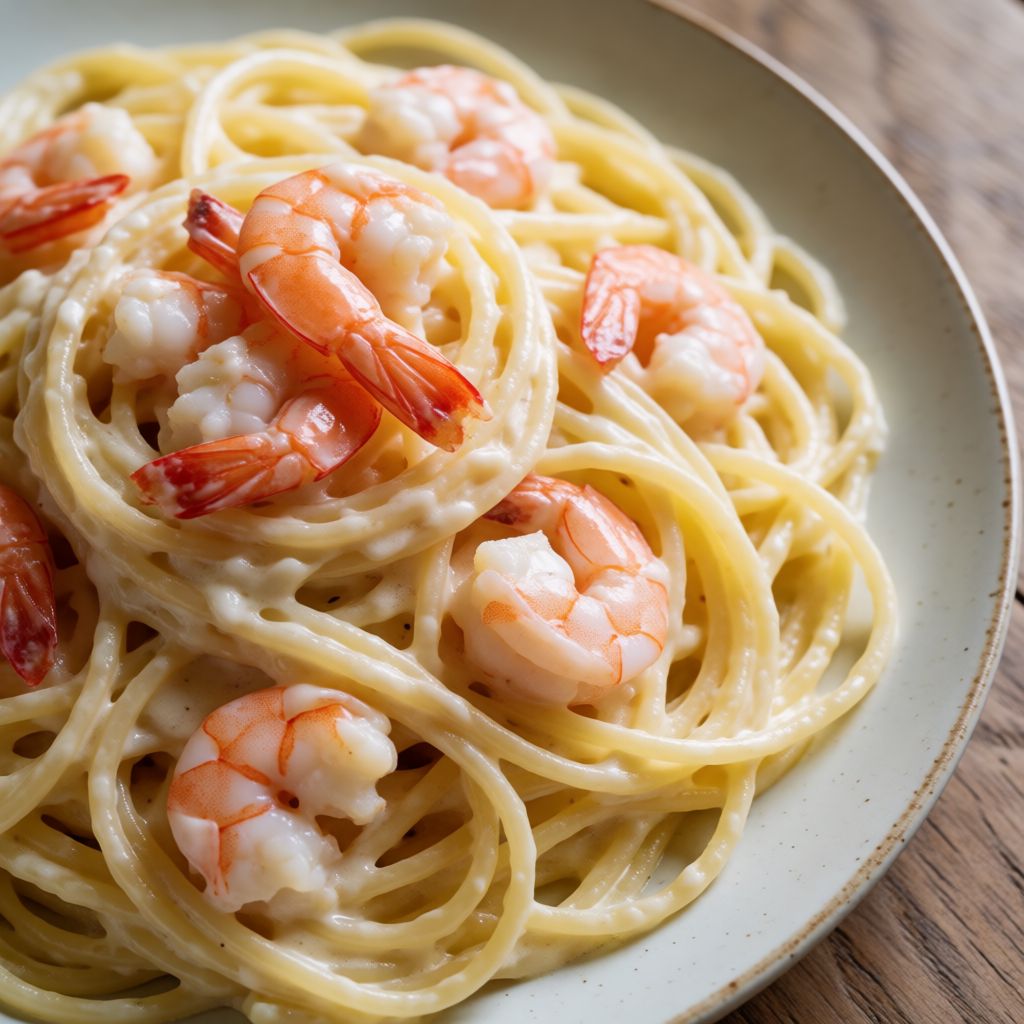
 AI photo
Creamy Spaghetti with Prawns and Tiger Prawn Tails
A creamy spaghetti dish with prawns and tiger prawn tails, finished with garlic, tomatoes and parsley.
Labels are worked out automatically from the ingredients and can be wrong. Check the packaging if it matters to you.
Ingredients
- 400 g Spaghetti
- 200 ml Double cream
- 200 g Prawns
- 200 g Tiger prawn tails
- 2 tbsp Olive oil plus extra to taste
- Salt to taste
- Black pepper to taste
- 150 g Datterini tomatoes chopped
- 1 clove Garlic
- Parsley to taste










Steps
In a pan, heat 2 tbsp of olive oil and fry the shells of the prawns and tiger prawn tails, crushing them to flavour the sauce.
5 minRemove the shells, crush the garlic and add it to the pan with the chopped datterini tomatoes.
2 minFry briefly, then add the peeled prawn tails and tiger prawn tails, and cook over high heat until pink. They are ready when the centre reaches 63°C.
5 minPour in the cream, season with salt and pepper, sprinkle with parsley, stir and heat through the sauce.
3 minMeanwhile, cook the spaghetti in salted water until al dente, drain and add to the pan.
10 minToss the pasta with the sauce, heat through for a couple of minutes and serve.
2 min
What was changed
The Tiger prawn tails were swapped for a prawn variety that is easy to find in UK shops.
This is a shellfish sauce built the way you'd build a quick bisque, except you haven't got three hours and a stockpot — you've got a pan and half an hour. So you take the shortcut that still works: fry the shells themselves before you throw them away. Shells hold more of a prawn's flavour and colour than the flesh does, and heat plus oil pulls it out fast. That first step looks like it does nothing. It's actually the whole dish.
What decides whether this works isn't the cream and it isn't the tomatoes — it's whether you give that oil its five minutes before binning the shells, and whether you pull the prawns off the heat the second they turn pink. Prawn flesh is unforgiving: translucent grey goes opaque pink in the time it takes to answer the phone, and a minute past that it tightens like a fist and squeezes out its own moisture. There's no fixing it afterwards, no amount of cream rescues a rubbery prawn.
Some kitchens swear seafood pasta needs a fistful of parmesan to feel finished. No — because cheese and shellfish argue with each other on the tongue, and that's not snobbery, it's an old, practical rule from Italian cooking. The cream is doing the richness here; the shell-infused oil is doing the flavour. Nothing else gets asked to do that job, so don't hand it to cheese that wasn't invited.
Two sizes of prawn, two jobs. The small prawns more or less melt into the sauce, barely keeping their shape; the tiger tails give you something to actually bite, a reason this is dinner and not a garnish on someone else's dinner. If you can only find one size, use it for both — but buy raw and shell-on where you can. The frozen, already-peeled, already-cooked ones have usually given up most of their flavour to the ice they sat in for months, which is exactly the flavour you're trying to put back with the shell-frying step.
The shells are your stock, compressed into five minutes instead of simmered for three hours. Crush them in the oil so more surface tears open — whole shells just sit there looking busy and give you almost nothing back. Don't watch a clock here, watch and smell: raw sea-smell turns toasty, grey-pink shell turns a deeper orange-red. Go too hard and it turns bitter, and that bitterness doesn't wash out of the oil once it's in — so keep it lively, not fierce, and let the five minutes actually be five minutes. This is where patience is the real ingredient; rush it and you've made pink water with cream poured on top.
Double cream specifically, not whatever's cheapest. At around 48% fat it won't split when it meets the acid from the tomatoes or sits over heat a little too long — single cream, or anything marked "light," will separate into fat and watery curds the moment you push it past a bare simmer, and once split there's no putting it back. If it's the same tub you'd use for a Sunday roast's jug of cream, that's fine, as long as the label says double, or something equally heavy like crème fraîche, which holds for the same reason.
Datterini tomatoes are small and thin-skinned on purpose — their whole job is sweetness and a touch of acid to cut the cream and the shell-fat, not bulk. A big beefsteak tomato brings mostly water at this scale and not much flavour for the trouble. Any small, ripe, genuinely sweet tomato does the same work — good cherry tomatoes, a ripe plum tomato halved. One clove of garlic, crushed rather than sliced: crushing opens more cells and gives you a rounder flavour in two minutes than slicing manages, and two minutes over a lively heat is enough to soften it without scorching it bitter.
For the oil, don't reach for the usual rule of "something with no smell of its own" — here you actually want a little presence, since this oil is what carries the shell-flavour into the sauce. A light, not too grassy olive oil suits it. If that's not in the cupboard, a neutral oil like sunflower will still carry the shell-flavour through, you just lose a bit of its own roundness underneath.
Cook the spaghetti separately in properly salted water, not crammed into the sauce pan — pasta needs real volume of boiling water to cook evenly, and a shallow sauce can't give it that. It's worth keeping back a cup of that starchy water before draining, not because the recipe says to but because if the sauce has tightened too much by the time the pasta goes in, a splash loosens it without watering down the flavour. And once it's all together, serve it — a domestic hob keeps the pan hot enough to go on cooking the prawns a little even off the heat, so this isn't a dish that's patient with you at the table, only before it.