
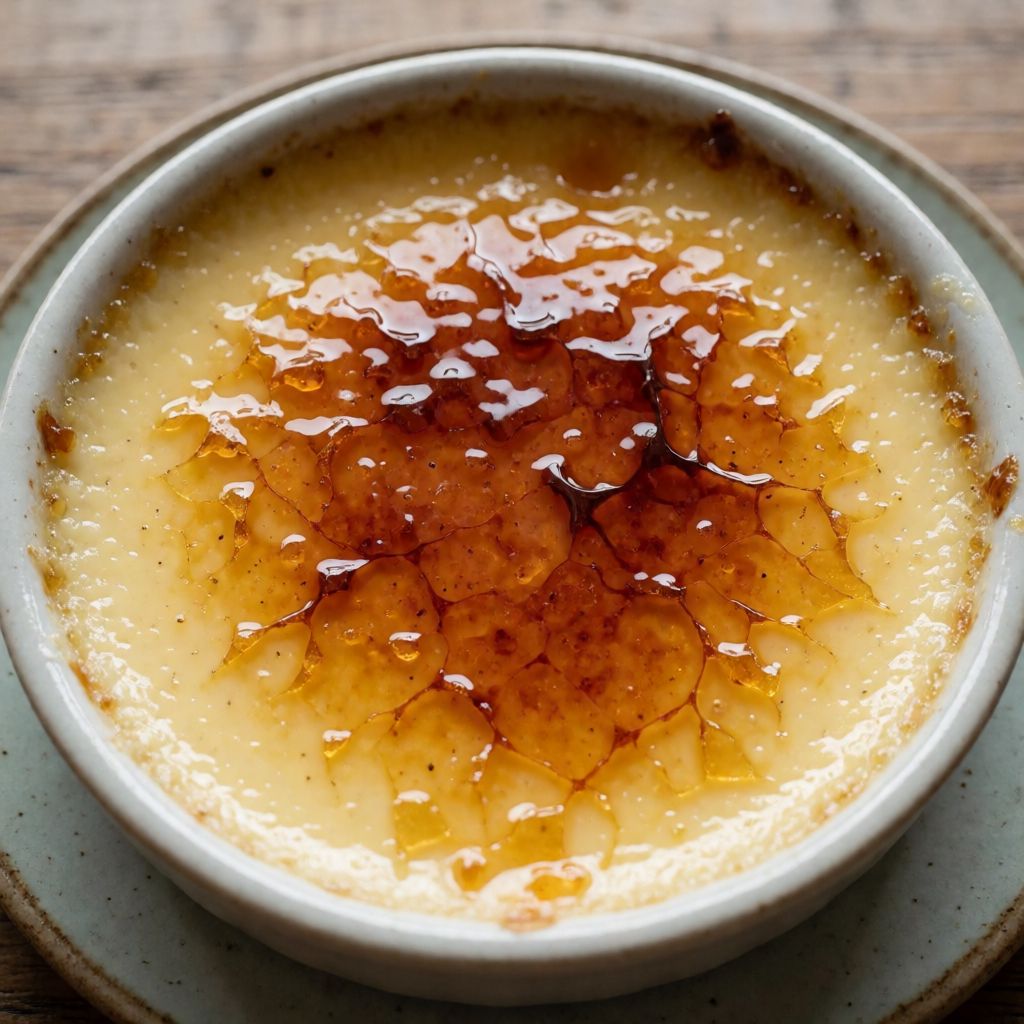
 AI photo
Crème Brûlée
A classic French-style baked vanilla custard with a crisp caramelised sugar topping.
Labels are worked out automatically from the ingredients and can be wrong. Check the packaging if it matters to you.
Ingredients
- 1 pcs vanilla pod
- 60 g caster sugar
- 5 pcs egg yolks
- 350 ml double cream
- 100 ml milk
- 50 g caster sugar





Steps
Split the vanilla pod lengthways, scrape out the seeds and mix them with the sugar.
Whisk the egg yolks with the sugar and vanilla until light and fluffy.
4 minHeat the cream and milk together with the scraped vanilla pod, stirring, until almost boiling.
5 minRemove the vanilla pod and slowly pour the hot cream into the egg mixture, whisking constantly.
3 minPour the custard back into the pan and heat gently, stirring, to exactly 80°C, checking with a sugar thermometer.
Leave the custard to cool for 1 hour, stirring a few times.
60 minSkim off any foam from the top of the custard and stir well so the vanilla seeds are evenly distributed.
2 minPour the vanilla custard into shallow ramekins 11 cm across and 3 cm deep.
Place the ramekins in a roasting tray with a little space between them, and set in an oven preheated to 120°C with conventional top and bottom heat. Carefully pour boiling water into the tray to come halfway up the ramekins.
Bake for 45–60 minutes, until the custard has set but still yields to a gentle press, remaining soft and slightly wobbly in the centre.
52 minChill the ramekins in the fridge for at least 3 hours, preferably overnight.
180 minTake the ramekins out of the fridge and sprinkle with a thin layer of sugar. Quickly torch with a crème brûlée torch until the sugar caramelises, and serve immediately.
Crème brûlée is two textures arguing with each other, and the whole dish is the argument: cold, soft-set custard underneath, a thin hot glass of caramel on top. You get one shot at the glass before it dissolves into syrup, which is why this is cooked twice — once gently, in the oven, days or hours ahead, and once violently, under a flame, seconds before anyone eats it. Everything in the method exists to protect that contrast.
What decides whether it works is heat control at two separate points. The custard base must never boil — egg yolks start to set around 70°C and turn grainy, scrambled, by 85°C, so cooking it to exactly 80°C on the hob, and then finishing in a bath of water in the oven, is not fussiness, it's the only way to hold the mixture in that narrow window long enough for it to thicken without curdling. Some say you need a kazan-deep bain-marie for this — no, you need water that stays below boiling, and a shallow domestic roasting tin does that fine, because the water's own temperature, not the pan's shape, is what's protecting the eggs.
The second heat point is the torch. A thin, even layer of sugar, blasted fast and close, caramelises before the custard underneath has time to warm up and go runny. This is also why you sprinkle the sugar only after the custard has chilled for hours, not before — a cold base buys you the seconds you need under the flame.
Start with the vanilla. Scraping the seeds into the sugar before anything else happens isn't decoration — rubbing seeds through sugar crystals breaks up the clumps and distributes the flavour-bearing oils through the whole batch, instead of leaving you with a few lucky black specks in one spoonful and none in the next. The empty pod still has plenty to give, which is why it goes into the cream to infuse rather than into the bin; infusing in warm liquid, not boiling, matters because vanilla's aromatic compounds are volatile and boil off exactly when you want to keep them.
The yolks carry the fat and the proteins that set the custard; the sugar whisked in with them does two jobs, sweetening and also protecting — sugar coats the yolk proteins and slows them from clumping the instant hot liquid hits them. That's also why the hot cream goes into the eggs slowly, whisking constantly, rather than the eggs going into the pan: a thin stream gives the proteins time to warm gradually instead of seizing in patches, which is the real cause of the grainy, curdled custard people blame on "bad eggs" when it's really bad pouring.
Cream and milk together, not cream alone, is a balance of richness against pourability — all cream sets heavier and feels almost buttery when chilled; cutting it with milk keeps the custard able to wobble rather than stand. If you want to swap, keep that ratio of rich-to-light roughly the same; a lower-fat cream will set softer and may need slightly longer in the oven to firm up.
The hour of cooling with occasional stirring, and the skimming of foam before baking, both solve the same problem from different ends: foam traps air that would otherwise rise to the surface in the oven and set as an ugly, bubbly crust, so you knock it out while the custard is still loose enough to let it go. Patience here is not optional — rushing the cool-down and pouring hot custard straight into ramekins just means it keeps cooking itself on contact with the dish.
The low oven, 120°C, with water halfway up the ramekins, is doing the same gentle-heat job as the 80°C hob step, just stretched over nearly an hour instead of minutes, because a shallow dish of custard needs slow, even heat to set through without the edges overcooking before the centre catches up. Don't judge it by the clock on the recipe — judge it by the centre still giving a little wobble under a light press, because ramekin thickness and your particular oven will shift the real time either side of that window.
Any caster sugar works for both the custard and the glass top — fine, pure, fast to dissolve — and if you only have granulated, that's fine for the custard where it has time to dissolve in heat, but for the brûlée top finer sugar melts more evenly and caramelises before it has a chance to burn in patches. If you have no torch, a very hot broiler will get you a caramel crust in a pinch, though it works the custard underneath harder and you lose some of that cold-hot contrast that is the whole point of the dish.