
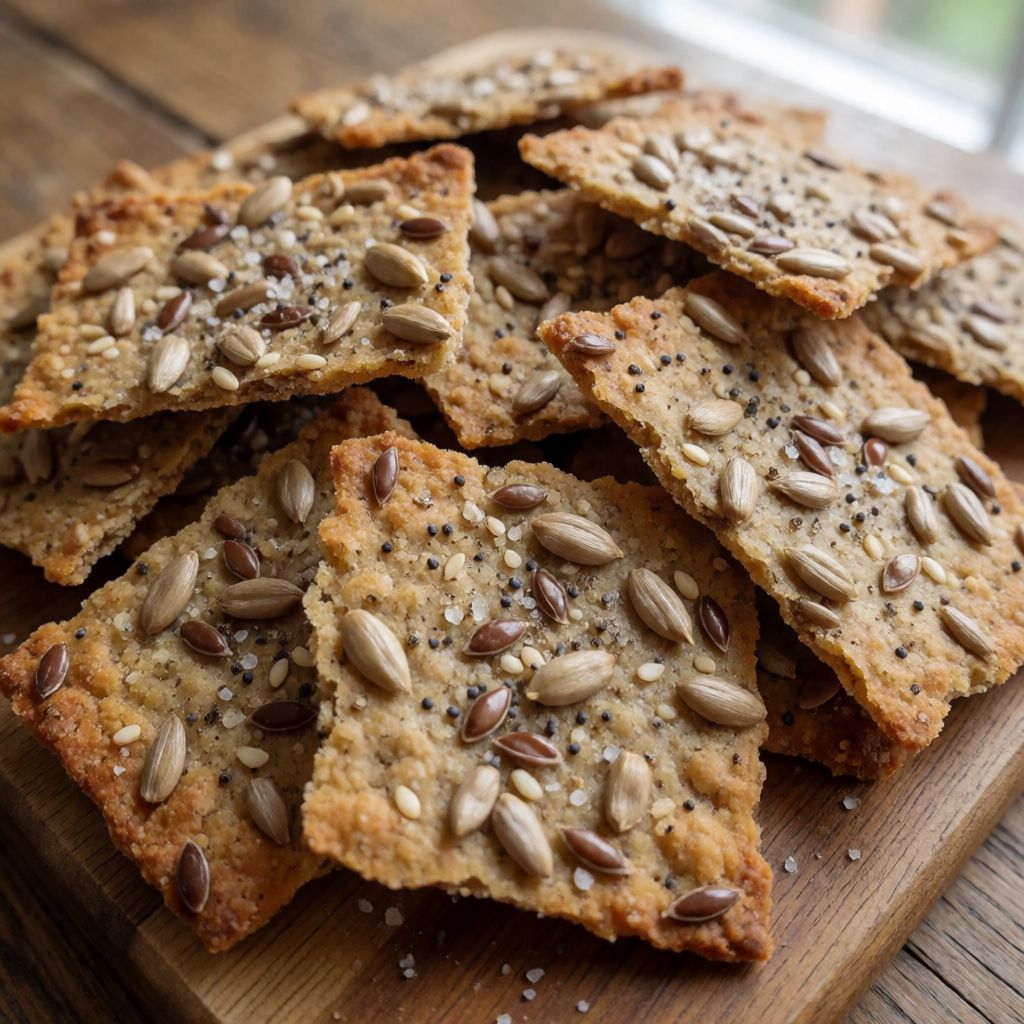
 AI photo
Crunchy Seed Crackers with Poppy Seeds, Salt and Pepper
Thin, crisp homemade crackers packed with seeds, perfect for snacking or serving with cheese.
Labels are worked out automatically from the ingredients and can be wrong. Check the packaging if it matters to you.
Ingredients
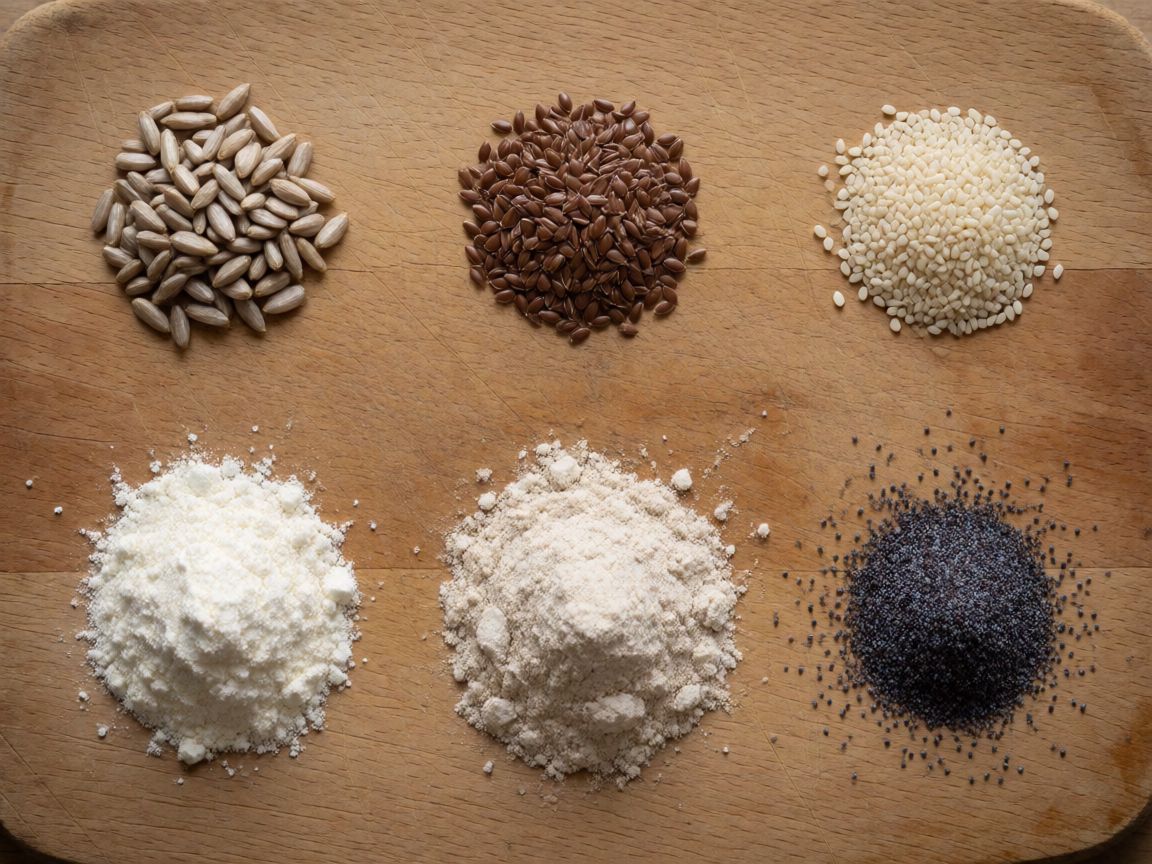
- 75 g Sunflower Seeds
- 75 g Flax Seeds
- 100 g Sesame Seeds
- 125 g Plain Flour
- 60 g Wholemeal Flour
- 1 tsp Poppy Seeds
- 0.5 tsp Salt
- 75 ml Olive Oil
- 200 ml Water
- 1 tsp Poppy Seeds for sprinkling
- 0.5 tsp Salt for sprinkling
- 1 pinch Black Pepper freshly ground





Steps
Mix the dry ingredients well in a bowl, then add the olive oil followed by the water. Stir until the dough is thick and smooth.
Divide the dough between two sheets of baking paper. Cover with another sheet of paper and roll out to a thickness of 1.5-2 mm.
Remove the top sheet of paper and transfer the paper with the dough onto a baking tray. Cut the dough with a sharp knife, a pizza cutter or a pastry wheel.
Sprinkle with flaky salt, freshly ground pepper and a little extra poppy seed.
Bake in a preheated fan oven at 175°C for 20-30 minutes, until the crackers are crisp.
25 minBreak along the scored lines or snap into pieces and leave to cool on a wire rack.
This isn't a biscuit dough, it's a slurry of seeds held together by just enough flour and oil to let it set. Three different seeds — sunflower, flax, sesame — each do a different job: sunflower gives bulk and a mild nuttiness, sesame brings crunch and a toasted edge once it hits the oven, and flax is the one doing the real work. Flax seeds release a gum when wet — that's why the mixture goes from loose and grainy to "thick and smooth" within a minute of adding water. That gum is your binder. Without it you'd need far more flour, and the cracker would taste of flour instead of seeds.
What decides whether these work is thickness, not time. Roll it thicker than 2mm and the inside stays chewy under a crisp shell — not a disaster, just a different cracker, more like a flapjack. Roll it properly thin and even, and the whole thing dries through at the same rate, so it shatters rather than bends. That's the test at the end: a cracker that's done snaps clean. One that's still faintly flexible when warm will go leathery, not crisp, as it cools — put it back in.
Some say you need a pasta machine or a proper rolling pin set with guide rings to get this even. No — you need two sheets of paper and patience. The paper does two jobs: it stops a wet, seedy dough sticking to the rolling pin, and it lets you transfer something fragile straight onto the tray without touching it. Tearing it or trying to drag the dough by hand is what cracks the sheet before it's even baked.
On ingredients: the flour here is structural scaffolding, not flavour. Plain flour gives you a dough that holds a shape when scored; wholemeal adds a little bran grit and colour, nothing more dramatic than that. If you've only got plain flour in the cupboard, use all plain — you lose a bit of nuttiness, you don't lose the cracker. Don't swap in self-raising. You want flat and dense here, not a rise; baking powder would just make the sheet buckle unevenly as it bakes, and uneven buckling means uneven crisping.
The seed mix is where you can actually play. The rule for substitution isn't "use these three seeds," it's: keep one seed that releases gum when wet (flax or chia both do this — chia even more aggressively, so cut the water slightly if you swap it in), and the rest can be whatever you have — pumpkin seeds, extra sesame, a spoon of chia. What you're protecting is the binding mechanism, not the seed inventory.
Olive oil at 75ml is doing a smaller but real job: it coats the seeds and flour particles so they don't just glue into a solid brick, and it's what gives the finished cracker that short, clean snap rather than a cardboard one. Any neutral or mild oil works — the brief given generally is "any oil with no smell of its own," but olive oil here is mild enough in this quantity that it's really there for texture, not for flavour, so a light olive or even a flavourless vegetable oil both do the job. Don't use a very assertive extra virgin — it'll sit on top of the seed flavour rather than melting into it.
Salt split two ways — half in the dough, half sprinkled on top — isn't fussiness, it's about where you taste it. Salt mixed through disappears into the body of the cracker; salt sprinkled on top before baking sits on the surface and is the first thing your tongue meets. Skip the sprinkle and the cracker tastes flat even though the same amount of salt is technically in there — taste is about contact, not total quantity.
On your cooker: a fan oven at 175°C is a genuinely gentle, drying heat rather than a scorching one — that's deliberate, because these crackers need moisture driven out slowly and evenly far more than they need colour fast. If your oven runs hot or has hot spots (most domestic ovens do, particularly at the back), turn the tray round halfway through rather than trusting the timer blindly — that protects against the classic result of one end burnt and the other soft.
Patience here isn't poetic, it's literal: the cooling on a wire rack at the end is doing chemistry, not just sitting around. A cracker straight from the oven is still steaming internally and will feel softer than it is; the crunch you're after sets in as it cools and that last bit of moisture escapes into the air rather than staying trapped against a plate or tray. Cool it flat on a solid surface and the underside goes soft from trapped steam — that's the one mistake that undoes everything correct you did with the rolling and the oven.