
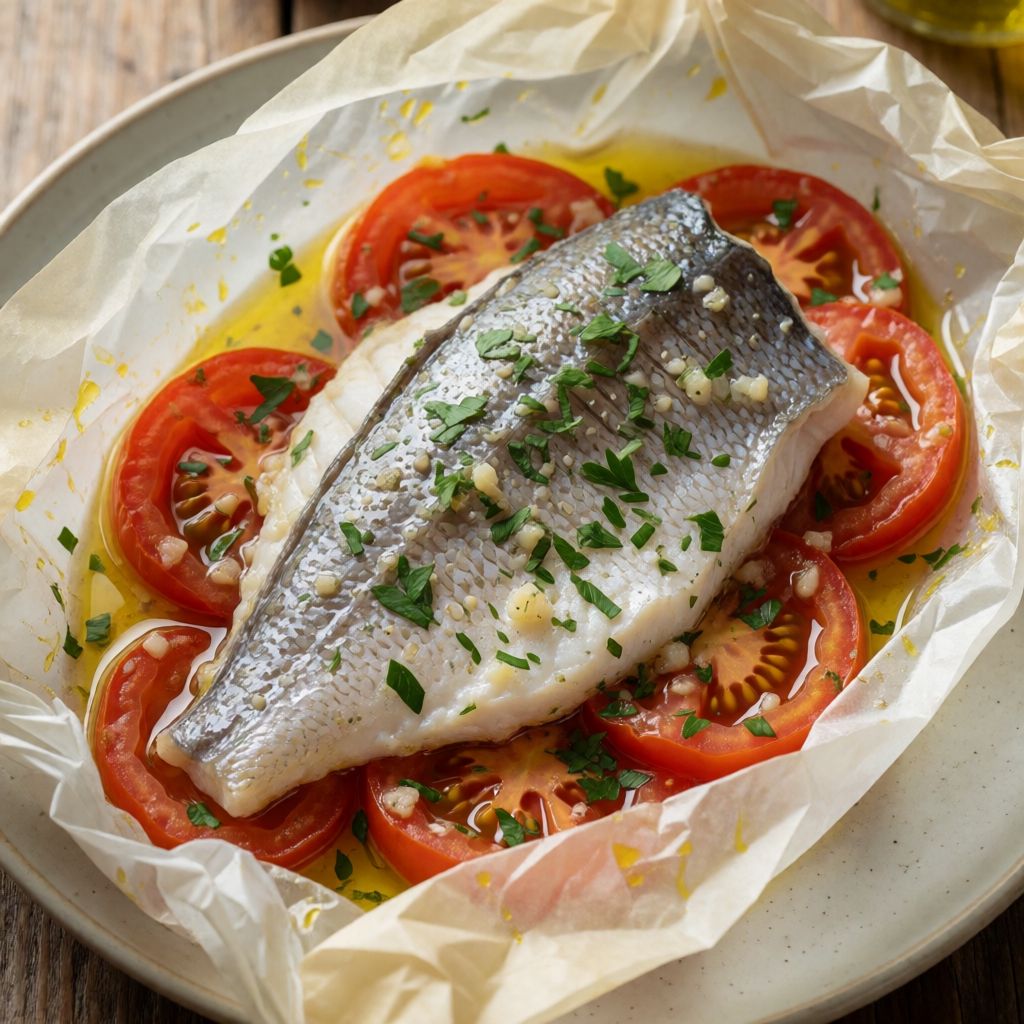
 AI photo
Sea Bream en Papillote
Sea bream baked in foil parcels with cherry tomatoes, garlic and parsley for a light, moist fish dish.
Labels are worked out automatically from the ingredients and can be wrong. Check the packaging if it matters to you.
Ingredients
- 4 pcs Sea Bream
- 20 pcs Cherry Tomatoes
- 2 clove Garlic
- 1 bunch Parsley
- 4 tbsp Olive Oil
- Salt to taste
- Black Pepper to taste







Steps
Clean the sea bream: slit the belly, remove the innards and bones, rinse under water, trim the fins with scissors, scale and rinse again.
Wash the cherry tomatoes and halve them. Peel the garlic, remove the sprout and chop it finely. Wash the parsley and chop it finely.
Spread the parsley, garlic and tomatoes over four sheets of foil, and season with salt and pepper.
Place one sea bream on each sheet, distribute the rest of the filling and drizzle with olive oil.
Wrap the foil tightly so the filling doesn't leak out.
Pour a little water into the bottom of a baking tray and place the four parcels on it.
Bake in an oven preheated to 180°C for about 20-25 minutes, until the fish is cooked through.
22 minRemove from the oven and serve.
A sea bream en papillote is not really baking. It is steaming, done inside its own little tin-foil oven, set inside your actual oven. Once you seal that parcel shut, the air inside can't get hotter than the point where its own moisture turns to steam — call it just over boiling. The 180°C around the parcel is there to keep that steam coming, not to roast the fish directly. That's the whole trick, and it's why this dish forgives a cook who's five minutes late to the kitchen: the fish is poaching gently in tomato juice and its own liquor, not frying in dry heat.
What decides whether it works is the seal, full stop. Not the fish, not the oven's accuracy, not even the tomatoes — the seal. A tight parcel holds its steam and the fish stays moist however long it sits. A torn or loosely folded one lets that steam escape, dry oven air gets in, and you end up with fish that's tough at the edges and raw near the bone, because now it's genuinely roasting unevenly instead of steaming evenly. If your bream turns out dry, don't blame the 22 minutes — go back and look at the foil.
Some people think foil-wrapped cooking must mean the fish is "roasted in foil", same family as a jacket potato. No — it's the opposite mechanism. A potato in foil still sits in dry oven heat, the foil just holds warmth close. Here the foil's job is to trap liquid that turns to vapour, which is a cooler, gentler environment than the air in your oven. That's why bream, a fish with modest fat and not much forgiveness, comes out tender instead of chalky.
Choose a fish, not a photograph of one. A whole bream that's fresh smells of the sea and faintly sweet, not "fishy"; eyes clear, not sunken and cloudy; gills red rather than brown. UK fishmongers and most supermarket counters will gut and scale it to order — ask, and you skip the belly-and-scissors work in step one entirely. If bream isn't to be had, the criterion is a firm, white-fleshed round fish of similar size — sea bass does the job with barely a change in behaviour. Avoid flat fish like plaice here; they're thin enough to overcook in the time it takes you to close the foil.
The cherry tomatoes aren't a garnish, they're the engine. Halved, salted, they weep juice almost immediately, and that juice is most of the steam your parcel runs on — along with whatever moisture the fish itself gives up. Fewer or drier tomatoes and the parcel runs on fumes, so if yours are the pale, watery winter kind rather than ripe and sweet, add a splash of water or wine to the parcel to be safe. Any ripe tomato, roughly chopped, does the same work.
Garlic goes in raw and sharp, but trapped in steam at a gentle heat for twenty-odd minutes it softens into something sweeter, closer to roasted garlic than the raw bite you'd get in a salad. That transformation is lost if you swap in garlic powder — convenient, but you get flatness instead of that mellow note. Fresh is worth the thirty seconds of chopping here.
Parsley is there for a clean, grassy lift against the richness of oily fish and olive oil — not for colour, though it does that too. Dill is the more traditional partner for fish in plenty of kitchens and works just as well if that's what's in your fridge; the only rule for the herb is that it shouldn't be so strong it argues with the fish rather than supporting it.
The oil needs no flavour of its own strong enough to compete with four minutes of delicate steam-cooking — a light olive oil is right; a heavily peppery, grassy extra-virgin will dominate a fish this subtle. Any neutral oil works if that's all you have; you lose a little richness, not the mechanism.
The water in the tray under the parcels is not decoration either — it stops the foil scorching or catching on a hot metal tray before the fish is even done, and adds a touch of ambient humidity to an oven that's otherwise bone dry. This is a trick worth remembering any time you're cooking something delicate wrapped in foil on a domestic hob's oven, which runs hotter and drier at the bottom than people assume. And don't rush the parcels open the second the timer goes — give them a minute's rest on the tray. The steam inside keeps working a little after the door's shut, finishing the fish gently rather than violently. That minute of waiting is the one bit of patience this dish actually asks of you.