
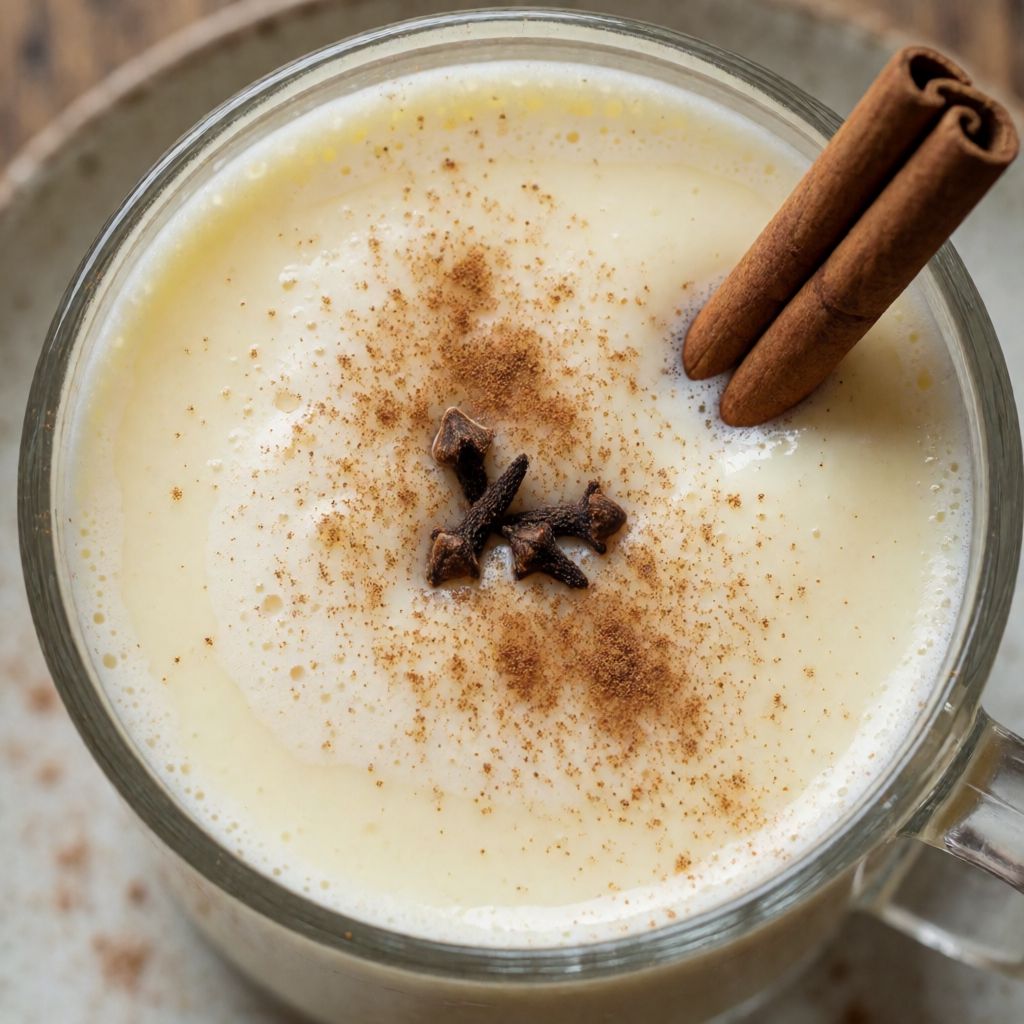
 AI photo
Eggnog Cocktail
A warming spiced eggnog with rum, finished with whipped cream and a peppermint-sugared rim.
Labels are worked out automatically from the ingredients and can be wrong. Check the packaging if it matters to you.
Ingredients
- ½ pcs vanilla pod
- 70 g caster sugar
- 4 pcs egg yolks
- 400 ml milk
- 4 pcs cloves whole
- ½ tsp cinnamon ground
- 150 ml rum
- 100 ml double cream
- 1 pinch nutmeg finely grated
- 6 pcs candy canes
- 1 tsp glucose syrup









Steps
Prepare 4 hours before serving. Scrape the seeds from the vanilla pod and mix with the sugar.
Whisk the egg yolks, vanilla and sugar in a bowl until pale and creamy.
Put the milk, cloves and cinnamon into a saucepan. Heat slowly, stirring, almost to the boil.
Strain out the spices and slowly pour the hot spiced milk into the egg mixture, whisking constantly.
Pour the drink back into the saucepan and slowly heat to 65°C, stirring constantly.
Check the temperature and make sure it does not exceed 70°C, or the eggs may curdle.
Chill the drink in the fridge for at least 3 hours.
180 minJust before serving, whip the cream to a light foam.
Stir the rum, whipped cream and a little nutmeg into the eggnog, to taste.
Crush a few candy canes.
Dip the rims of the glasses first in the syrup, then in the crushed candy canes.
Pour the eggnog into the glasses and serve at once.
Forget the carton of yellow stuff from the supermarket shelf. What you're making here is a spiced custard — the same family as the stuff you pour over a Sunday pudding — except this one is chilled instead of served warm, and loosened with rum and whipped cream so it drinks instead of sits on a spoon. Egg yolks, sugar, milk: that's crème anglaise. Everything else is seasoning and theatre.
What decides whether this works is one number, and it isn't really a number you need a thermometer for, though it helps: the point where egg proteins stop being liquid and start holding shape, somewhere around 65°C, and the point two degrees later where they stop holding shape nicely and start holding it in lumps. That's the whole drama of the recipe. Below the first point, you have warm, flavoured milk with raw egg stirred through it — thin, a bit dangerous, not an eggnog. Above the second, you have sweet spiced scrambled egg floating in milk, which nobody has ever wanted to drink. The window between is narrow, maybe five degrees, and it closes fast once the pan gets ahead of you.
Trace the actual failure — curdled, grainy eggnog — back to its cause and it's almost never the recipe's fault. It's a domestic hob with a thin-bottomed pan delivering heat faster at the base than your stirring arm can redistribute it. The egg right against the metal hits 80°C while your spoon reads an average of 60. Fix: don't trust 'medium heat', trust what you see — the first threads of steam lifting off the surface, no bubbles, and a spoon dragged across the back leaving a trail that holds its shape for a second before oozing back. That's your 65-ish. If you own a thermometer, use it and stop guessing; if you don't, go off the trail test and take the pan off the heat a shade earlier than you think you need to, because residual heat in milk this volume will carry the temperature up another couple of degrees on its own. That's step 6's whole purpose — it's not a suggestion, it's the line between custard and omelette soup.
Vanilla pod, split and scraped: it's there for the seeds, which carry the flavour; the pod itself (don't throw it away) can go straight into the sugar jar to scent the next batch of sugar for free. No pod in the cupboard — use a good vanilla extract, a small splash, added with the sugar; vanilla sugar from a jar works too, just drop the caster sugar quantity slightly since it's already sweetened.
Egg yolks do two jobs at once: they thicken the milk into something with body, and they carry fat-soluble flavour — vanilla, nutmeg, spice — far better than milk alone does. Use the freshest yolks you can, because a tired yolk breaks sooner under heat, giving you less room in that temperature window, not more.
Milk, cloves, cinnamon: this is exactly the logic of a spiced chai base — simmer spice in milk, strain, use the milk, discard the solids. Don't boil it; boiling milk with egg waiting downstream is just inviting the curdling problem in early. Whole cloves rather than ground because ground cloves cloud the milk and leave grit; you want flavour you can strain out, not flavour you have to chew.
Rum goes in cold, after chilling, never into the hot pan — heat drives off the alcohol and most of its aroma with it, so cooking it defeats the point of adding it. Any dark or spiced rum works on the criterion of 'alcohol with warmth and a little sweetness of its own, no sharp raw-spirit smell'; brandy or whisky are reasonable substitutes on the same logic, though the flavour shifts accordingly.
Double cream, whipped soft, folded in at the very end: it's there for lightness and a head on the drink, not for extra thickening — that job is already done by the yolks. Whip it only to soft peaks; whip it stiff and it sits as a separate layer instead of marrying into the custard. Nutmeg, finely grated at the last second rather than bought pre-ground, because nutmeg's aroma is mostly gone within minutes of grating — this is the one spice worth the small bit of effort with a grater.
The candy cane rim is pure texture contrast, nothing more — crunch against smooth, a cold sharp mint note against the warm spice. Glucose syrup is the glue holding the crushed cane to the glass; it's chosen over honey or jam because it's tacky without being wet, so the sugar shards stick and stay crisp instead of dissolving into a mess the moment they touch the rim. No glucose syrup in the cupboard — a little golden syrup or even a thin smear of melted sugar does the same sticking job, just watch it doesn't run.
This feeds four as a proper after-dinner glass, not a pint each — it's rich, it's a dessert that happens to be drinkable, and a small glass is the right amount.