
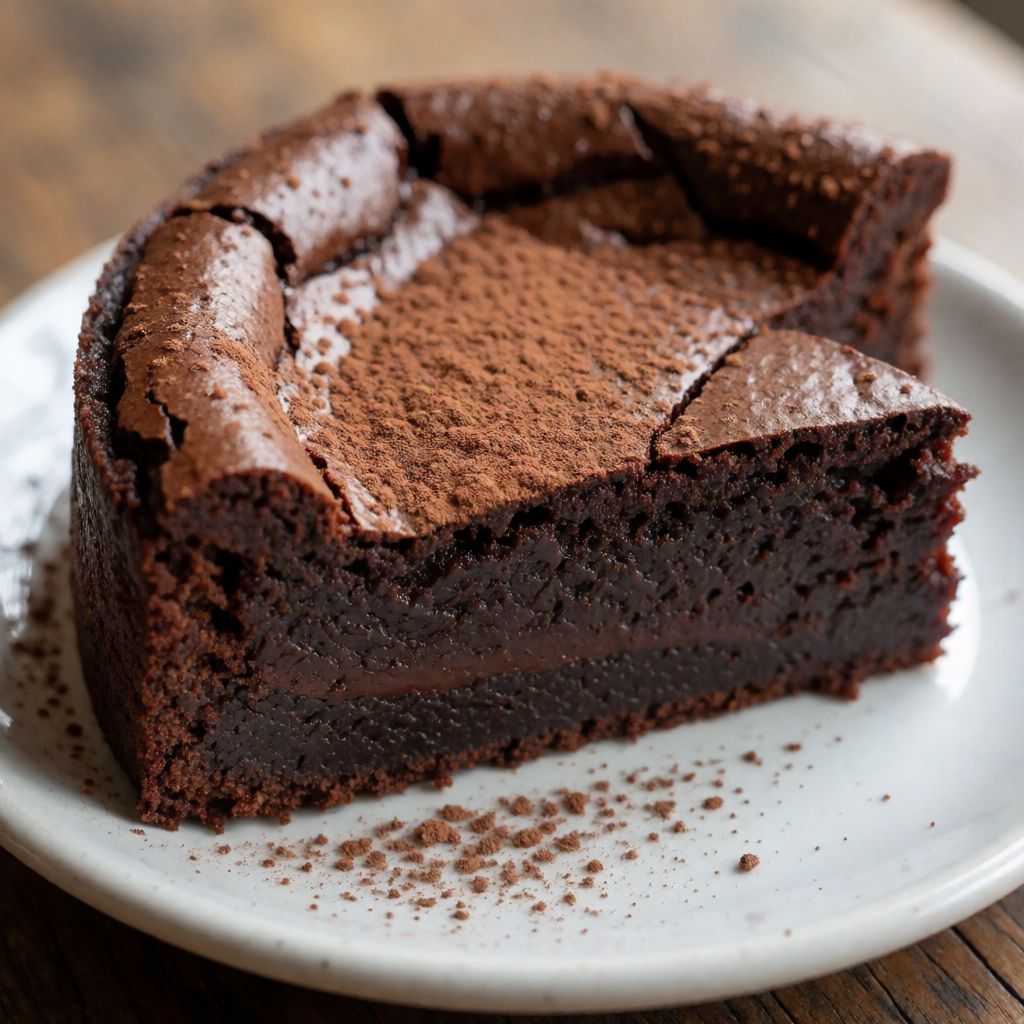
 AI photo
Espresso Chocolate Cake
A rich, gooey espresso and dark chocolate cake, baked in small moulds and chilled overnight.
Labels are worked out automatically from the ingredients and can be wrong. Check the packaging if it matters to you.
Ingredients
- 70 g Butter
- 70 g Dark Chocolate
- 50 ml Espresso or strong freshly brewed coffee
- 2 pcs Eggs
- 50 g Caster Sugar
- 1 pinch Salt
- 35 g Plain Flour






Steps
Melt the butter gently in a saucepan. Remove from the heat and stir in the espresso and finely chopped dark chocolate. Stir until the chocolate has completely melted.
2 minWhisk the eggs with the sugar until pale and fluffy. Sift the flour and salt into the mixture.
3 minSlowly pour the chocolate mixture into the egg mixture, mixing well until you have a smooth batter. Divide the batter among small buttered tartlet moulds or 10cm ramekins.
2 minBake in a preheated fan oven at 180°C for about 10 minutes, watching the cakes closely. They should be slightly underbaked; once baked, chill them in the fridge until the next day.
10 min
What was changed
We rounded to match the display steps used in this market.
This isn't a cake that rises and falls on cue — it's closer to a chocolate custard wearing a cake's clothes. Two eggs and only 35g of flour means there's almost no gluten scaffolding here; the structure comes from whisked egg foam and from fat that goes solid again once it's cold. Butter and chocolate melted together, loosened with a splash of espresso, folded gently into fluffed eggs — that's the whole engine. The oven doesn't finish the job. The fridge does.
What decides whether this works isn't the ten minutes on the clock — that's your floor, not your finish line. It's what you see when you open the door: edges just pulling from the sides of the mould, the surface gone matte instead of wet-shiny, the centre still trembling like a just-set custard, not liquid. Pull it then. If you wait for a firm top, you've baked past the point of no return — the fudge texture you want tomorrow won't happen; you'll have dry cake with a hard crust instead.
Some people see 'chocolate' and 'barely baked' and assume this is a lava cake — crack it open hot, watch it ooze. No, because that's not what's happening here. This one goes into the fridge and sets overnight into something dense and fudgy, almost truffle-like, not a cake that pours. If you chase the lava-cake moment by serving it warm, you'll either get raw batter or, worse, you'll overbake trying to force a 'set' that was always meant to happen cold. Know which dessert you're making before you judge it by the wrong one.
Butter: melted gently, never boiled, because boiling it risks splitting the fat and water apart, and once that happens no amount of stirring brings back a smooth mixture — you'd get a greasy, grainy batter instead of a glossy one. Its job here is to carry flavour and to give you something that goes firm again in the fridge, which is half of why this cake sets at all. Any fat that's solid at room temperature and has no smell of its own will do the same job — ghee works, a flavourless margarine works at a push, though margarine carries more water than butter and that water has to go somewhere, usually into a slightly less rich crumb.
Dark chocolate: the cocoa solids are doing structural work, not just flavour work — a chocolate with enough cocoa (roughly 60–70%) sets up firm when it's cold again. Milk chocolate won't do this job properly: too much sugar and milk fat, not enough cocoa mass, and your pudding stays soft and slumps instead of holding its shape on the plate. If dark chocolate at that strength isn't in the cupboard, cocoa powder loosened with a bit more butter can stand in, but you're rebuilding the fat balance yourself, so go carefully.
Espresso or strong coffee: the criterion is concentration in a small volume — a tablespoon of instant coffee dissolved in the same 50ml of hot water does the identical job. What it's buying you is contrast; without it the cake reads as flat-sweet, with it the chocolate tastes darker and more serious. Don't skip it thinking it's decorative — it's cheap insurance against a one-note pudding.
Eggs and sugar, whisked until pale and fluffy: this is where your lift comes from, since there's no raising agent in the recipe at all. Whisking beats air into the egg, and that air is the only thing standing between you and a flat, dense disc. That's also why the chocolate mixture goes in slowly, folded rather than dumped — tip it in all at once and you knock the air straight back out, and the cake you get is denser than it should be, closer to a brownie than intended. The pinch of salt isn't there to make things salty; it's there the way it always is near chocolate, to mute the sweetness just enough that the cocoa comes through.
Flour: 35g for two eggs is barely a thickener's worth — just enough to give the batter something to hold onto so it doesn't collapse into soup in the oven. Sift it in with the salt to break up clumps before they meet wet batter, because flour lumps stay lumps once they're wet, no amount of stirring un-clumps them. Any plain, low-protein flour behaves the same; you're not trying to build gluten here, so there's no reason to reach for a 'strong' flour.
For the moulds: butter them properly, because sugar caramelises against hot metal and a chocolate batter without a buttered surface will grip a ramekin like glue. Small tartlet moulds or 10cm ramekins give you six individual puddings from this amount — which also explains the household logic: this is a rich, small-format pudding, the kind a French bistro serves one of, not a slice off a big cake. It fits neatly after a Sunday roast precisely because it's made the day before — you bake it Saturday evening while the kitchen's quiet, it sits in the fridge overnight doing its real work, and on the day the oven's free for the roast and all you're doing with the pudding is taking it out of the fridge.