
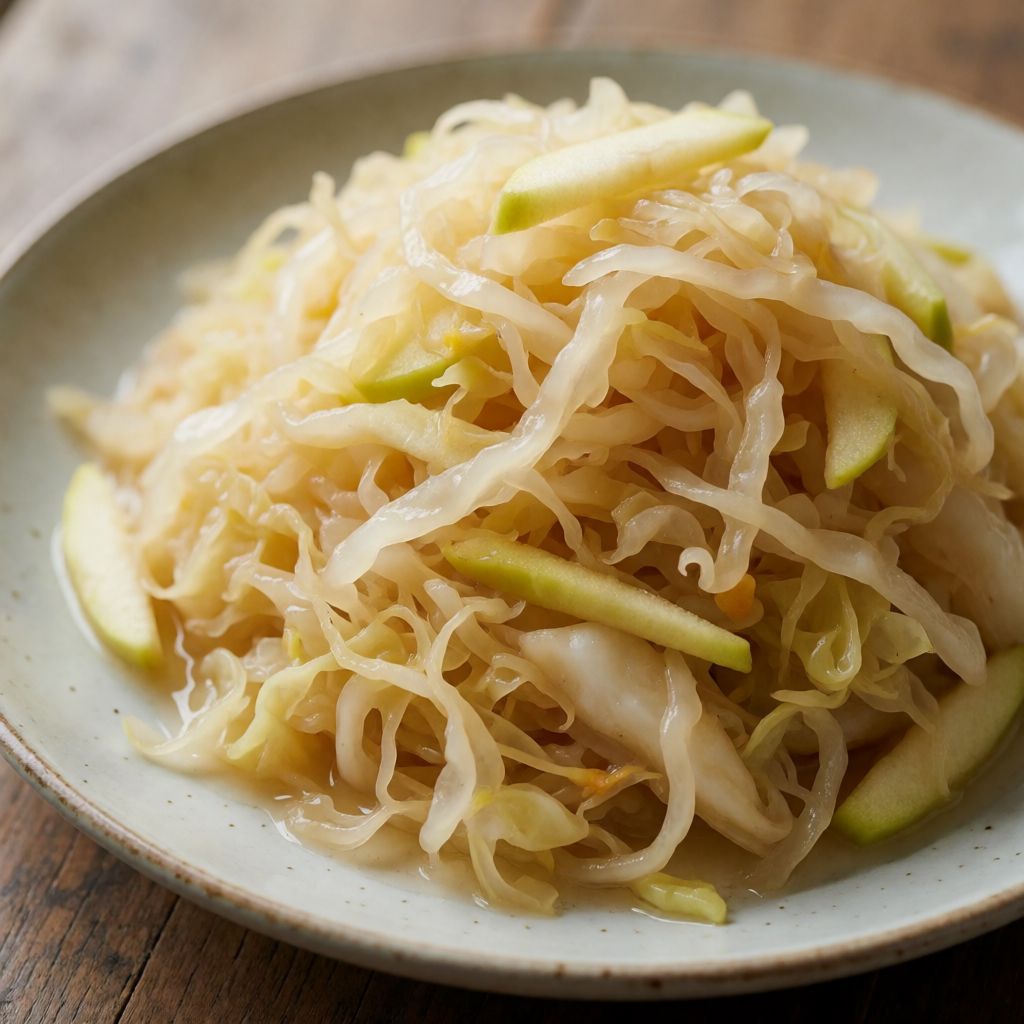
 AI photo
Fermented Cabbage with Ginger and Apple (Kraut)
A simple fermented cabbage recipe with ginger and apple for a crisp, tangy kraut you make at home.
Labels are worked out automatically from the ingredients and can be wrong. Check the packaging if it matters to you.
Ingredients




Steps
Put all the ingredients in a large bowl, mix well and leave for 30 minutes.
30 minWith clean hands, massage the mixture thoroughly until the cabbage softens and releases plenty of juice.
Transfer the mixture into a clean 2-litre jar with a clamp lid, press down firmly and make sure the brine covers the cabbage.
If you like, place a few large cabbage leaves on top and press down well so they stay under the brine.
Close the lid and keep in a cool place for 2-4 weeks, opening it daily to release the air.
Taste the cabbage; once it has the sourness you like, it's ready. Store in the fridge.
This is kraut, not pickle — and that distinction is the whole mechanism. A pickle is preserved by something you pour in: vinegar, brine from outside. A kraut preserves itself. You add salt, and the cabbage's own population of lactic bacteria — already living on every leaf, whether you asked them to or not — does the work, turning sugar into acid while starved of air. Apple and ginger aren't flavourings dropped in afterwards; they're fuel and seasoning for that same process, riding along in the same brine.
What decides whether this works isn't the 30 minutes or the massaging time written as minutes in the recipe — those are just a lower bound, a "long enough to see juice pooling at the bottom of the bowl." What decides it is two things: the brine has to cover the vegetable completely, and the vegetable has to sit somewhere cool rather than warm. Cover it, because any cabbage poking above the brine is exposed to air, and air means mould and the wrong kind of bacteria — the ones that rot rather than sour. Cool, because heat speeds the bacteria up, and a fast ferment is a crude, sometimes slimy one; cold slows them down and lets the sourness build in layers instead of all at once.
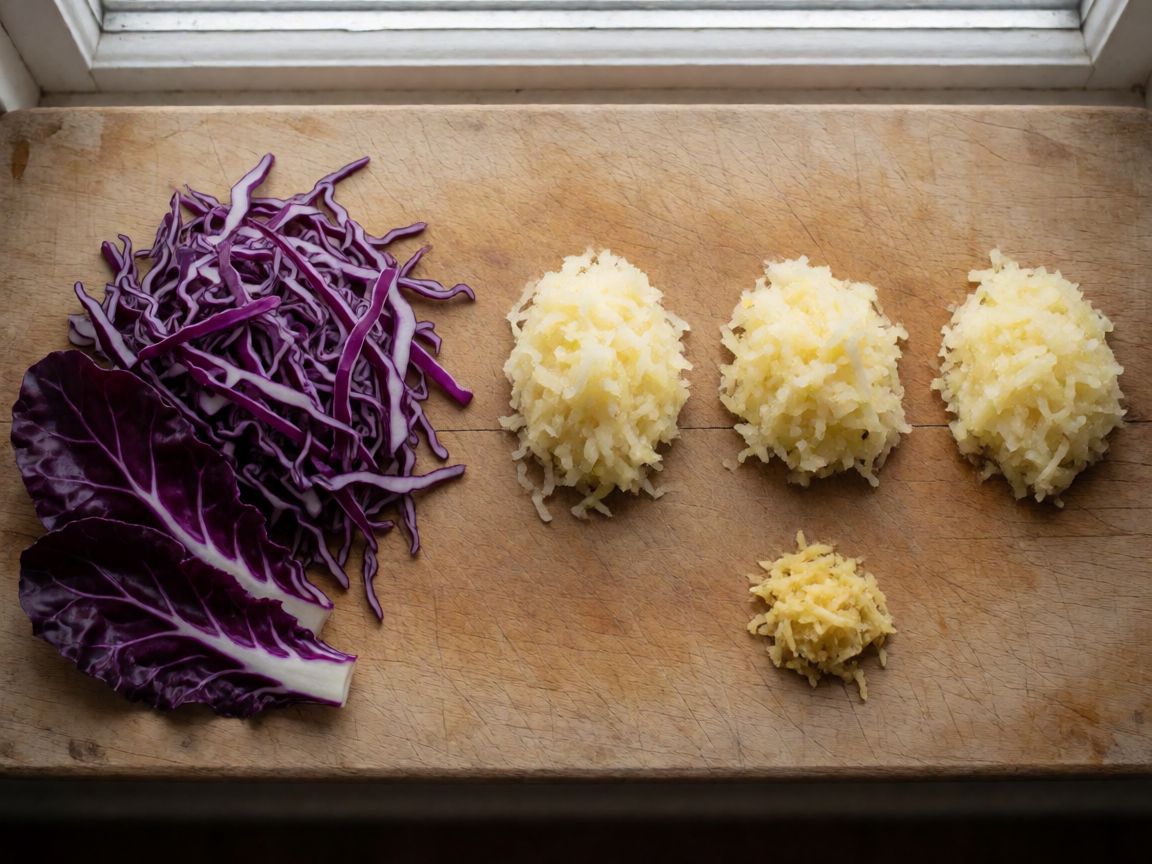
Cabbage: you want a head that feels dense and heavy for its size, leaves packed tight, not the loose, leafy spring kind. Dense means less water locked in the cells, which means a crunchier, less watery kraut once it's done fermenting — a loose cabbage gives you more volume for less actual vegetable, and it collapses faster into mush. Red cabbage or pointed cabbage both work for the same reason, as long as the head is firm. Grate it coarse, not fine: fine shreds burst too many cell walls at once, the mixture turns to pulp under the salt instead of staying crisp strands in brine.
Apple: this is sugar, mainly. The bacteria doing the souring need something to eat besides what little sugar is in cabbage itself, and apple hands it over generously while adding its own sharpness later. Use a firmer, tarter variety if you can — a soft, very ripe apple breaks down into the brine rather than staying as texture. A cooking apple like Bramley will do the job but brings a lot of tartness of its own; an eating apple such as Braeburn or Cox gives a gentler result. If you have neither, pear works on the same logic — sugar and bite — though it softens faster.
Ginger: less about feeding the bacteria, more about what it leaves behind — a clean heat that cuts through the sourness later, plus its own mild antimicrobial oils, which do no harm to the balance you're trying to set up. Fresh only; dried ginger has lost the moisture and the sharpness that make this work here.
Salt: the whole mechanism rests on this one ingredient, so don't use table salt with additives. Iodised salt and salt with anti-caking agents can slow or confuse the fermentation and cloud the brine — not always, but often enough that it's not worth the risk. Use plain coarse sea salt or kosher salt. The 1.5 tablespoons against roughly 1.4 kg of cabbage and apple together lands close to 2% of the vegetable's weight, which is the rough rule any fermenter works to: enough to suppress spoilage, not enough to suppress the fermentation itself. If you're ever scaling the recipe up or down, scale the salt by weight of vegetable, not by the tablespoon.
Jar and weight: a clamp-lid jar is fine, no crock needed — most flats don't have a larder let alone a cellar, so don't feel you're cutting corners. The reason for pressing leaves on top and weighting the mixture down isn't tidiness; it's keeping every surface under brine so air never touches the cabbage directly, which is where mould starts. If you don't have spare large leaves, a small plate that just fits inside the jar's neck, weighted with something clean, does the same job.
As for the "cool place" for those two to four weeks — a cold larder is ideal, but failing that, the coolest corner of the kitchen, away from the oven, the radiator, or a sunny windowsill, is enough. Not the fridge at this stage: it's too cold, the bacteria barely work, and you'll be waiting months rather than weeks. Once it tastes the way you want, that's when the fridge earns its place — to hold the sourness still, not to build it.